Virginia Supreme Court Overturns Voter-Approved Democratic Redistricting Amendment
The Supreme Court of Virginia invalidated a voter-approved constitutional amendment aimed at redrawing congressional maps, ruling 4-3 that lawmakers violated procedural timing rules prior to an intervening legislative election.
In this piece
The Supreme Court of Virginia has struck down a Democratic-backed constitutional amendment that sought to redraw congressional districts mid-decade. The 4-3…
The Supreme Court of Virginia has struck down a voter-approved constitutional amendment designed to redraw the commonwealth's congressional map mid-decade, ruling in a tight 4-3 decision that state lawmakers failed to follow required constitutional procedures before sending the measure to the ballot. The decision invalidates the results of a special election in which voters approved the Democratic-backed initiative, delivering a substantial blow to national and state party leaders who sought to reshape Virginia's 11 congressional districts.
Writing for the four-justice majority, Justice D. Arthur Kelsey determined that the Democratic-led General Assembly violated Article XII, Section 1 of the Constitution of Virginia. Under the state constitution, any proposed constitutional amendment must be approved by the legislature in two separate legislative sessions, with a general election of the House of Delegates taking place between those two votes. The court found that lawmakers took their second vote after early voting had already commenced for the intervening legislative election, thereby failing to satisfy the mandatory constitutional sequence.
The majority opinion concluded that an election constitutes the entire statutory voting window, including authorized early in-person voting periods, rather than merely the single day designated as Election Day. Justice Kelsey wrote that because citizens were already casting ballots when the General Assembly took its second vote, the legislative process was incurably flawed. Consequently, the majority held that the procedural breach nullified the legal authority of the subsequent referendum, rendering voter approval legally ineffective.
In a pointed dissenting opinion, Chief Justice Cleo L. Powell, joined by Justices Thomas Mann and Junius Fulton III, strongly contested the majority's interpretation of election timing. The dissent argued that state and federal precedent has consistently recognized elections as single-day legal occurrences, with early voting serving merely as an advance balloting mechanism. Chief Justice Powell warned that expanding the legal definition of an election to include early voting periods misconstrues constitutional text and effectively disenfranchises the voters who cast ballots in favor of the measure.
The contested amendment originated as a response to Virginia's voter-approved 2020 redistricting reform, which established a bipartisan redistricting commission and removed map-drawing power from lawmakers. The new measure sought to temporarily bypass that commission to permit the Democratic-majority legislature to enact new boundaries mid-decade. Democratic lawmakers argued that redrawing the map was necessary to counter aggressive, mid-decade partisan gerrymandering efforts advanced by Republicans in other states across the country.
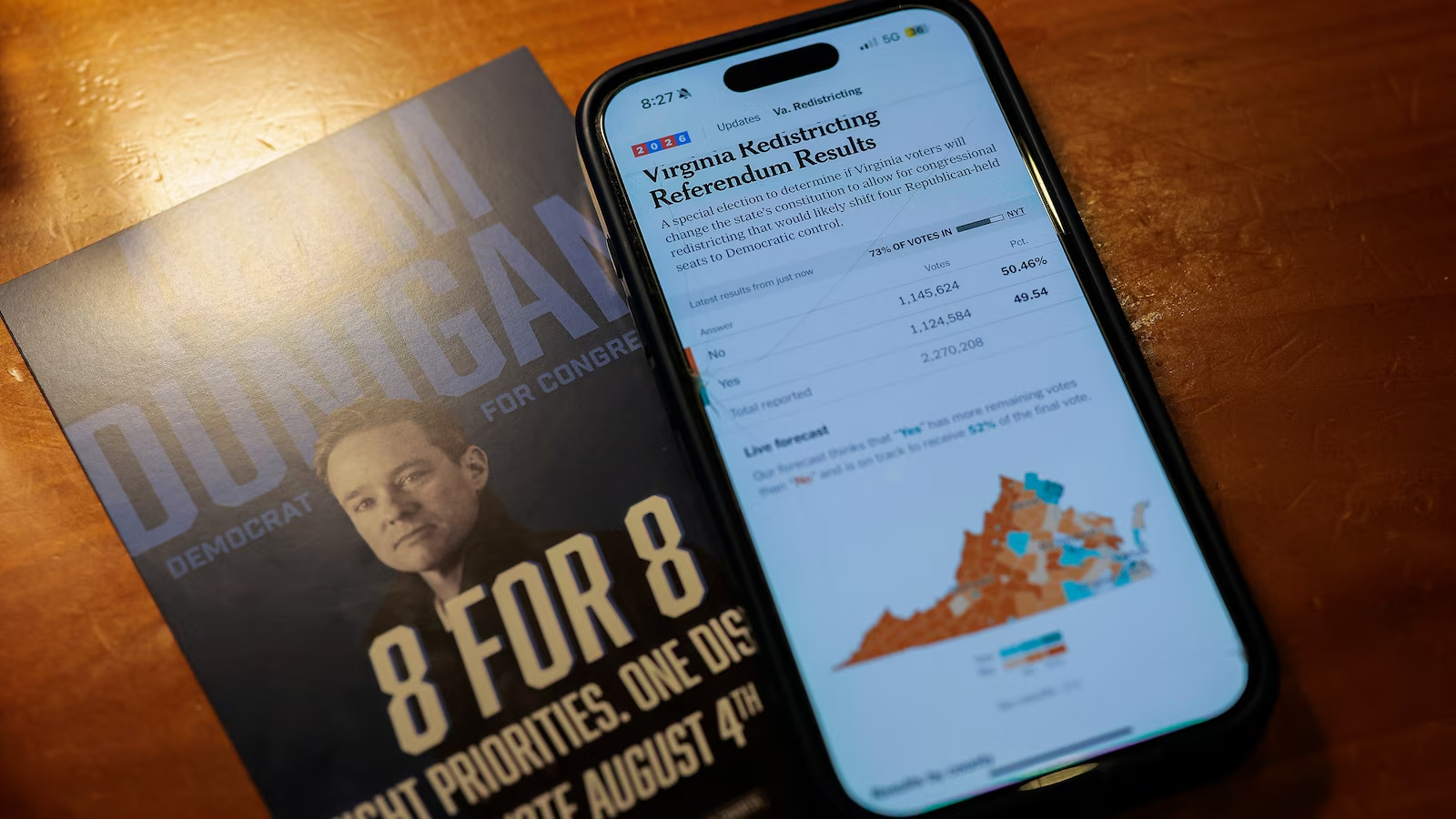
Despite strong opposition from Republican lawmakers and conservative legal organizations, the amendment was placed before the electorate in a statewide special election. Virginia voters narrowly ratified the referendum, with approximately 51.7 percent voting in favor and 48.3 percent opposed. Under the proposed redistricting plan, Democrats had projected gaining as many as four additional seats in the U.S. House of Representatives by reconfiguring districts to favor Democratic candidates in 10 of the commonwealth's 11 seats.
Following the legislature's maneuver, Republican officials challenged the amendment in court, contending that Democrats had circumvented the state constitution's rigorous amendment framework. Opponents argued that the procedural rules are vital safeguards designed to ensure the public has full notice and an opportunity to hold delegates accountable at the ballot box before the constitution can be altered. Republican leaders praised the high court's decision, calling it a necessary defense of constitutional order and fair electoral competition.
The ruling carries profound implications for the national balance of power in the U.S. House of Representatives. In an era marked by razor-thin congressional majorities, both national parties have increasingly looked to state legislatures and courts to redraw congressional lines between decennial censuses. The invalidation of Virginia's measure eliminates what had been considered one of the Democratic Party's most potent opportunities to pick up multiple House seats heading into upcoming federal elections.
With the constitutional amendment voided, Virginia's existing congressional map—drawn by court-appointed special masters following the 2020 census deadlock—remains legally operative. State election administrators will continue operating under those established boundary lines, ensuring stability for voters and candidates as primary deadlines approach. Legal experts noted that any further effort to amend the state constitution would require restarting the multi-year legislative and electoral process from the beginning.
Democratic state officials, including the attorney general's office, had previously signaled their intent to seek emergency intervention from the federal judiciary, citing voter sovereignty. However, legal analysts emphasized that state supreme courts serve as the ultimate arbiters of their own state constitutions, leaving extraordinarily narrow grounds for federal review. For now, the commonwealth's political landscape remains tied to the status quo, closing the door on mid-decade redistricting in Virginia for the foreseeable cycle.
Primary source: Google News Virginia. Newzly rewrites and structures source reporting for clarity; verify critical details at the original.