What Jammu and Kashmir's Union Territory Status Means for Civil Services Aspirants
The constitutional and administrative overhaul of Jammu and Kashmir offers civil services aspirants a major real-world case study in Indian federalism, governance structures, and public policy dynamics.
In this piece
Jammu and Kashmir's transition from a state to a Union Territory has reshaped public administration and civil services examination preparation across India. The…
The administrative reorganization of Jammu and Kashmir from a full-fledged state into a Union Territory has emerged as a focal case study for civil services aspirants across India, according to an analysis by the Daily Excelsior. The region's ongoing constitutional and statutory evolution presents critical lessons in public administration, governance, and federal architecture for candidates preparing for national and state-level competitive examinations.
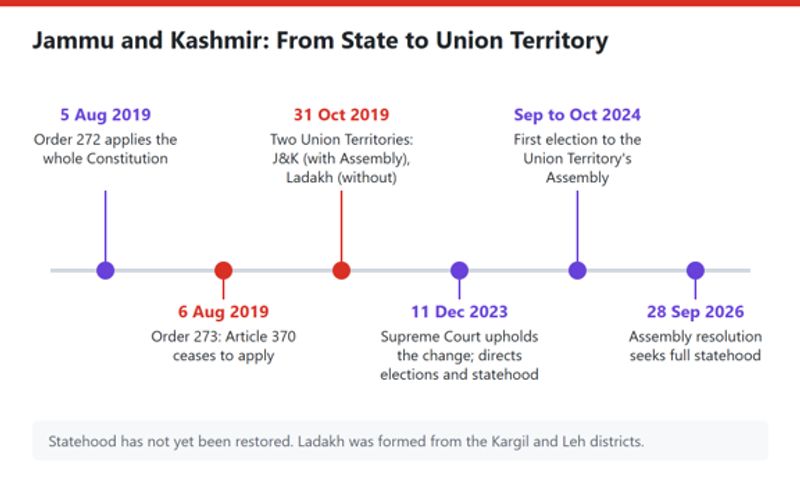
Following the statutory measures introduced under the Jammu and Kashmir Reorganisation Act, the erstwhile state was bifurcated into the Union Territories of Jammu and Kashmir and Ladakh. This legislative overhaul rendered previous provisions under Article 370 inoperative, replacing special constitutional mechanisms with direct central oversight and uniform administrative frameworks.
Under the revised system, the distribution of executive and legislative authority shifted significantly, placing executive authority under a Lieutenant Governor while establishing a unique legislative assembly framework. The administrative apparatus also saw the extension of numerous central statutes and modern recruitment rules that replaced earlier permanent resident certificates with standardized domicile requirements.
For civil services aspirants appearing for the Union Public Service Commission and regional administrative exams, these developments have transformed multiple core examination papers. In general studies papers covering Indian polity and governance, the shift provides real-world applications of asymmetrical federalism, centre-state relations, and constitutional provisions governing territory reorganization under Article 3.
The governance shift also features prominently in assessments of internal security paradigms, regional economic integration, and development administration. Candidates examine how the removal of historic investment restrictions and the harmonization of regional regulations intersect with public order, security operations, and grassroots institutional reforms.
Beyond structural governance, the transformation prompts examination of ethical and societal dimensions in public policy. Prospective administrators increasingly evaluate how uniform nationwide legislation balances regional cultural preservation with equal citizen protections, reservations, and centralized administrative accountability.
On the ground within Jammu and Kashmir, the institutional realignment has coincided with heightened competitive participation among local students. Clearer civil service recruitment pathways and broader exposure to all-India examinations have encouraged growing numbers of youth across the region to seek careers in public administration and systemic public service.
Recent governance dynamics, including the revival of an elected legislative assembly alongside the constitutional prerogatives exercised by the Lieutenant Governor, further underscore evolving questions in administrative law. Aspirants study these friction points to understand how executive authority operates within a Union Territory equipped with a legislature, mirroring dynamics observed in jurisdictions like Delhi and Puducherry.
As discussions regarding the eventual restoration of statehood continue to evolve in legal and political discourse, administrative scholars note that Jammu and Kashmir will remain a foundational benchmark for testing federal doctrines. For civil servants and aspiring administrators alike, understanding the ongoing transition offers a vital roadmap for navigating complex constitutional shifts and modern Indian governance.
Primary source: Google News Jammu and Kashmir. Newzly rewrites and structures source reporting for clarity; verify critical details at the original.