Zero-Day Options Traders Bet on Calm as S&P 500 Risks Loom
Traders in options expiring the same day are increasingly leaning against S&P 500 moves, a pattern that may restrain volatility even as earnings, geopolitical risks and interest rates threaten to unsettle stocks.
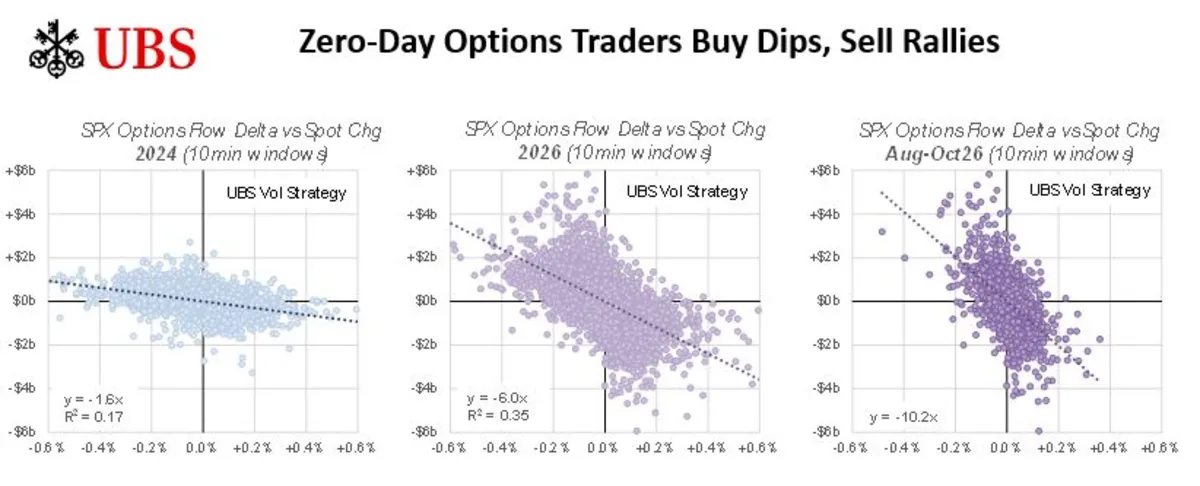
Zero-day options traders are increasingly positioning for contained S&P 500 moves, even as other investors prepare for artificial intelligence earnings, geopolitical developments and interest rates to drive stocks sharply higher or lower. Their activity may also be helping keep the benchmark within a narrower trading range.
UBS derivatives strategist Kieran Diamond identified a pattern of traders buying calls and selling puts during declines, then reversing those positions during rallies, according to Bloomberg reporting carried by Yahoo Finance. That approach leans against the market’s immediate direction rather than extending it.
The distinction matters because an options trade can influence more than the buyer’s return. Bloomberg reported that these countertrend flows can help suppress index swings, creating a feedback loop in which traders responding to quiet conditions also help sustain them. That is a description of trading behavior, not a guarantee that prices will remain stable.
Zero-days-to-expiration options, commonly called 0DTE contracts, expire at the end of the current trading day, according to exchange operator Cboe. The label describes their remaining lifespan, rather than a single strategy or market view. Traders can use the same short-lived instruments to position for rising prices, falling prices or a limited trading range.
Cboe offers S&P 500 options expirations on every trading weekday, making expiration-day positioning a recurring feature of the market. That availability gives investors a way to concentrate exposure within one session rather than maintain an options position over several days. It also makes the timing of a price move especially important.
A calm index does not mean the contracts themselves carry little risk. The Options Industry Council explains that buyers of expiration-day options can lose the entire amount paid. With little time remaining, a position has limited opportunity to recover if the anticipated move fails to arrive before expiration.
Different structures also produce different exposures. Cboe’s educational materials describe spreads that combine options positions to limit risk, while other approaches have different potential losses. Consequently, heavy 0DTE activity alone does not establish whether traders collectively expect turbulence or calm; the direction and construction of their positions matter.
The stabilizing pattern could change during a sustained decline, Diamond cautioned in the Bloomberg report. If traders switch from buying dips to purchasing puts as prices fall, their activity could reinforce the downturn rather than restrain it. The same market segment would then be operating in the opposite direction.
The question ahead is whether traders continue fading daily moves when earnings, geopolitical news or rate developments test the market. The report’s outlook is conditional: countertrend positioning has helped contain fluctuations, but its persistence depends on traders maintaining that behavior. A shift toward chasing declines would challenge that source of calm.
Primary source: Yahoo Finance Markets. Newzly rewrites and structures source reporting for clarity; verify critical details at the original.