345-Million-Year-Old Fossil Reclassified After X-Rays Reveal Gills
Advanced X-ray imaging has overturned a decades-old interpretation of a famous fossil, revealing an aquatic or amphibious animal rather than an early reptile and reshaping how its land-associated traits are understood.
In this piece
A 345-million-year-old fossil long interpreted as an early reptile instead belonged to a primitive aquatic or amphibious animal, ScienceDaily reports. X-ray…
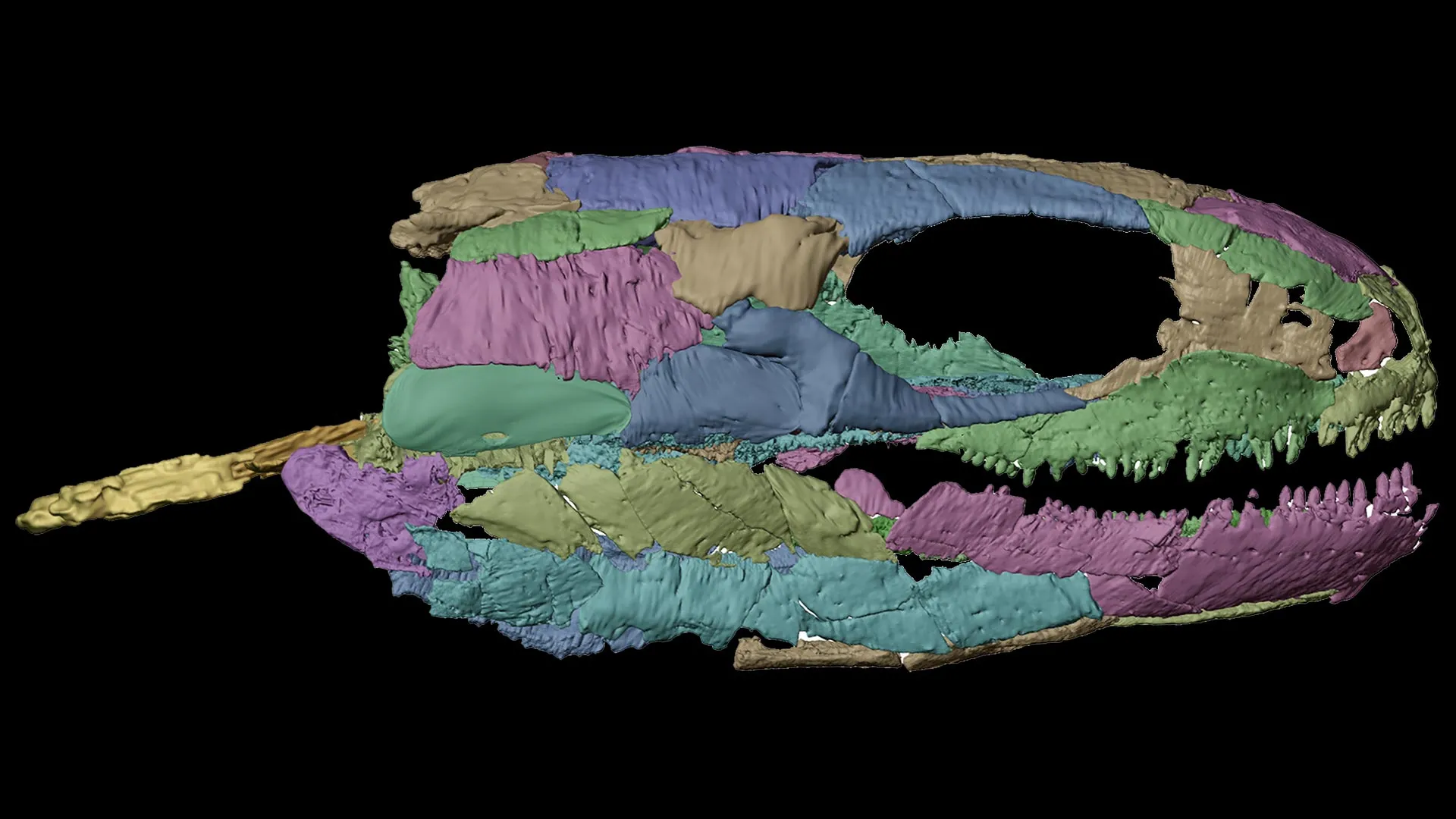
A famous 345-million-year-old fossil long regarded as an early reptile belonged instead to a primitive aquatic or amphibious animal, according to a report from ScienceDaily. Advanced X-ray imaging revealed hidden gills and thousands of tiny teeth, overturning an interpretation that had persisted for decades and changing the evolutionary significance of the specimen.
The newly revealed anatomy provides a different picture of how the animal lived. Rather than representing an early reptile adapted to terrestrial life, the fossil preserves evidence of a creature that remained dependent on water. The distinction matters because it changes the setting in which scientists interpret the animal’s other physical features.
The gills are central to that reassessment, providing evidence of an aquatic component to the animal’s life. The thousands of tiny teeth add to the anatomical information uncovered by the scans. Together, the discoveries exposed features that had not been accounted for in the long-standing identification, prompting a substantially different reading of the fossil.
The broader implication concerns adaptations commonly associated with life on land. According to the report, the discovery suggests that several such traits evolved in animals that were still dependent on water. Their presence therefore does not necessarily mean that an ancient animal had already adopted a fully terrestrial way of life.
That interpretation separates the evolution of particular features from the emergence of an animal capable of living independently of water. A creature could possess adaptations later associated with terrestrial life while remaining aquatic or amphibious. In this case, the revised identification places those features in a different biological context from the one researchers had previously assumed.
The finding also illustrates how access to hidden anatomy can alter the interpretation of a familiar specimen. The fossil’s age has not changed in the account; what has changed is the evidence available to understand it. X-ray imaging supplied information that challenged its established classification rather than simply adding detail to the existing picture.
Important specifics are absent from the supplied account, including the fossil’s name, where it was found and which land-associated adaptations were reassessed. It also does not describe whether the animal was primarily aquatic or spent substantial time outside water. Those limits leave its precise lifestyle unresolved in the material available, even as the reported gills undermine the earlier reptile interpretation.
The next questions concern how the newly exposed anatomy fits into the wider reconstruction of the animal and its evolutionary relationships. On the evidence described by ScienceDaily, the central conclusion is that traits associated with terrestrial life need to be understood alongside signs of continued dependence on water, rather than treated alone as proof of life on land.
Primary source: ScienceDaily. Newzly rewrites and structures source reporting for clarity; verify critical details at the original.