world·Andhra Pradesh·Guntur District
Algae-Based Artificial Tree Installed in Guntur to Combat Air Pollution
Guntur has deployed Andhra Pradesh's first algae-based artificial tree at Gandhi Park, leveraging microalgae photosynthesis to absorb carbon dioxide and generate oxygen in crowded urban spaces.
In this piece
The Guntur Municipal Corporation has launched Andhra Pradesh's first algae-based artificial tree at Gandhi Park to filter urban air pollution. Powered by solar…
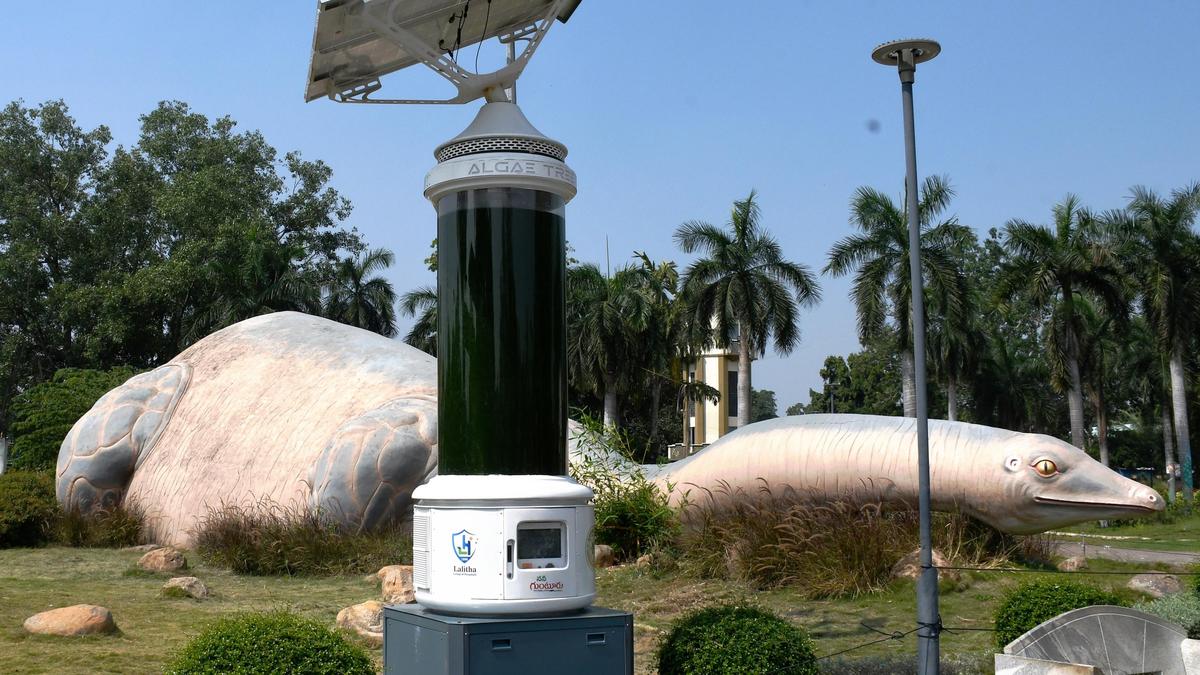
The Guntur Municipal Corporation has introduced Andhra Pradesh's first algae-based artificial tree in an effort to curb localized air pollution and improve urban environmental quality. Installed at Gandhi Park in Guntur as a pilot project, the innovative installation utilizes living microalgae cultures to filter ambient air. The civic body designed the structure to capture carbon dioxide and emit fresh oxygen through accelerated biological photosynthesis.
The specialized apparatus operates around a 600-litre tank containing liquid microalgae cultures integrated with supportive mechanical hardware. Equipped with solar panels, automated circulation pumps, monitoring sensors, and intake fans, the system actively draws in surrounding contaminated air. The enclosed microalgae process the incoming air stream, utilizing photosynthetic activity to sequester greenhouse gases before releasing purified oxygen back into the atmosphere.
According to municipal specifications, a single artificial algae unit matches the environmental output of approximately 20 to 25 mature trees. Civic officials note that the compact bio-filter functions continuously within its immediate vicinity, providing effective air purification across a 15-metre radius. This biological efficiency allows dense urban centers to achieve the filtration benefits of mature woodland within a footprint measuring just a few square meters.
The installation was implemented under the municipal administration's 'Nava Guntur' initiative, representing an expenditure of approximately five lakh rupees. The pilot venture was realized through Corporate Social Responsibility funding extended by the Lalitha Group of Hospitals. Public-private partnerships of this kind enable local governments to trial specialized green technologies without imposing heavy fiscal burdens on routine civic budgets.
Urban centers across Andhra Pradesh and wider peninsular India have faced recurring seasonal dips in ambient air quality driven by vehicle exhaust, road dust, and rapid commercial expansion. Traditional tree-planting drives frequently encounter practical barriers in crowded commercial districts, including land scarcity, lengthy gestation periods, and ongoing maintenance challenges. Bioreactor installations offer an immediate, space-conscious supplement to traditional forestry initiatives in heavily built-up municipal quarters.
Microalgae species have long been recognized in biochemical research for their exceptional photosynthetic efficiency, which significantly outpaces terrestrial plant life per unit volume. Because these single-celled organisms remain suspended in nutrient-rich liquid media, they absorb solar radiation and dissolve atmospheric carbon dioxide at heightened rates. The biomass cultivated within such bioreactors can also periodically be harvested and repurposed, creating closed-loop opportunities for biofertilizers or clean energy research.
Maintaining artificial bioreactor systems requires consistent upkeep to ensure the biological cultures remain healthy and resilient to climatic shifts. Municipal technical teams must monitor nutrient balances, prevent contamination, and manage water temperature during the peak heat of south Indian summers. Dedicated sensor arrays and automated circulation cycles help regulate the internal microclimate, mitigating the risk of culture collapse under shifting seasonal weather.
Following the launch of the Gandhi Park pilot, civic authorities intend to evaluate performance data to determine the feasibility of wider urban deployment. The municipal corporation has outlined prospective plans to introduce additional algae-based units across high-footfall public locations throughout the city. Proposed deployment sites include major transit corridors, busy educational campuses, government administrative complexes, and popular community recreational grounds.
As urban planners across India seek scalable innovations to meet clean air targets, localized bio-filtration projects offer valuable operational lessons. If the Guntur pilot demonstrates consistent biological resilience and measurable local air cleansing, similar artificial tree networks could become regular features of municipal environmental strategies. For now, municipal administrators are tracking the Gandhi Park installation as a tangible intersection of biotechnology and civic urban rejuvenation.
Primary source: The Hindu. Newzly rewrites and structures source reporting for clarity; verify critical details at the original.