Aramco Tower Hit in Heart of Saudi Capital as Houthis Launch Fresh Strikes
Aramco Tower in the Saudi capital has sustained damage following fresh Houthi strikes, with authenticated video footage confirming an impact inside the city's central financial district amid heightened regional security concerns.
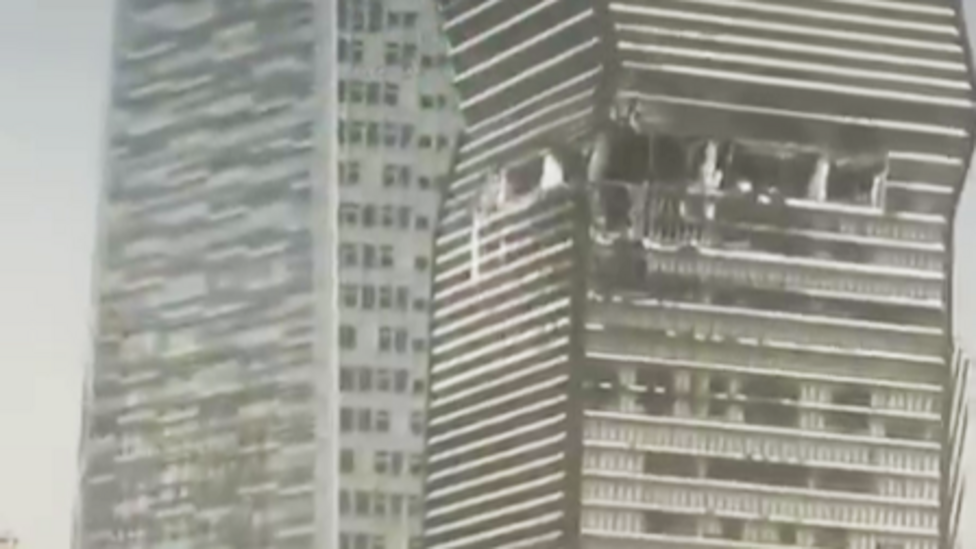
A high-rise tower associated with Saudi energy giant Aramco has been struck in the heart of the Saudi capital, following fresh strikes launched by Houthi forces. Visual evidence circulating from the scene shows visible structural damage to the commercial property located inside the capital's central financial district.
The incident was corroborated after footage from the site was independently reviewed and authenticated by BBC Verify. The authenticated visual recordings confirm impact damage to the landmark structure, highlighting an escalation in cross-border aerial operations reaching deep into the Saudi metropolis.
Emergency assessments and preliminary observations focused on the commercial core of the city, where the affected high-rise stands among key corporate offices and financial institutions. Visual documentation indicated localized exterior destruction, though comprehensive assessments regarding the full extent of internal damage or any casualties remain unconfirmed in immediate reporting.
The strike marks a notable development in the protracted hostilities involving Houthi fighters, who have repeatedly conducted aerial operations directed at commercial and industrial assets across the Arabian Peninsula. Targeting infrastructure linked to major state-affiliated entities represents a direct operational push toward high-profile urban and economic centers.
Attacks targeting central administrative and corporate hubs carry broad implications for regional energy markets, commercial logistics, and general civilian security. Because Aramco represents the central pillar of the kingdom's economic profile, incidents touching assets tied to the corporation draw rapid international attention from analysts and market watchers worldwide.
Air defense operations and early warning systems across the capital have historically sought to intercept inbound projectiles and unmanned aerial systems before impact. Despite defense measures across regional airspace, occasional penetrations and falling shrapnel have posed persistent hazards to dense commercial districts and civilian infrastructure.
Cross-border strikes against major metropolitan centers also intensify broader geopolitical anxieties across the Middle East. Regional security analysts emphasize that sustained attacks on financial districts complicate ongoing diplomatic efforts aimed at stabilizing regional shipping corridors and resolving long-running military conflicts.
Corporate and financial entities operating within the capital's commercial corridors face heightened operational vigilance following such strikes. Businesses and municipal authorities routinely re-evaluate protective protocols and emergency preparedness measures whenever strategic urban real estate is compromised by inbound military hardware.
Official statements clarifying the exact trajectory of the attack, the weapon systems deployed, and the precise defensive response were not immediately detailed in initial disclosures. Independent verifications have therefore prioritized confirmed imagery while awaiting authoritative technical briefings from regional military monitors and defense authorities.
Looking ahead, international observers and energy sector monitors will closely watch for subsequent official communications from both Saudi authorities and Houthi representatives. Further updates are expected to clarify the full scale of structural disruption, assess commercial continuity, and outline any corresponding regional defense adjustments in response to the strike.
Primary source: BBC World. Newzly rewrites and structures source reporting for clarity; verify critical details at the original.