ARCENT Security Cooperation Division Visits University of South Carolina
Officers from U.S. Army Central's Security Cooperation Division visited the University of South Carolina to brief international relations students on defense diplomacy and partner engagements across the Middle East and Central Asia.
In this piece
U.S. Army Central leaders visited the University of South Carolina's Walker Institute to discuss military diplomacy and international security cooperation.…
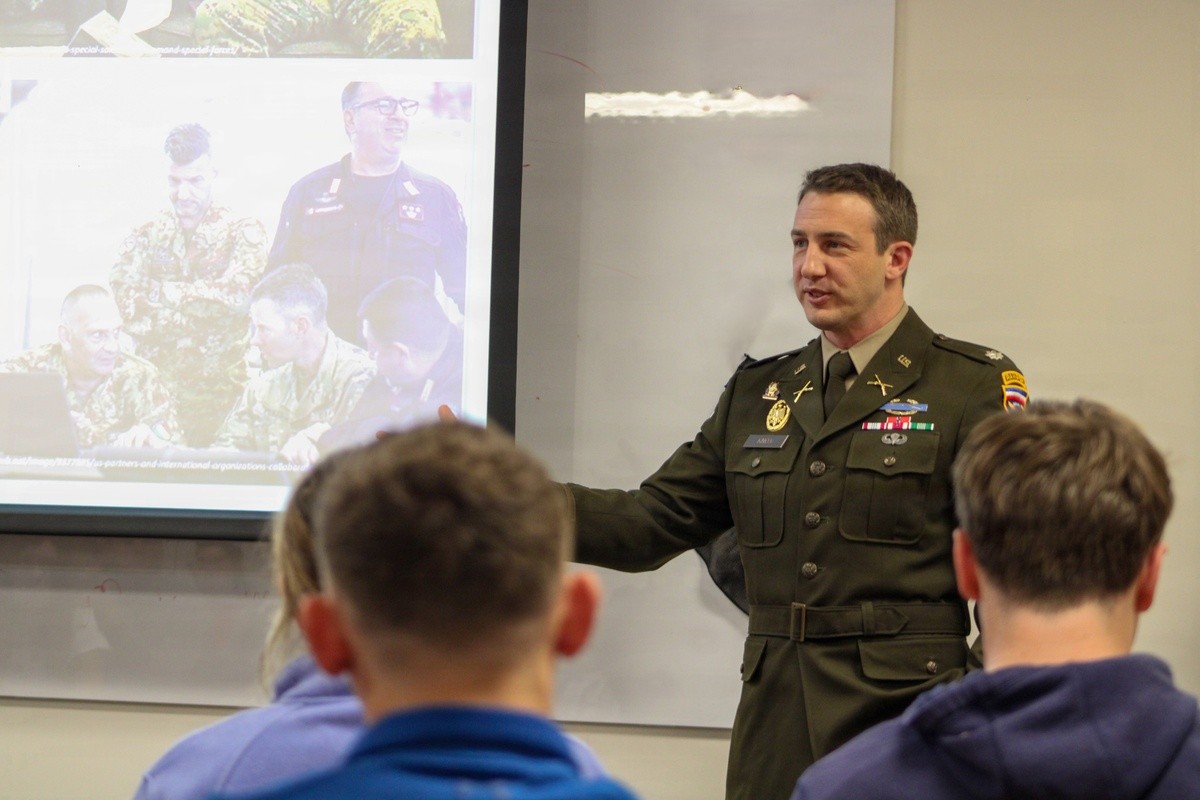
Officers from the U.S. Army Central Security Cooperation Division visited the University of South Carolina to engage with undergraduate students specializing in international relations and political science. Hosted at the university's Walker Institute of International and Area Studies, the visit was designed to give students direct exposure to the practical application of military diplomacy and strategic defense partnerships.
The delegation was led by Col. Stuart Peebles, the director of ARCENT's Security Cooperation Division, and Lt. Col. David Knox, the division's branch chief for Central and South Asia. Drawing from extensive careers in global defense operations, both officers addressed classroom audiences about the strategic mechanisms the U.S. military employs to maintain diplomatic and defense ties abroad.
A principal focus of the presentation was the distinct role played by Army Foreign Area Officers, who operate as soldier-diplomats embedded within U.S. embassies and consulates around the world. The officers outlined how these specialized personnel combine regional cultural knowledge, foreign language fluency, and tactical military experience to advise ambassadors, coordinate with host-nation armed forces, and advance American defense interests.
The discussion highlighted ARCENT's geographic and operational responsibilities as the army component of U.S. Central Command, an area encompassing more than twenty countries across the Middle East, Central Asia, and South Asia. Navigating this vast and volatile geopolitical environment requires the command to sustain continuous defense cooperation to preserve regional security frameworks and deter emergent threats.
Peebles and Knox detailed the programmatic tools ARCENT uses to forge durable international alliances, noting that security cooperation extends far beyond traditional combat operations. The command actively facilitates bilateral military exercises, foreign military sales, professional military education exchanges, and joint defense consultations that reinforce interoperability with partner nations.
The speakers emphasized that academic theories of international relations often take on new dimensions when executed on the ground through defense diplomacy. They noted that strategic access and international security pacts are frequently sustained by the trust and personal working relationships forged between military professionals over decades of collaborative engagement.
During an interactive discussion period, undergraduate students questioned the officers on the operational challenges of modern military diplomacy and the personal transition from tactical combat leadership to diplomatic assignments. The dialogue explored how defense representatives balance departmental guidance from the Pentagon with the diplomatic directives of the Department of State in overseas settings.
The session also offered students perspective on the expanding array of career opportunities situated at the intersection of national security, foreign service, and global policy analysis. The officers shared insights on the analytical discipline required to evaluate regional defense dynamics and how interagency collaboration shapes long-term national policy outcomes.
The visit forms part of ongoing efforts by military commands to maintain transparent communication with higher education institutions and engage future public policy leaders. By demystifying the day-to-day functions of defense diplomacy, ARCENT leaders underscored the importance of connecting academic scholarship with the evolving realities of global statecraft.
Primary source: Google News South Carolina. Newzly rewrites and structures source reporting for clarity; verify critical details at the original.