'Arrow for a Stone Heart' Brings Indigenous Perspective to Tallinn Film Festival
Brazilian director Luiza Calagian's debut feature, 'Arrow for a Stone Heart,' has premiered at the Tallinn Black Nights Film Festival, offering a poetic Indigenous-lens portrait of forest ecology near São Paulo.
In this piece
Director Luiza Calagian's debut feature 'Arrow for a Stone Heart' has premiered in the Rebels With a Cause competition at Tallinn Black Nights. Developed in…
Brazilian filmmaker Luiza Calagian has unveiled her debut feature film, "Arrow for a Stone Heart," taking the poetic work onto the competitive international festival circuit. The documentary-hybrid production officially made its premiere in the Rebels With a Cause competition at the Tallinn Black Nights Film Festival in Estonia. The selection marks a prominent European debut for the Brazilian director, who also served as the project's writer and cinematographer.
Set against the contrasting landscapes surrounding São Paulo, the film explores the fragile interface between metropolitan growth and ancient natural territory. Modern infrastructure, including railway lines cutting through ancestral land, forms an uneasy boundary with the Atlantic forest. Calagian documents this friction through an atmospheric cinematic style that prioritizes sensory experience over conventional plot mechanics.
The production was conceived and crafted in direct collaboration with the Guaraní Mbya Indigenous community over the course of more than ten years. Calagian worked closely with community members to ensure that local customs, spirituality, and storytelling methods informed the production from within. Rather than observing from a detached distance, the camera engages as a participating listener within the village and surrounding groves.
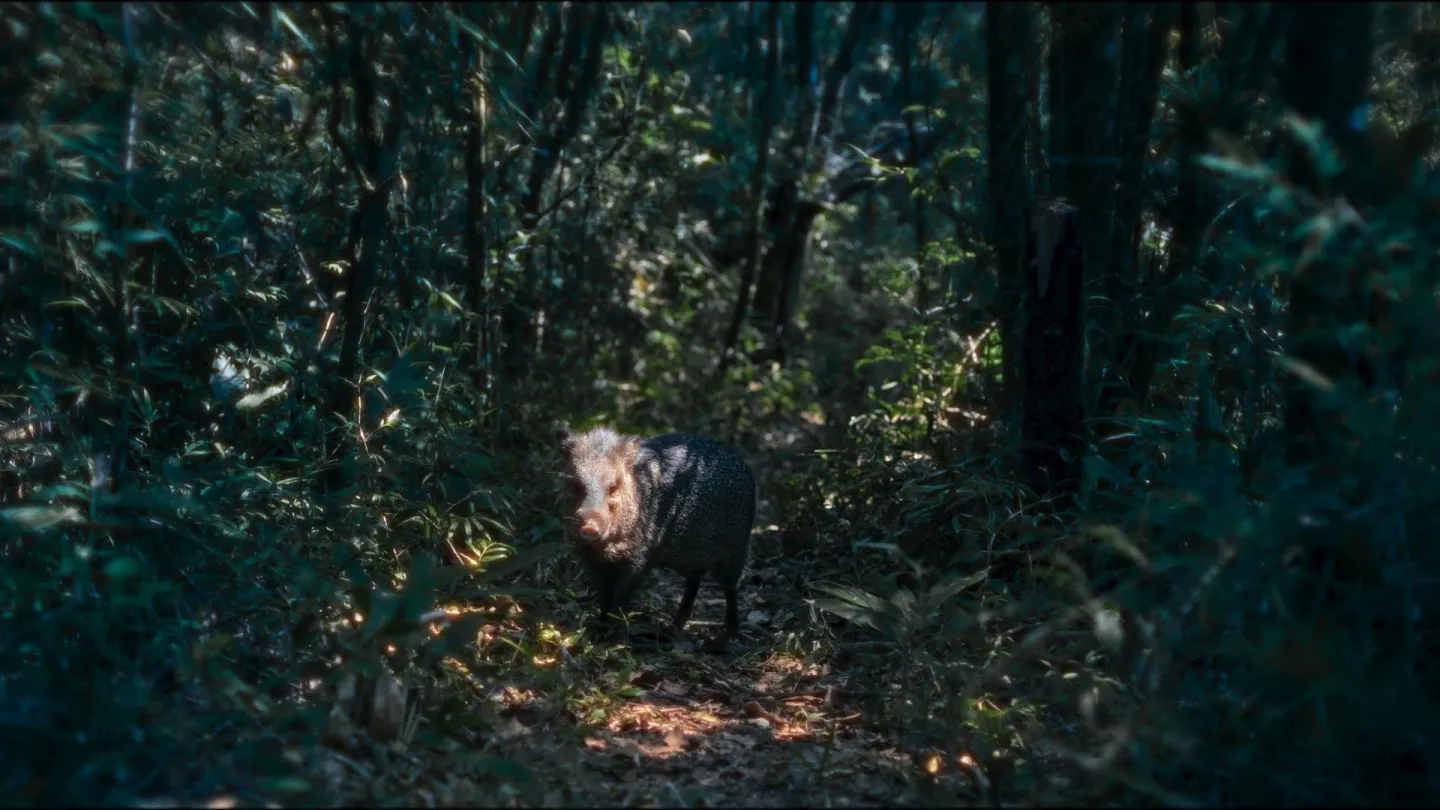
Narratively, the film centers on the interconnected lives of an Indigenous woman named Jera and a wild forest peccary named Rete. Through dreams, quiet daily encounters, and spiritual reflections, the film tracks their shared existence within a pressured habitat. The resulting portrait blurs the customary lines separating human observation, animal consciousness, and mythical memory.
A central element of the film is its decision to grant voice and agency to the peccary, an animal deeply rooted in regional forest ecology. Rete moves across distinct planes of awareness, carrying memories of an ancient river that ran freely through the territory before centuries of urban development buried it. This perspective introduces an ecological reckoning, prompting viewers to consider environmental history through the senses of non-human inhabitants.
Visually and acoustically, the film emphasizes the auditory life of the natural world, urging audiences to pay heed to the whisper of the river and the breathing forest. Calagian pairs ambient wildlife recordings with the discordant mechanical hum of nearby trains and city sprawl. This delicate sound design reinforces the thematic tension between enduring ecological rhythms and the ceaseless pressures of urbanization.
The film arrives amid growing international interest in cinema crafted through authentic Indigenous lenses and collaborative methodologies. By elevating Guaraní cosmology above standard Western documentary structures, the project offers an alternative model for cinematic engagement with threatened territories. The work treats Indigenous cosmologies not as static folklore, but as urgent, living tools for navigating modern environmental crises.
Tallinn's Rebels With a Cause sidebar was conceived specifically to champion unconventional filmmaking voices and provocative narrative approaches. Festival curators highlighted Calagian's feature for its lyrical courage, boundary-pushing structure, and evocative visual poetry. The inclusion in Tallinn provides the independent production with valuable visibility among European film programmers, critics, and global sales agents.
Following its initial screenings in Tallinn, "Arrow for a Stone Heart" is poised to pursue additional festival berths and cultural exhibition programs worldwide. The filmmakers and community partners hope the international spotlight will bring wider recognition to Guaraní Mbya cultural resilience and territorial advocacy. As distribution discussions advance, the project stands as a testament to the power of sustained, collaborative storytelling across cultural and ecological divides.
Primary source: The Hollywood Reporter. Newzly rewrites and structures source reporting for clarity; verify critical details at the original.