Artemis III Astronaut Andre Douglas Inspects RS-25 Engine at Kennedy Space Center
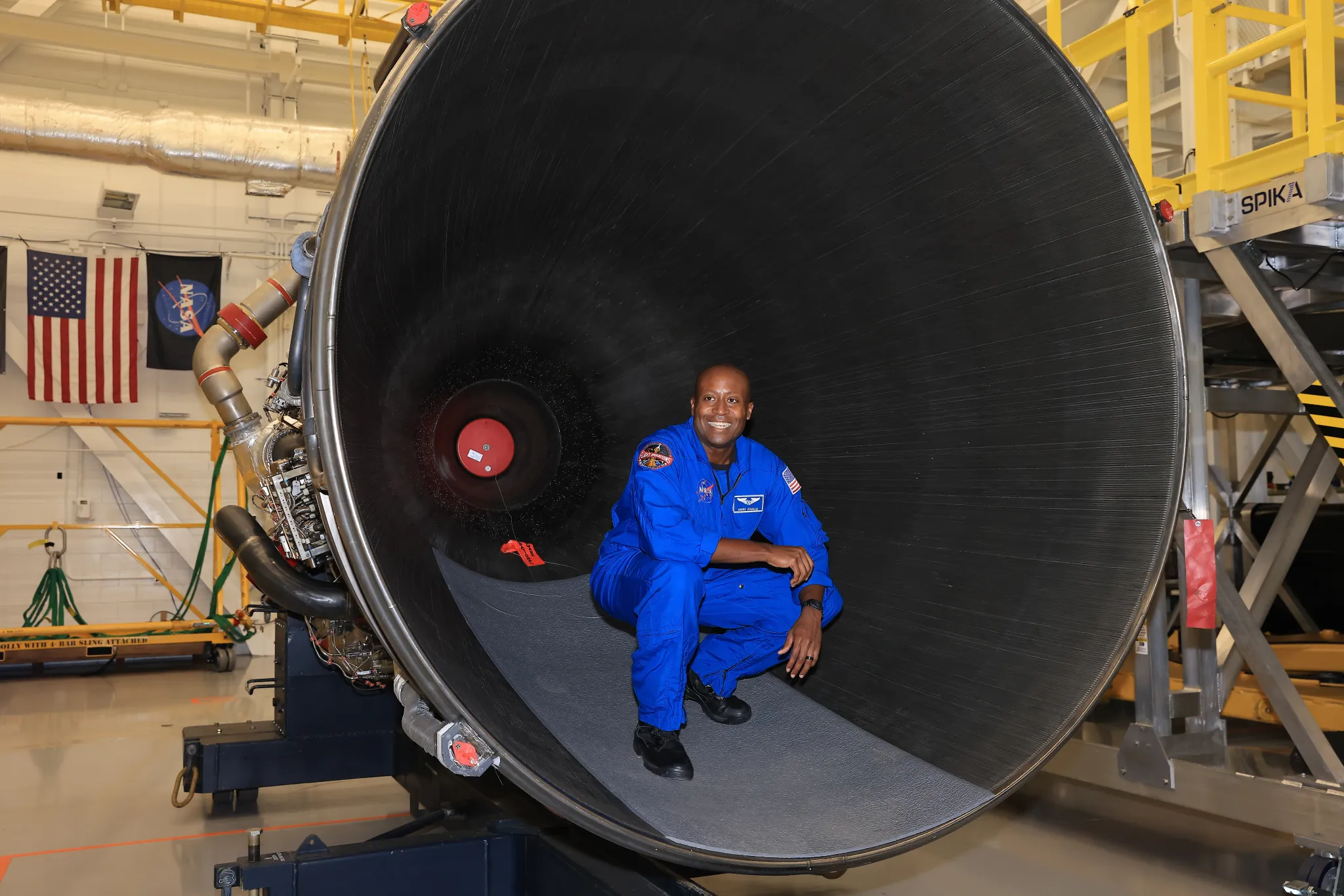
NASA astronaut and Artemis III mission specialist Andre Douglas toured Kennedy Space Center’s Vehicle Assembly Building in Florida on Tuesday, inspecting an RS-25 engine test article that will help power future lunar exploration.
In this piece
NASA astronaut Andre Douglas visited the Vehicle Assembly Building at Kennedy Space Center in Florida to inspect an RS-25 engine test article. The…
NASA astronaut and Artemis III mission specialist Andre Douglas visited the historic Vehicle Assembly Building at Kennedy Space Center in Florida on Tuesday, inspecting propulsion hardware central to the agency's deep-space architecture. During the tour, Douglas stood inside an RS-25 engine test article, examining the full-scale interior of the power unit scheduled to lift future lunar missions. The visit offered the astronaut a close-up perspective on the mechanical scale of the hardware being readied for flight.
The RS-25 engine configuration serves as the primary liquid-propulsion backbone for the Space Launch System, NASA's heavy-lift rocket designed for crewed deep-space voyages. During the Artemis III mission, a cluster of four RS-25 engines mounted at the base of the massive core stage will fire together during ascent. Their combined thrust will propel the launch vehicle through the atmosphere before placing the upper stage and crew cabin onto a trans-lunar trajectory.
Under the Artemis III mission profile, the SLS launcher will send the Orion spacecraft carrying Douglas and his fellow crew members toward lunar orbit. The expedition aims to advance NASA's sustained lunar exploration agenda, building upon foundational flight tests to land astronauts on the Moon. Agency planners emphasize that seamless coordination between the spacecraft and its propulsion elements remains vital to crew safety throughout the multi-day voyage.
The Vehicle Assembly Building at the Florida spaceport serves as the central hub where engineers stack, integrate, and test rocket components prior to rollout. Walkthroughs and hardware inspections by assigned astronauts allow flight crews to interface directly with assembly personnel and examine flight-like test hardware. These interactions also provide operational teams with critical feedback on crew interfaces and accessibility before final assembly steps proceed.
High-fidelity test articles like the RS-25 unit Douglas examined allow ground teams to validate tooling, verify clearances, and refine installation procedures without risking sensitive flight equipment. The heavy-lift rocket core requires precise integration between propellant lines, structural mounts, and electronic monitoring harnesses. Comprehensive ground testing ensures that the four engines can be seated and serviced safely within the tight confines of the rocket's engine section.
Originally adapted from the Space Shuttle program, the RS-25 design has undergone extensive upgrades to endure the harsher launch environments and higher operating pressures required by deep-space exploration. In the SLS configuration, the engines operate in conjunction with two solid rocket boosters to deliver unprecedented initial thrust. Every iteration of testing and ground verification reinforces the operational parameters needed to support human missions beyond low Earth orbit.
As a mission specialist, Douglas will be responsible for overseeing complex technical systems and managing mission operations throughout the flight sequence. Engaging with launch vehicle components in person provides mission specialists with practical spatial awareness that complements simulator training. Familiarity with the dimensions and integration state of propulsion assemblies helps astronauts maintain clear situational awareness during the high-demand launch phase.
NASA ground teams in Florida continue to execute verification routines and subsystem checks inside the assembly complex as preparations move forward. Milestones accomplished across the SLS core stage and RS-25 engine program will help agency leadership assess progress toward the Artemis III launch. For Douglas and the Artemis workforce, Tuesday's inspection marks another measured step in the ongoing ground campaign to return humans to the lunar surface.
Primary source: NASA Breaking News. Newzly rewrites and structures source reporting for clarity; verify critical details at the original.