Crimea bridge partly collapses after attack Zelensky calls unprecedented
Ukraine says the strike on the strategic Crimea bridge took weeks to plan. The Kremlin has vowed to rebuild after a partial collapse that President Volodymyr Zelensky called unprecedented.
In this piece
A strategic bridge to Crimea has partly collapsed after an attack Ukraine says it spent weeks planning, the BBC reported. President Volodymyr Zelensky called…
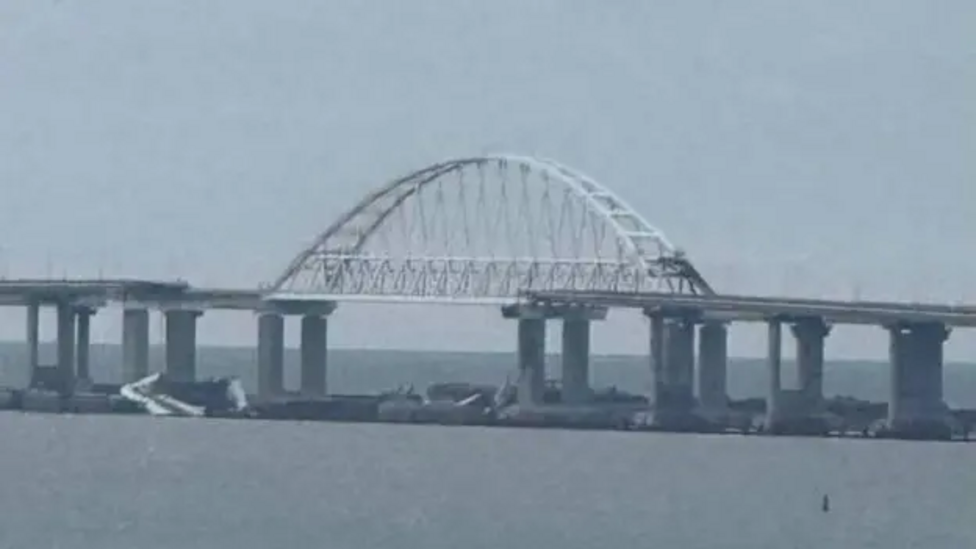
A strategic bridge linking Russia with Crimea has partly collapsed after an attack that Ukraine’s president, Volodymyr Zelensky, hailed as unprecedented, the BBC reported. Ukraine said the operation took weeks to plan. The Kremlin said it would rebuild the crossing.
The report ties the partial collapse to a Ukrainian strike and records Moscow’s pledge to restore the span. Zelensky’s “unprecedented” description is the sharpest political claim attached to the incident in the account. The BBC World summary used here gives the outline of the event and leaves weapon type, timing, and any casualty toll for fuller official detail.
The headline framing calls the crossing “Putin’s Crimea bridge,” language that shows how closely the structure is identified with the Russian president. The available report does not carry a longer statement from Zelensky or a direct comment from Vladimir Putin. Public positions so far rest on Kyiv’s description of the attack and the Kremlin’s promise to rebuild.
The bridge across the Kerch Strait is the fixed road-and-rail link between Russia’s mainland and the Crimean Peninsula. Moscow built it after taking control of Crimea in 2014, a seizure most countries still treat as illegal. For Russia, the span has served as both a supply route and a symbol of lasting control.
That dual role is why a partial collapse matters beyond the image of damaged concrete. Traffic and freight that depend on the bridge have limited alternatives: sea routes are slower and more exposed, and overland movement through southern Ukraine remains contested in wartime. A sustained interruption would complicate Moscow’s ability to move military supplies and civilian goods to and from the peninsula. How severe this interruption is will depend on engineering assessments still to come.
Kyiv has long treated the bridge as a military target because of that logistics role, while Moscow has treated attacks on it as strikes on Russian territory. Ukraine’s statement that planning took weeks presents the operation as prepared rather than opportunistic. The “unprecedented” label and the planning claim stand as Ukrainian characterizations pending independent verification of method and effect.
For the Kremlin, the immediate public response was a vow to rebuild. Reconstruction promises carry political weight: a visibly broken bridge would undercut the message that Crimea is securely held and normally connected to Russia. The account sets out the pledge and leaves timetable, cost, and engineering plans for later announcements.
The incident sits inside a war in which supply lines shape what each side can sustain at the front. A bridge that is only partly down may still carry some traffic, or engineers may close it while they inspect the structure. Claims of a lasting cutoff will rest on inspections, verified imagery, and traffic data as those emerge.
Diplomatically, the strike will be read through the unresolved status of Crimea. Ukraine and most of its partners regard the peninsula as occupied territory. Russia treats it as a subject of the federation and the bridge as domestic infrastructure, so the same partial collapse is a strike on a military lifeline in Kyiv’s telling and a strike on a strategic internal link in Moscow’s.
What happens next turns on whether the damaged section can be reopened quickly, whether Ukraine attempts further strikes, and whether Russia shifts shipping or road convoys while repairs proceed. The Kremlin has committed itself publicly to rebuilding. Ukraine has committed itself publicly to a weeks-long plan and to Zelensky’s word, unprecedented. Fuller reporting, imagery, and official briefings will test both claims against the condition of the bridge.
Primary source: BBC World. Newzly rewrites and structures source reporting for clarity; verify critical details at the original.