Deeply divided Israel braces for pivotal election
Israelis go to the polls on Tuesday in the country's first national election since the October 7, 2023 Hamas attacks, with the two main blocs running almost neck-and-neck in a contest that cuts to the heart of what kind of state Israel wants to be.
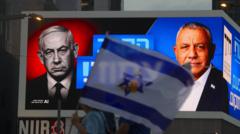
Israelis vote on Tuesday in a general election that has been building for three years, shaped by war, grief and an increasingly acute argument about the kind of democracy their country should be. Polling day arrives with the two main blocs — the governing coalition led by Prime Minister Benjamin Netanyahu and an opposition alliance grouped around centrist challenger Gadi Eisenkot — running almost neck-and-neck, with fewer than ten percent of voters still undecided.
Eisenkot, a former military chief of staff who leads the centrist Yashar party, has sought to position himself as a non-politician capable of national repair. He has pledged to end Hamas rule in Gaza within eighteen months and has framed the contest in the broadest possible terms. "Elections are about the identity of the State of Israel," he said during the campaign. Netanyahu, Israel's longest-serving prime minister, is running on a security-first platform from his Likud base, insisting that only continuity of leadership can consolidate the military gains of the past three years.
The election is the first since Hamas militants breached the Gaza border on October 7, 2023, killing nearly a thousand Israelis in a single day and seizing 251 hostages. The assault on Kibbutz Nir Oz alone left 47 residents dead and 76 taken into Gaza. That morning has haunted every aspect of Israeli politics since, generating demands for accountability that polls suggest more than seventy percent of Jewish Israelis want addressed through a formal state commission of inquiry — a measure Netanyahu's government has so far resisted.
More than 74,000 people have been killed in Gaza since October 2023, according to figures from the Hamas-run health ministry, a toll that has drawn sustained international pressure on Israel and deepened internal arguments about proportionality and war aims. The conflict spread across the region in the months that followed, drawing in Hezbollah in Lebanon and proxies elsewhere, making Tuesday's vote the first in Israeli history to be held in the shadow of such prolonged multi-front fighting.
The electorate has been further unsettled by the unfinished business of judicial reform. Netanyahu's coalition introduced sweeping changes to the country's legal architecture in 2023, triggering the largest protest movement in Israeli history before the October 7 attacks temporarily suspended that fight. Opponents of the reforms argue that democratic guardrails have been eroded; supporters say an unelected judiciary had accumulated excessive power over elected governments.
The question of military conscription for ultra-Orthodox men adds another layer of social tension. Critics across the political spectrum argue that the burden of service has been distributed unequally for too long, and the issue has proved one of the most charged dividing lines of the campaign, with coalition partners in the religious parties fiercely resistant to any change.
Far-right parties led by Itamar Ben Gvir's Jewish Power and Bezalel Smotrich's Religious Zionism are projected to capture more than sixteen percent of first-time voters, a figure that underlines the drift toward the nationalist right among younger Israelis even as centrist voices appeal for a reset. The electoral map means that Arab party blocs, representing a community that makes up roughly twenty percent of Israel's population, could yet play a kingmaker role in coalition negotiations, a prospect that has animated debate about inclusion and belonging.
Approximately 500,000 Israelis are eligible to vote for the first time on Tuesday, and around 70,000 citizens are reported to have flown in from abroad specifically to cast a ballot, a measure of the intensity of feeling on all sides.
Political analysts caution that even a clear result in the vote count may not quickly produce a stable government. Israel's proportional system routinely fragments the Knesset into multiple parties, making coalition-building a protracted and unpredictable process. Negotiations after recent elections have stretched for months.
What emerges from Tuesday's count will nonetheless set the terms for how Israel handles the remaining hostage file in Gaza, how it responds to international legal pressure, and whether the domestic rupture over democracy and the rule of law can be bridged. For a country that has spent three years in near-constant crisis, the ballot offers both a verdict on that period and an opening argument about what comes next.
Primary source: BBC World. Newzly rewrites and structures source reporting for clarity; verify critical details at the original.