DNA maps a 50,000-year link between India and Southeast Asia
The Times of India reports that DNA evidence traces a connection between India and Southeast Asia going back about 50,000 years, adding a genetic line to the study of early human movement across Asia.
In this piece
The Times of India reports that DNA research maps a roughly 50,000-year-old genetic link between India and Southeast Asia. The account points to deep population…
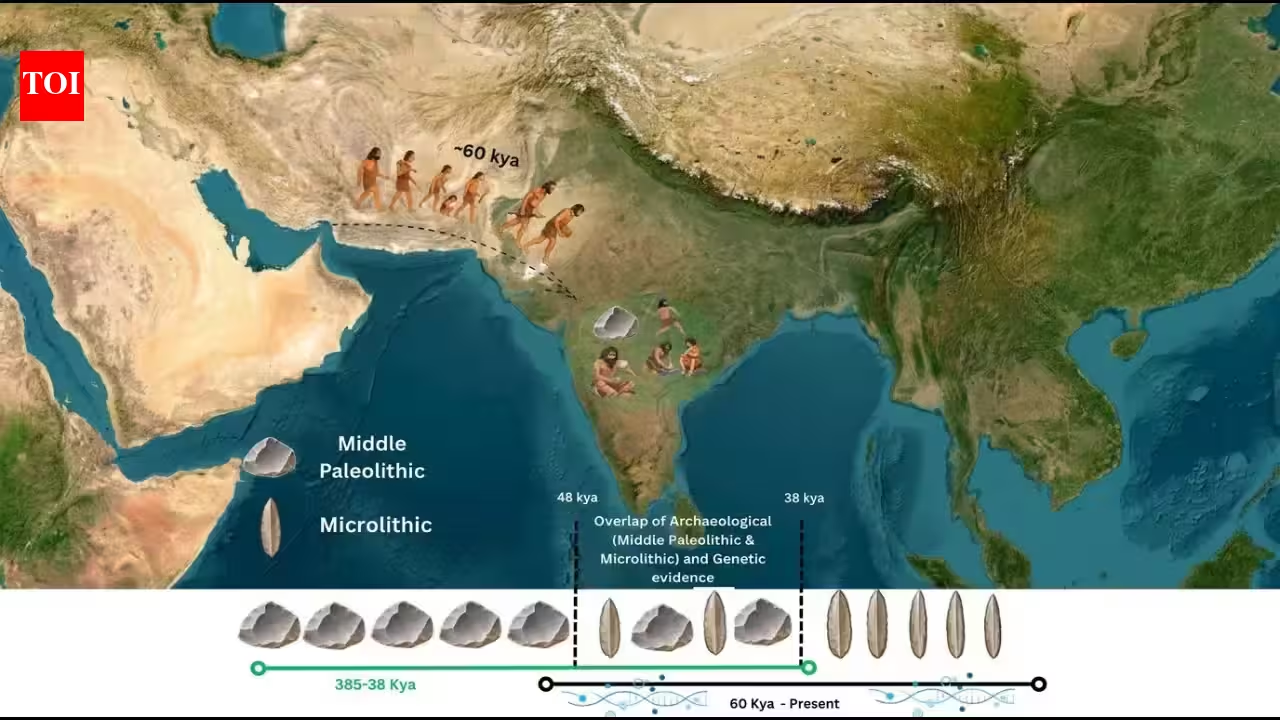
The Times of India reports that DNA research has mapped a genetic link between India and Southeast Asia stretching back about 50,000 years. As presented, the finding places part of the subcontinent’s deep ancestry in the same broad chapter of human movement that carried early populations across South and Southeast Asia. The report frames the result as a map of ancient connection among people who lived long before modern states.
The headline identifies genetic data as the tool used to trace that link. Studies of this kind compare patterns in DNA inherited across many generations, looking for shared ancestry that predates written history. The reported timescale of roughly 50,000 years sits in the late Pleistocene, when modern humans were already established across much of Asia.
The item available for this article centers on that claim. The Times of India headline, as carried in the wire summary at hand, gives the geographic span and the age. It leaves the research team, journal, genome count, and sampled communities for the full story and the underlying paper.
What the report states is a connection between India and Southeast Asia on a very deep timescale. In human-origins research, a span of about 50,000 years is commonly used for early dispersals of Homo sapiens through southern Asia. Readers should take the figure as the timescale given by the news report, pending the study’s own dating language.
A link of this age is usually discussed as ancestry shared among many later populations. Modern India and the countries of Southeast Asia took political shape long after the period in question. A genetic connection reported at that depth concerns ancient people who moved, mixed, and left traces that later groups still carry.
Researchers have long treated South Asia and Southeast Asia as connected corridors in models of early human expansion, including coastal and inland routes. Genetic, archaeological, and linguistic records are often read together, and they can point to overlapping movements across many millennia. A DNA-based map, once set beside the full methods, would add a genetic line of evidence to that wider discussion. This article rests on the news report and does not reanalyze any genomes.
The finding matters because it speaks to questions of origin that sit beneath later history. Language spread, farming, and recorded kingdoms all come much later than 50,000 years ago. Deep ancestry describes inherited biological history. It sits apart from citizenship, culture, and claims about who belongs where today.
Results in this field draw public attention because they touch identity. The headline claim, as reported, describes a link across India and Southeast Asia on an ancient clock. It names no ethnic group and assigns no rank among peoples. Until methods are in view, it remains open which lineages were compared and how later mixing was handled.
The meaning of a “50,000-year-old link” depends on design choices that the short report does not spell out. A date can mark a split between lineages, a shared ancestral population, or a modeled pulse of movement, and those are distinct events. Sample design and statistical model decide which reading is available.
What comes next is the ordinary scientific sequence: the study’s full details, comment from geneticists, and comparison with archaeology from South and Southeast Asia. The Times of India item flags a DNA map of that ancient connection. Fuller interpretation waits on the paper and on how specialists weigh it against earlier work on Asian population history.
Primary source: Google News Lakshadweep. Newzly rewrites and structures source reporting for clarity; verify critical details at the original.