Drought and Human-Set Fires Drive Record Smoke and Emissions Across New Guinea
Prolonged drought linked to a strong El Niño has fueled runaway agricultural fires across both halves of New Guinea, blanketing the island in hazardous smoke and driving carbon emissions to historic levels.
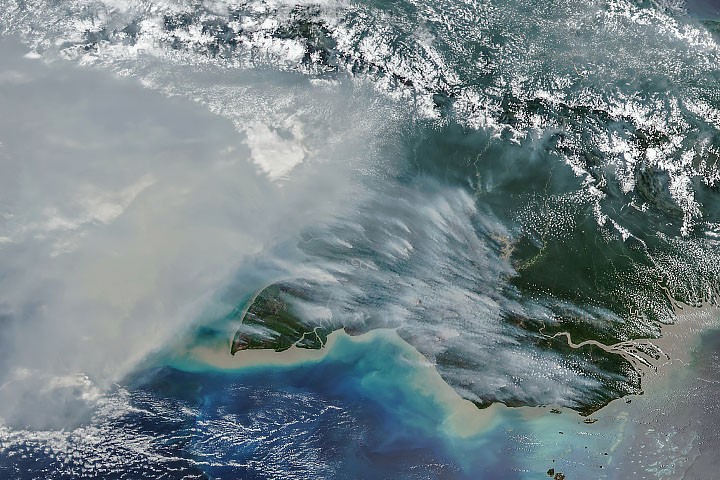
Severe drought conditions have catalyzed an escalating fire crisis across New Guinea, with human-set blazes escaping control and spreading through parched landscapes on both halves of the island. Satellite observations from NASA and environmental monitoring agencies indicate that carbon emissions have surged to extraordinary heights as fires sweep through diverse ecosystems in both Indonesian territory and Papua New Guinea.
Imagery captured by the Visible Infrared Imaging Radiometer Suite aboard the NOAA-20 satellite reveals massive streams of smoke billowing from the southern half of the island. These thick gray plumes have formed a persistent blanket over hundreds of miles of terrain, obscuring coastal regions and drifting across neighboring waters.
The underlying catalyst for the blazes is a powerful El Niño climate pattern that suppressed seasonal rainfall throughout September and October. The resulting lack of precipitation dried out vegetation that typically remains humid year-round, turning normally resilient landscapes into highly combustible fuel.
The flames have burned through a complex mosaic of ecosystems, ranging from dense tropical rainforests and lowland swamp forests to seasonally dry savannas. While savannas in the region routinely experience fire cycles, the profound dryness has allowed blazes to penetrate deep into moist forest edges and wetland habitats that are largely unadapted to regular burning.
Most of the blazes originated from intentional land-clearing and agricultural practices, which local communities commonly employ to manage brush and prepare soil for planting. Under normal moisture conditions, these controlled fires typically burn out before reaching surrounding forest cover. However, extreme ground desiccation enabled small, localized burns to breach traditional containment lines and expand into sprawling wildfires.
The prolonged haze has created critical public health hazards for communities beneath the smoke layer. Air quality indexes have plunged to hazardous categories across several population centers, prompting municipal authorities to close schools and issue advisories urging residents, particularly children and the elderly, to wear protective masks outdoors.
Dense smoke has severely disrupted transportation networks across the island, where communities frequently rely on light aircraft for regional connectivity. Low visibility caused extensive delays and cancellations of commercial and humanitarian flights, stranding passengers and complicating the delivery of medical and essential supplies to remote inland settlements.
Data tracked by the Global Fire Emissions Database confirms that the atmospheric output from New Guinea during this burning episode has shattered previous seasonal records. The combustion of biomass and underlying organic soils releases stored carbon directly into the atmosphere, transforming critical tropical carbon sinks into major temporary emission sources.
Ecologists warn that the incursions of fire into tropical rainforests and peat-rich swamp habitats could leave lasting ecological scars. New Guinea harbors some of the most biodiverse, intact tropical rainforest blocks on the planet, and repeating fire cycles degrade canopy structure while exposing forest understories to repeated drying and future vulnerability.
Meteorologists and atmospheric scientists note that significant relief will ultimately depend on a shift in regional weather patterns and the arrival of steady seasonal rains. Until the monsoon transition establishes consistent moisture across the island, fire management specialists caution that active hot spots will likely persist, leaving vulnerable communities and ecosystems at continued risk.
Primary source: NASA Breaking News. Newzly rewrites and structures source reporting for clarity; verify critical details at the original.