Fossil Footprints in Brazil Reveal Cougar-Size Mammal Walked Alongside Dinosaurs
Fossilized footprints preserved in ancient Brazilian sandstone show that a quadrupedal mammal the size of a modern cougar shared the landscape with dinosaurs, upending long-held assumptions about early mammalian evolution.
In this piece
Newly analyzed fossil tracks from Brazil's Botucatu Formation reveal that a mammal-like creature roughly five feet long roamed alongside dinosaurs during the…
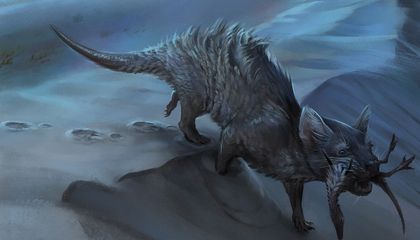
Fossilized footprints uncovered in South America indicate that a substantial, cougar-sized mammal once prowled the ancient landscapes of the Cretaceous Period alongside dinosaurs. The tracks, preserved in the fine desert sandstones of Brazil's Botucatu Formation, reveal a quadrupedal animal estimated at roughly five feet in length. The discovery offers compelling evidence that some Mesozoic mammals grew far larger than the rodent-like creatures typically depicted in textbook accounts.
The footprints measure up to five inches wide and demonstrate distinct paw-like impressions left by short, stout digits. Analysis of the trackway reveals an animal with a plantigrade gait, walking with the soles of its feet flat on the ground much like modern badgers or bears. Spacing between the consecutive impressions indicates a confident, deliberate stride across prehistoric sand dunes roughly 130 million years ago.
Researchers examining the trackways associated the impressions with Chelichnopodidae, an ichnofamily linked to advanced mammal-like synapsids and early mammals. While smaller footprints known under the trace fossil genus Brasilichnium have long been documented in the region, the sheer scale of the newer specimens caught paleontologists by surprise. The proportions suggest a heavily built animal capable of thriving in an arid, dune-dominated environment.
For decades, classical evolutionary theory maintained that mammals during the Mesozoic Era were confined to extreme ecological margins. Conventional thinking held that the presence of predatory dinosaurs forced early mammals to remain diminutive, nocturnal insectivores roughly the size of shrews or mice. Under that paradigm, mammals were presumed incapable of attaining significant body mass until the catastrophic asteroid impact 66 million years ago cleared the ecological stage.
The Brazilian tracks provide further field corroboration to a growing body of evidence dismantling that restrictive view. Discoveries across China and North America over the past two decades have documented Mesozoic mammals that swam, glided, and even preyed on small juvenile dinosaurs. Finding footprint evidence of a large terrestrial quadruped in South America demonstrates that mammalian body size experimentation occurred across disparate continents during the dinosaur age.
The ancient Botucatu desert presented extreme environmental demands, characterized by vast wind-swept sand seas and scarce water resources. In such harsh dune systems, massive theropod dinosaurs may have been relatively uncommon, allowing mid-sized mammals to occupy predatory or scavenging niches. The physical scale of this animal suggests it was well equipped to hunt smaller vertebrates and survive the taxing climate of an ancient inland desert.
Because complete mammalian skeletons from the Cretaceous can be exceedingly fragile and rare in arid sedimentary settings, fossilized trackways provide indispensable snapshots of living behavior. Footprints record dynamic locomotion, weight distribution, and ecological interactions that fossilized bones alone cannot reconstruct. In this case, the preserved stride lengths allow scientists to calculate hip height and overall body mass with notable precision.
While trace fossils cannot pinpoint the exact anatomical genus without accompanying skeletal remains, specialists emphasize that the morphological traits clearly diverge from contemporary reptiles and dinosaurs. Some researchers caution that pinpointing the precise mammalian lineage will require finding corresponding fossilized bones in equivalent strata. Nonetheless, the consensus remains that no known non-mammalian trackmaker from the formation matches the unique pad and toe configurations.
Field researchers intend to conduct further systematic surveys across the sandstone exposures of the Paraná Basin in search of additional trackways and associated skeletal material. Ongoing excavations aim to clarify how these formidable mammals interacted with contemporaneous fauna and how widely they ranged across Gondwana. As paleontologists uncover more evidence from neglected rock formations, the portrait of the Mesozoic continues to evolve into a far richer and more balanced evolutionary tapestry.
Primary source: Smithsonian Magazine. Newzly rewrites and structures source reporting for clarity; verify critical details at the original.