From Russian cages to Irish sanctuary: The five-year rescue journey of Bu and Tyapa
Two brown bears rescued from cruel conditions in Dagestan, Russia, have arrived at a County Donegal wildlife sanctuary after a 13,500-kilometre journey spanning five years, two war zones, and four countries.
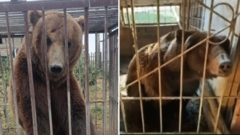
Two brown bears rescued from grim captivity in Russia's Republic of Dagestan have begun a new life at a wildlife sanctuary on Ireland's Inishowen Peninsula, ending a five-year international effort that navigated war zones, international sanctions, and successive transport crises.
Bu, a former circus bear, had spent years confined to a small indoor cage with severely limited access to water. Tyapa, who came from a petting zoo, was being raised for taxidermy and had lived in a cage measuring just 2.5 by 2.5 metres — too low for the bear to stand upright. Both animals were being housed at a small dog-and-cat sanctuary in Dagestan that lacked the resources to properly care for them.
Killian McLaughlin, founder of Wild Ireland and a qualified solicitor, first learned of the bears in 2021 and began efforts to bring them to his sanctuary in Burnfoot on the Inishowen Peninsula in County Donegal. What he envisioned as a logistically complex but achievable rescue quickly became far more complicated.
In February 2022, Russia's invasion of Ukraine closed off the most direct overland transport route westward. Sanctions and transport restrictions created further legal and practical barriers. Then in early 2026, renewed conflict in the Middle East forced the closure of key airspace corridors, temporarily derailing a transport plan that had finally been taking shape.
The breakthrough came when Dima and Yana Kim, who operate the Tiger House sanctuary near St. Petersburg — Yana is a veterinarian — agreed in January 2025 to assist. In October 2025, the couple drove 36 hours to retrieve Bu and Tyapa from their Dagestan cages and transport them to Tiger House, where the bears could be stabilised and assessed ahead of the international flight.
Veterinary examinations at that stage revealed the full extent of the damage years of confinement had caused. Both bears were severely malnourished and showed clear signs of psychological trauma. Bu and Tyapa were also found to have serious kidney problems attributed to prolonged dehydration — a direct consequence of their limited water access in Dagestan.
By June 2026, with logistical support from animal transport specialist Intradco Global and Etihad Cargo, the necessary veterinary requirements had been met and a viable route secured. The bears were flown from Moscow to Abu Dhabi and then on to Dublin, completing a journey of approximately 13,500 kilometres. They arrived in Ireland on 3 August 2026 and were transported by cattle lorry to Wild Ireland, where they entered a mandatory quarantine period.
On 7 September 2026, Bu and Tyapa were released from quarantine and introduced to their permanent woodland habitat at the Burnfoot sanctuary. Within two months of arrival, veterinary staff reported that both bears had recovered normal kidney function and shown meaningful improvements in weight and coat condition.
The animals' psychological recovery is ongoing. Staff at Wild Ireland say the bears remain fearful of open spaces, moving vegetation, and deep water — behaviours consistent with years of severe environmental deprivation. Both frequently return to enclosed retreat houses within their habitat for security.
With Bu and Tyapa now resident, Wild Ireland is home to four brown bears in total, making it the only place in Ireland where the species — extinct on the island for more than two thousand years — can be seen. McLaughlin, who described the outcome as "mission accomplished," said he could never forget the bears even in the darkest moments of the campaign.
A documentary about the rescue, produced by Moondance Productions — the company behind the earlier film Return of the Wild: The Bearman of Buncrana — is expected for release in 2027. The rescue effort involved more than 100 people across multiple countries, according to Wild Ireland.
Primary source: BBC Science. Newzly rewrites and structures source reporting for clarity; verify critical details at the original.