Grayscale Warns Crypto Token Inflation Can Wipe Out Holder Rewards
Grayscale warned that aggressive token supply inflation can erode holder rewards across crypto applications, urging investors to weigh protocol earnings against dilution rather than relying solely on speculative narratives.
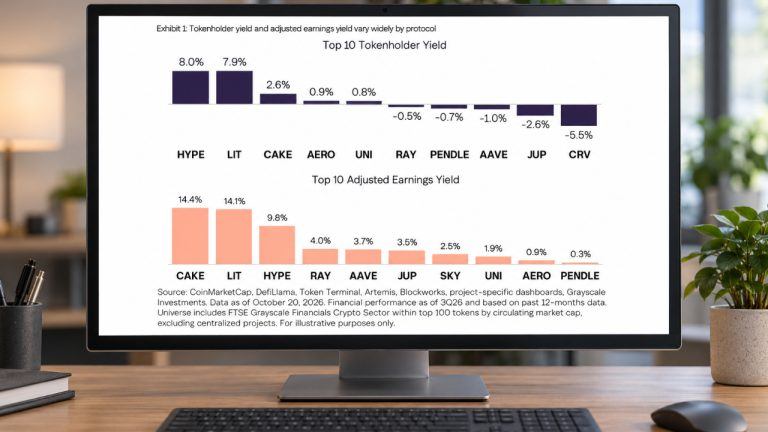
Digital asset manager Grayscale has issued a warning to cryptocurrency investors, cautioning that rapid token supply inflation can significantly diminish or eliminate the benefits distributed to holders. The firm outlined its perspective in a recent research analysis focused on evaluating decentralized applications based on fundamental financial metrics. According to Grayscale, evaluating headline earnings alone is insufficient without monitoring how new token issuance dilutes capital returns over time.
The asset manager highlighted that many blockchain-based protocols and applications have demonstrated an ability to generate substantive protocol revenue. However, when networks continuously mint and release new tokens into circulation, the underlying economic value generated by those platforms may fail to reach existing tokenholders. Grayscale pointed out that expanding supplies effectively reduce per-token earnings, challenging assumptions that protocol usage automatically translates into individual investor gains.
The analysis places a strong emphasis on moving digital asset valuation beyond broad market narratives and speculative sentiment. While early-stage crypto markets have historically relied heavily on momentum and thematic trends, Grayscale argues that mature valuation frameworks must incorporate verifiable cash flows and distributions. Grounding protocol assessments in measurable financial performance provides a clearer benchmark for distinguishing sustainable networks from speculative ventures.
To address these dynamics, Grayscale proposes an analytical framework that measures protocol earnings alongside direct tokenholder returns. Under this approach, market participants evaluate how much revenue an application produces and how much of that capital is returned to holders via mechanisms such as fee distributions or buybacks. Crucially, these metrics must be weighted against the project’s total market capitalization to gauge whether current valuations reflect economic reality.
The central risk identified by Grayscale lies in the failure to adjust headline yield figures for token supply growth. High nominal distributions can create an illusion of profitability while simultaneously being offset by aggressive token emissions. If a protocol distributes earnings at a pace slower than its annual inflation rate, holders face an erosion of purchasing power and proportional network ownership.
This analytical distinction matters significantly for institutional and retail allocators attempting to assess income-generating crypto assets. Traditional financial modeling routinely accounts for share dilution, yet crypto market metrics have often obscured how circulating supply expansions impact net yields. Grayscale’s research suggests that investors who ignore issuance schedules risk misinterpreting protocol sustainability and overpaying for nominal yields.
The issue also reflects broader structural questions regarding how decentralized application developers design their long-term tokenomics. Projects facing declining liquidity or mounting emissions schedules must determine whether their current distribution models are viable over extended periods. Networks that rely on high inflation to incentivize short-term engagement may struggle to retain capital if holders realize that dilution outweighs headline incentives.
Looking ahead, Grayscale’s analysis indicates that protocol evaluation will increasingly demand granular scrutiny of emission curves and distribution structures. As digital asset markets mature, analysts expect valuation models to place greater weight on net real returns rather than unadjusted top-line protocol fees. For market participants, verifying whether token supplies are outpacing actual protocol earnings is poised to become a standard requirement for fundamental crypto analysis.
Primary source: Bitcoin.com News. Newzly rewrites and structures source reporting for clarity; verify critical details at the original.