Gujarat Leads India in Fixed Capital With 19.87% Share, ASI Data Shows
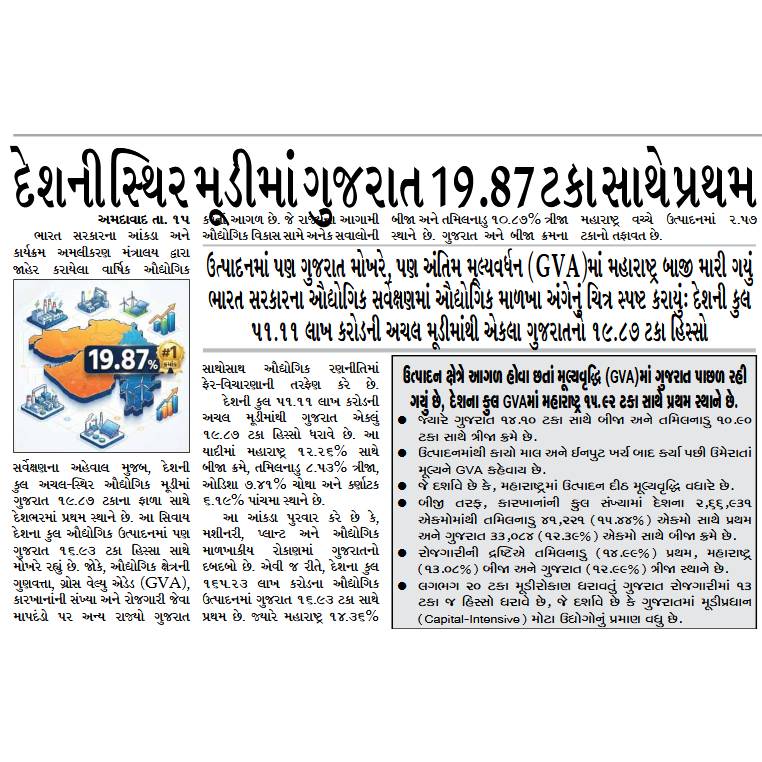
Gujarat commands a leading 19.87 percent share of India's industrial fixed capital and accounts for 16.93 percent of national industrial output, according to Annual Survey of Industries data cited by the Chief Minister's Office.
In this piece
Data from the central government's Annual Survey of Industries shows Gujarat leads all Indian states with a 19.87 percent share in fixed industrial capital. The…
Gujarat has secured the top rank across India in industrial fixed capital investment, accounting for a 19.87 percent share of the national total, according to data from the central government's Annual Survey of Industries highlighted by the Chief Minister's Office. The survey also positioned the western coastal state as the foremost contributor to nationwide factory production, delivering approximately 16.93 percent of total industrial output. The findings underscore the state's continued dominance in India's organized manufacturing ecosystem.
The Annual Survey of Industries, compiled by the Ministry of Statistics and Programme Implementation, serves as the primary statistical benchmark assessing the performance of India's registered manufacturing units. The assessment evaluates key industrial barometers, including capital investments, gross value added, employment figures, and total operational turnover. By measuring fixed capital, the survey tracks productive physical assets such as plant equipment, factory buildings, and machinery deployed on site.
Capturing nearly a fifth of India's aggregate industrial fixed capital highlights the sustained accumulation of high-value manufacturing infrastructure within Gujarat. Analysts view fixed capital formation as a vital indicator of long-term economic commitment, distinguishing durable plant investment from short-term financial flows. Such heavy asset concentration typically indicates that enterprises are investing in permanent operational capacity rather than transitory assembly lines.
The state's industrial strength has traditionally rested upon an extensive network of specialized production clusters spanning petrochemicals, chemicals, engineering goods, and textile processing. Over recent decades, state authorities and industrial promotion bodies have aggressively developed port-linked infrastructure, specialized investment regions, and industrial estates. These mature logistics networks and continuous utility supplies have steadily drawn domestic conglomerates and multinational manufacturers to build capital-intensive facilities.
Gujarat's pole position in fixed capital and manufacturing output places it ahead of other leading industrialized states, including Maharashtra, Tamil Nadu, Karnataka, and Uttar Pradesh. While states such as Maharashtra and Karnataka hold commanding positions in commercial services and technology exports, Gujarat has concentrated on scale-driven physical manufacturing. This division of economic strengths reinforces regional specialization across India's broader federal growth map.
A high proportion of fixed capital assets also generates significant downstream economic activity across regional supply chains. Heavy machinery and automated industrial operations support an ecosystem of small and medium auxiliary enterprises supplying precision components, packaging, and specialized maintenance services. Consequently, capital accumulation in primary industrial plants fosters broader economic resilience and local supplier integration throughout the state.
While capital-intensive industries demand substantial initial outlays for automated plant and heavy equipment, state officials emphasize that sustained capital formation underpins lasting employment opportunities. Modern manufacturing complexes require a skilled technical workforce to operate sophisticated production systems, supporting vocational education initiatives and engineering talent pipelines. The presence of dense infrastructure corridors further accelerates logistical connectivity between interior manufacturing parks and international sea gateways.
Looking ahead, Gujarat is seeking to leverage its strong industrial base into high-technology segments such as semiconductor fabrication, electric vehicle manufacturing, and green hydrogen infrastructure. State economic planners expect ongoing policy incentives and industrial park expansions to sustain private capital inflows into these emerging sectors. Official tracking from upcoming industrial survey cycles will measure whether this heavy capital base translates into continued output expansion and broader workforce gains.
Primary source: Google News Gujarat. Newzly rewrites and structures source reporting for clarity; verify critical details at the original.