How J&K Recruitment Scam Exposed the Power Rift Between Lok Bhavan and the Chief Minister
A major cheating ring uncovered during Jammu and Kashmir’s civil recruitment exams has sparked youth protests and intensified a jurisdictional power struggle between Chief Minister Omar Abdullah and Lok Bhavan.
In this piece
The bust of an organized cheating syndicate in the Jammu and Kashmir Services Selection Board exams has triggered public outrage and exposed institutional…
A high-tech cheating racket uncovered during the Jammu and Kashmir Services Selection Board examinations has renewed intense scrutiny over the administrative divide in the Union Territory. Following the arrest of 20 individuals, including six government employees, by local police investigators, the scandal has expanded from a law enforcement operation into a constitutional debate. The case has reignited questions over whether executive oversight over civil service hiring rests with the elected Chief Minister or the Lieutenant Governor's administration at Lok Bhavan.
According to investigators from the Jammu and Kashmir Police, the illicit ring targeted the Finance Accounts Assistant recruitment test conducted across the region. A Special Investigation Team discovered that conspirators established an elaborate inside-outside network, using an exam insider to photograph question papers from absentee candidates shortly after testing began. Intermediaries stationed outside solved the papers and transmitted answers back to select candidates via electronic gadgets and encrypted communication channels.
Police disclosed that organizers demanded substantial payoffs, often negotiating sums between 10 lakh and 12 lakh rupees per candidate conditional on passing the test. To secure these transactions, syndicate members reportedly collected blank cheques and original academic credentials from aspirants before the exam. Raids led by law enforcement yielded wireless communications equipment, mobile phones, and vehicles used to coordinate the cheating operation across test centers.
In response to public alarm, the Services Selection Board stated that the irregularities were caught and isolated before corrupting the examination on a mass scale. Officials maintained that strict security protocols limited the breach to a specific module rather than a widespread leak of the test paper. However, the discovery that government staff actively facilitated the fraud fueled widespread skepticism among thousands of candidates who sat for the test.
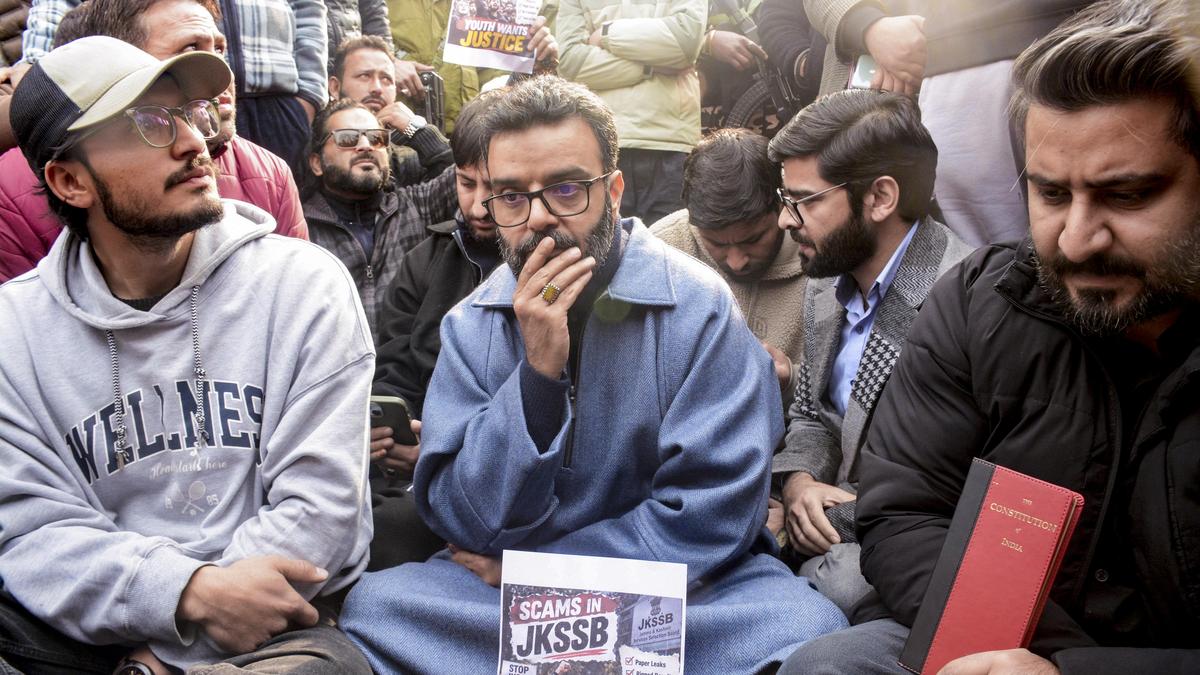
The scandal quickly sparked street protests and demonstrations by educated youth and student unions across Jammu and Kashmir. Demonstrators braved severe cold to stage sit-ins, expressing deep frustration over repeated integrity breaches in public recruitment drives over recent years. Aspirants voiced despair that persistent malpractices continue to jeopardize fair employment opportunities in a region grappling with elevated joblessness.
The political fallout has brought the governance structure of Jammu and Kashmir under sharp public focus. Since its reorganization as a Union Territory, administrative authority has been split between the newly elected government led by Chief Minister Omar Abdullah and the central government's appointee at Lok Bhavan. While elected representatives face immediate public pressure when administrative scandals break, key apparatuses governing civil service cadre, police, and higher administration remain anchored to the Lieutenant Governor.
The controversy has laid bare the institutional friction between the Chief Minister's Office and Lok Bhavan over who controls autonomous recruitment bodies. While citizens demand immediate accountability and systemic overhauls from their elected leaders, ministerial authority over the Services Selection Board remains legally circumscribed by the Union Territory framework. Elected ministers have publicly highlighted that ultimate executive command over public services and anti-corruption machinery resides primarily with the Lieutenant Governor.
Recruitment controversies have plagued Jammu and Kashmir repeatedly in recent years, leading to the cancellation of multiple high-profile recruitment drives. Previous investigations into junior engineering and police sub-inspector tests revealed organized syndicates operating within bureaucratic circles. The recurrence of similar schemes underscores structural vulnerabilities in test logistics and oversight that previous administrative interventions failed to eliminate.
Legal proceedings are continuing against the arrested suspects, with authorities signaling that further arrests and departmental dismissals may follow as financial trails are examined. At the same time, regional political leaders are expected to use the scandal to amplify demands for full statehood and restored executive autonomy. Until clear jurisdictional lines are established between Lok Bhavan and the Chief Minister's Secretariat, recruitment integrity will likely remain a persistent flashpoint in Jammu and Kashmir governance.
Primary source: Google News Jammu and Kashmir. Newzly rewrites and structures source reporting for clarity; verify critical details at the original.