HYPE Retreats From Record as Competition Tests Hyperliquid
Hyperliquid remains a leading decentralized derivatives venue, but HYPE’s retreat from its September peak highlights concerns over competition, future token supply and the durability of fee-funded buybacks.
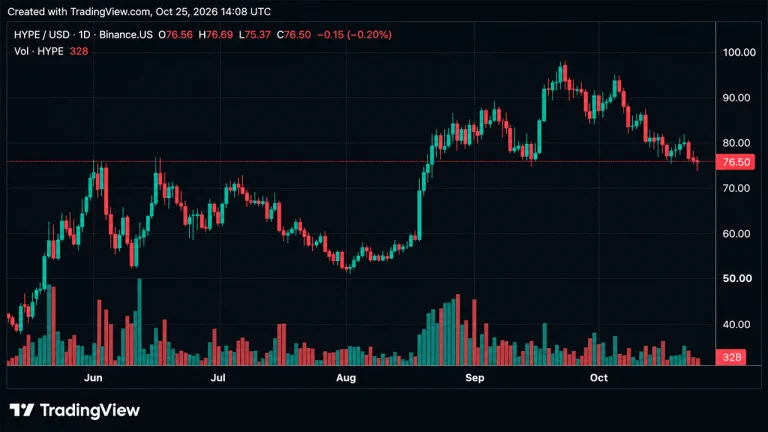
Hyperliquid’s HYPE token has retreated roughly 22% from its September record near $98, according to Bitcoin.com News, even as the platform retains a leading position in decentralized perpetual futures trading. The pullback highlights a widening tension between the exchange’s operating strength and expectations embedded in its token price.
The report’s opening snapshot puts Hyperliquid’s open interest at approximately $7.7 billion and HYPE’s market capitalization near $17 billion. Its later figures differ, however, making those measurements indicative rather than a consistent market snapshot. The distinction matters when assessing the size of the trading business against the token’s valuation.
Hyperliquid operates its own blockchain supporting derivatives and spot trading. Its investment narrative rests partly on a direct connection between trading activity and token purchases, rather than solely on expectations that more users will eventually create demand for HYPE.
According to Hyperliquid’s official fee documentation, the Assistance Fund automatically converts trading fees into HYPE through the blockchain’s execution process. The documentation says HYPE held in the fund is burned, permanently removing those tokens from circulating and total supply. That mechanism provides a recurring link between platform usage and supply reduction.
The relationship is not a guarantee of price appreciation. Stronger trading activity can support more fee-funded purchases, while weaker activity can reduce that buying capacity. Hyperliquid’s documentation also describes volume-based fee tiers and staking discounts, meaning headline trading volume alone does not provide a complete measure of revenue available to support token purchases.
Competition is another pressure point. Bitcoin.com News reported that Hyperliquid’s share of real-world asset perpetual futures volume fell from approximately 80% in July to 26% in subsequent measurements. That narrower market-share measure should not be confused with its position across decentralized perpetual futures as a whole, where the report says it remains dominant.
The supply outlook adds a separate challenge. A Hyperliquid Strategies securities filing describes a core-contributor allocation representing 23.8% of HYPE’s initial maximum supply, with monthly vesting beginning in November 2025 and continuing through 2027–2028. Those scheduled releases make the pace of tokens becoming available an important counterweight to purchases and burns.
Unlocking tokens does not establish that recipients will immediately sell them. Nevertheless, newly transferable holdings can create potential selling pressure that buybacks must absorb alongside ordinary market activity. The filing itself cautions that the Assistance Fund mechanism offers no assurance about HYPE’s market price, an important qualification to bullish arguments built around supply reduction.
For investors, the central question is therefore not simply whether Hyperliquid remains a large trading venue. It is whether sustained fee generation and broader demand for HYPE can offset potential selling while competitors pursue the same users. The next indicators to watch are trading activity, effective fee generation, Assistance Fund purchases and actual contributor distributions—not unlock schedules or exchange rankings in isolation.
Primary source: Bitcoin.com News. Newzly rewrites and structures source reporting for clarity; verify critical details at the original.