world·Madhya Pradesh·and district
India Administers Over 1 Crore HPV Vaccine Doses in Under Nine Months
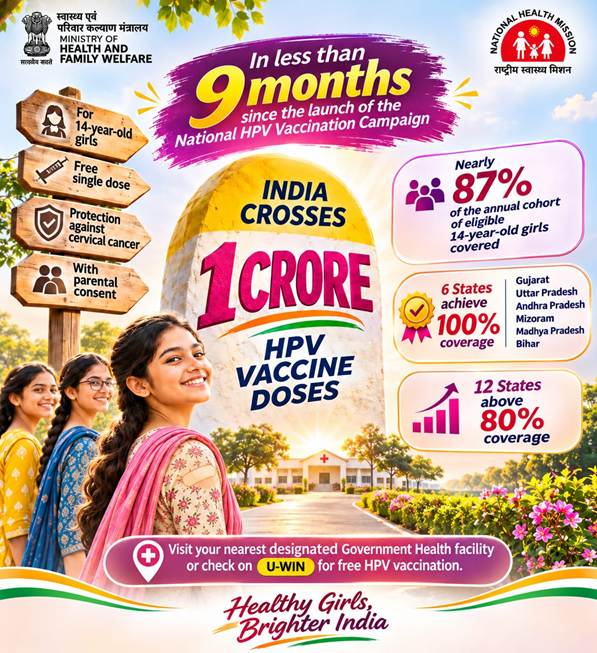
India has administered over one crore HPV vaccine doses in under nine months, reaching nearly 87 percent of its target cohort of 14-year-old girls in a major national drive against cervical cancer.
In this piece
India has crossed the milestone of administering more than 10 million HPV vaccine doses to adolescent girls in less than nine months. Supported by the digital…
India has administered more than one crore doses of the Human Papillomavirus vaccine in less than nine months, marking a significant milestone in the country's public health campaign against cervical cancer. According to data released by the Union Ministry of Health and Family Welfare, the national rollout has rapidly scaled up preventive healthcare for adolescent girls across both rural and urban areas.
The initiative, launched earlier this year by Prime Minister Narendra Modi, offers free, safe, and voluntary single-dose HPV vaccinations to 14-year-old girls with parental consent. Health authorities designated government medical centers, community health facilities, and district hospitals to ensure accessible distribution across all regions.
The campaign has achieved nearly 87 percent cumulative coverage of its estimated annual target cohort of approximately 1.2 crore eligible girls nationwide. Health officials highlighted the speed of the rollout, noting that reaching ten million beneficiaries in under nine months reflects strong coordination across state and local health systems.
State-level performance indicators reveal that six states and Union territories have already attained 100 percent coverage of their identified target populations. These leading regions include Gujarat, Uttar Pradesh, Andhra Pradesh, Mizoram, Madhya Pradesh, and Bihar, each achieving full inoculation of their registered cohorts.
In terms of absolute numbers, Uttar Pradesh registered the highest volume in the country, administering vaccine doses to more than 29.33 lakh girls. Bihar followed with over 13.70 lakh vaccinations, while Gujarat successfully administered more than 7.75 lakh doses to eligible adolescents.
Several other states also recorded high participation rates that significantly bolstered the national tally. Official figures show Assam surpassing 96 percent coverage, Telangana exceeding 95 percent, Karnataka reaching over 93 percent, and Uttarakhand achieving more than 90 percent coverage among eligible girls.
Central to the operational success of the immunization drive has been the U-WIN digital platform, which enabled real-time monitoring and administrative oversight. The portal facilitated beneficiary registration, tracked slot allocations, and generated instant digital vaccination certificates for participating families.
Cervical cancer remains one of the leading causes of cancer-related mortality among women in India, with persistent high-risk HPV infections responsible for the vast majority of cases. Public health experts emphasize that timely vaccination during early adolescence provides strong immunological protection before potential exposure to the virus occurs.
By integrating the HPV vaccine into the broader public immunization framework, the program seeks to eliminate economic and logistical barriers that previously restricted access primarily to the private market. Wide-scale preventive coverage is expected to substantially lower cervical cancer incidence and related healthcare costs over the coming decades.
Health authorities plan to sustain the campaign's momentum by mobilizing community health workers, school networks, and local administrative bodies to reach the remaining eligible cohorts. The government aims to maintain high coverage rates as subsequent age groups become eligible, reinforcing national efforts toward long-term cervical cancer elimination.
Primary source: Google News Madhya Pradesh. Newzly rewrites and structures source reporting for clarity; verify critical details at the original.