Initia Halts Blockchain Network After $2.7 Million Token Minting Exploit
Modular blockchain platform Initia halted operations on Friday following a security breach that allowed an attacker to mint an estimated $2.7 million in unauthorized tokens, co-founder Ezaan Mangalji confirmed.
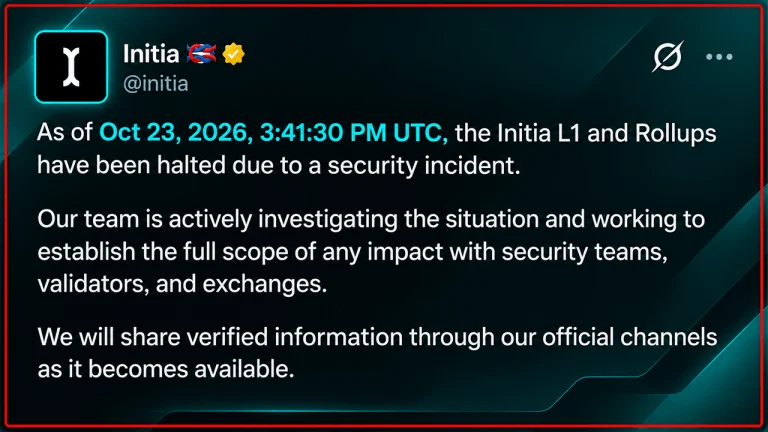
Modular blockchain network Initia halted its operations following a confirmed security incident that compromised the platform. Co-founder Ezaan Mangalji disclosed that an attacker exploited a vulnerability to mint an estimated $2.7 million worth of cryptocurrency tokens. The breach prompted an immediate pause across the network on Friday as developers rushed to contain the unauthorized minting.
The decision to suspend the blockchain represents an emergency response designed to prevent further unauthorized token issuance. By freezing block production and network transactions, core contributors effectively severed the attacker's ability to extract additional funds from the ecosystem. Mangalji confirmed the operational shutdown shortly after anomalous activity was detected on October 23, 2026.
Unauthorized token minting remains one of the most critical threat vectors in the digital asset landscape. Unlike attacks targeting liquidity pools or user private keys, minting exploits allow a malicious actor to artificially generate new tokens directly through systemic vulnerabilities. When attackers manipulate protocol logic or underlying execution environments, they can fabricate assets without providing requisite collateral or reserves.
Initia operates as a modular blockchain, an architectural approach designed to decouple consensus, execution, and data availability across specialized layers. While modular architectures promise enhanced scalability and flexibility for developers, interconnecting distinct execution environments can introduce unique security surfaces. In such ecosystems, an unaddressed flaw in token issuance mechanisms can rapidly jeopardize economic guarantees across linked components.
Sudden halts of layer infrastructure invariably present complex operational hurdles for active market participants and decentralized applications. Freezing a distributed ledger freezes ongoing transfers, smart contract interactions, and user withdrawals until node operators coordinate an official remediation. When illicitly minted tokens enter secondary trading venues, liquidity providers face immediate price volatility and severe slippage risks.
The incident highlights ongoing security vulnerabilities that continue to test decentralized networks as platforms experiment with novel designs. High-value exploits targeting emerging blockchain systems have repeatedly demonstrated how small implementation oversights can yield multi-million-dollar breaches within minutes. Industry security analysts frequently note that the speed of capital deployment in decentralized finance often outpaces formal protocol verification.
In the aftermath of the disclosure, development teams typically conduct comprehensive forensic audits to trace the attacker's transaction flow and pinpoint the exact entry vector. Identifying whether the flaw stemmed from core state machine rules or cross-layer communication remains a primary investigative focus following an unauthorized minting event. Coordinating with external security researchers and tracking on-chain movements often form the frontline of efforts to mitigate broader ecosystem fallout.
Restarting a suspended blockchain requires rigorous consensus and coordinated execution among independent node operators and validators. Engineering teams must design, test, and distribute patched software releases to patch the underlying vulnerability before nodes can safely resume consensus. Any premature reactivation without full synchronization risks state divergence, further exploits, or uncoordinated network splits.
For Initia, restoring trust will depend on transparent post-mortem findings and robust technical assurances that the exploited mechanism cannot be reactivated. While the full extent of recovery efforts and forensic findings has yet to be detailed, the halt serves as a vital safeguard during live incident response. The platform faces a cautious path forward as developers work toward a secure network restart and address the $2.7 million breach.
Primary source: Bitcoin.com News. Newzly rewrites and structures source reporting for clarity; verify critical details at the original.