Magazine report says people now speak 338 fewer words as technology spreads
Divya Bhaskar Magazine reports that the latest research finds people speak 338 fewer words than they once did, and it asks whether technology is behind the quieter habit.
In this piece
Divya Bhaskar Magazine says recent research finds people speak 338 fewer words than before and ties the decline to technology. The item, presented as a global…
A Gujarati magazine report is drawing attention to a stark claim about everyday conversation: technology, it says, may be leaving people with far less to say out loud. Divya Bhaskar Magazine, in a Kalash section item, reported that the latest research finds people now speak 338 fewer words than they used to.
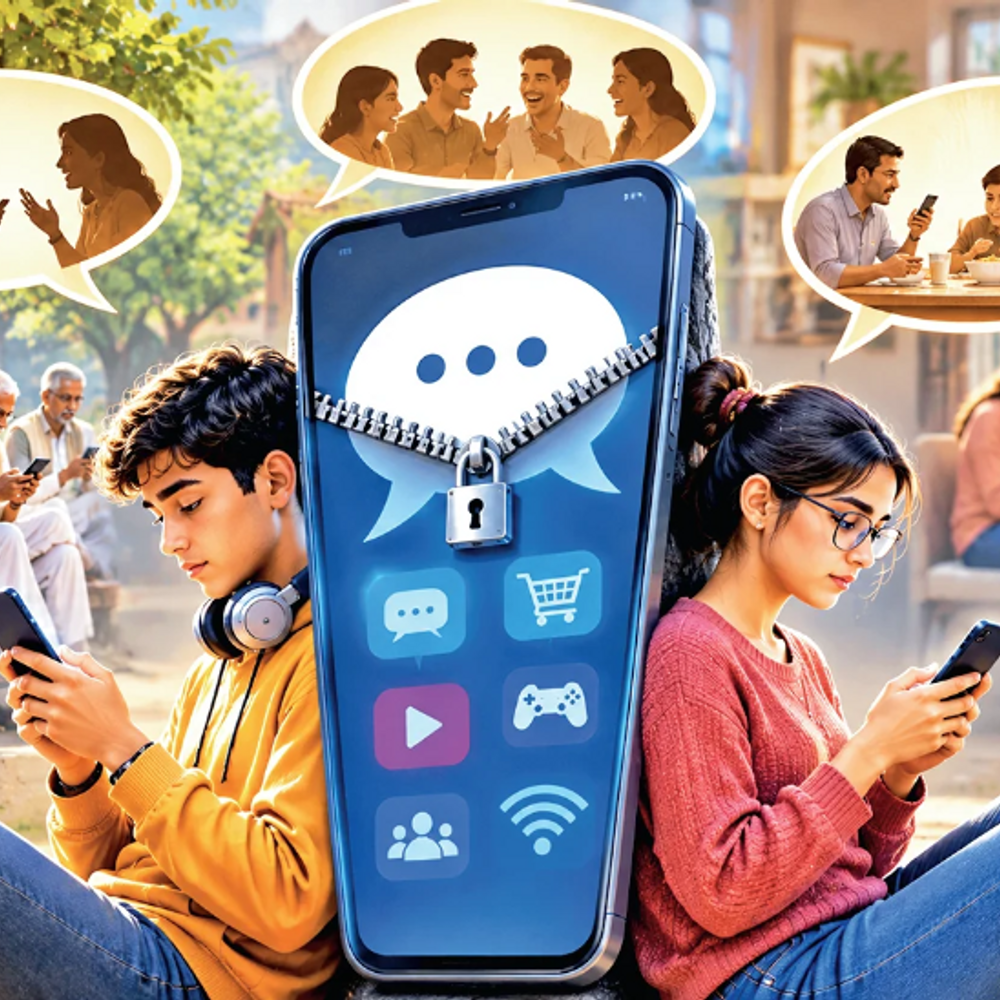
The headline poses the question directly — has technology stopped us from talking? — and answers with that single comparative figure. The piece frames the change as a decline in human speech tied to the spread of digital tools, and the web address of the report describes the subject as a global research finding on technology’s impact.
The material available from the item does not name the researchers, the journal, the countries studied, or the period being compared. It also does not say whether the 338-word gap is measured per day, per conversation, or on some other basis. Those details would be needed before the number can be treated as a settled scientific result.
What the report does put forward is a familiar social worry stated as news: screens, messages, and other technology are crowding out spoken exchange. In the magazine’s framing, the loss is counted in words people no longer say aloud.
Speech is how families settle plans, how coworkers clear up confusion, and how strangers turn a passing moment into a relationship. A drop of hundreds of words, if the underlying research holds, would mean shorter exchanges and more silence in ordinary life, even when people remain constantly connected online.
Commentators have long treated messaging as a substitute for some of the work once done by voice — a short text in place of a phone call, a reaction in place of a sentence. The Divya Bhaskar item sits in that line of concern and rests the claim on what it calls the latest research, rather than on interviews or local anecdotes set out in the text at hand.
The distinction matters for readers. A headline figure can travel faster than the study behind it. Anyone who wants to judge the 338-word claim will need the original paper: who was counted, how speech was recorded, and what “before” means. Until those elements are clear, the number is best read as the magazine’s summary of research.
Why the claim resonates is easier to see from daily routine. Many tasks that once required talking — asking for directions, paying a bill, checking on a friend — can now be completed with taps. If those substitutions add up, the total of spoken words can fall without anyone deciding to become quieter.
The magazine’s question also leaves room for another reading. People may be speaking less in some settings and more in others, such as voice notes or video calls, and a single net figure would hide that mix. The item as published does not break the 338-word difference into settings or age groups.
For now, the report functions as a prompt rather than a finished brief. It tells readers that a recent study, as the magazine describes it, links technology to a measurable thinning of speech, and it invites them to ask whether their own conversations have shrunk.
What comes next is verification, which the piece itself does not supply. Educators, parents, and health writers often treat sustained conversation as a skill that has to be practiced. If further reporting confirms the study and its methods, the 338-word gap will become a benchmark those debates can cite. If the methods are narrow, the headline will need a quieter rewrite.
Divya Bhaskar’s Kalash item does not say what institutions plan to do with the finding. Its outlook is the question in the headline itself: whether technology has already changed how much people speak, and whether that change is as large as 338 words.
Primary source: Divya Bhaskar Magazine. Newzly rewrites and structures source reporting for clarity; verify critical details at the original.