world·California·Los Angeles County
Magnitude 3.3 Earthquake Rattles Coast Off San Pedro in Southern California
A magnitude 3.3 earthquake struck off the coast of San Pedro on Saturday morning, sending light tremors across coastal Los Angeles County. The shallow offshore quake caused no damage or injuries but added to a recent string of regional tremors.
In this piece
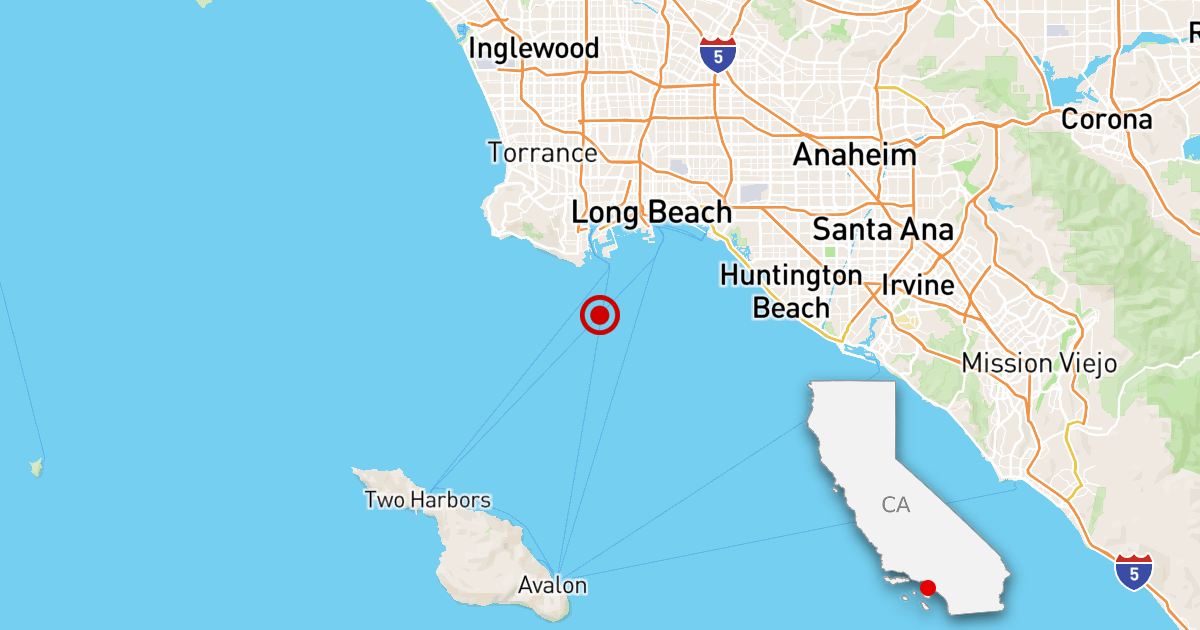
A magnitude 3.3 earthquake rattled coastal Southern California on Saturday morning, centering roughly four miles off San Pedro. Weak shaking was felt across…
A magnitude 3.3 earthquake struck waters off the coast of Southern California on Saturday morning, giving coastal communities another light jolt during an active stretch of regional seismicity. The offshore tremor occurred at approximately 6:09 a.m. local time, according to data from the U.S. Geological Survey. Residents from the South Bay to parts of Orange County reported feeling weak, rolling vibrations.
The epicenter was located about four miles southeast of Point Fermin in San Pedro and roughly nine miles southwest of downtown Long Beach. Seismologists confirmed the event occurred at a shallow depth beneath the Pacific Ocean floor near the entrance to the Port of Los Angeles. Automated regional sensors registered the event almost instantaneously across the greater Los Angeles metropolitan basin.
Hundreds of people logged reports on the USGS Did You Feel It? platform within minutes of the quake. The shaking was predominantly felt in waterfront neighborhoods including San Pedro, Rancho Palos Verdes, Wilmington, and Long Beach, extending eastward toward Seal Beach and Huntington Beach. Most observers described brief, rattling motion accompanied by a low rumble rather than abrupt, violent thrusting.
Emergency agencies across Los Angeles County quickly surveyed critical infrastructure and reported no structural damage or injuries. The Los Angeles Fire Department did not need to enter its full earthquake operational status, noting that standard protocols found no disrupted lifelines. Maritime officials also confirmed normal operations at the twin ports of Los Angeles and Long Beach.
The coastal tremor arrived just days after a separate magnitude 4.4 earthquake centered near the East Los Angeles and Commerce area rattled millions of Southern Californians. That earlier event swayed high-rises in downtown Los Angeles and rattled dishes across the San Gabriel Valley, keeping nervous residents on edge. Seismologists noted that while both events occurred within days, they took place on different fault systems.
The waters off San Pedro are crisscrossed by a complex web of active seismic structures, including the Palos Verdes Fault Zone and the Cabrillo Fault. The Palos Verdes fault system extends for dozens of miles offshore and onshore, capable of producing significant quakes over long geologic intervals. Saturday's modest rupture represents routine tectonic accommodation common along the broader Pacific and North American plate boundary.
Earthquake specialists at the California Institute of Technology emphasized that minor quakes of this size are typical for Southern California, which experiences thousands of undetectable and small tremors each year. Scientists often remind the public that small tremors do not necessarily relieve regional seismic stress or foreshadow a massive event. Instead, each event offers seismologists valuable diagnostic data on localized fault behavior.
Local and state disaster preparedness authorities used the recent cluster of perceptible shaking to remind residents about essential safety measures. Officials urge households to secure loose heavy furniture, assemble emergency supplies, and download early warning tools such as the MyShake app. Recent upgrades to the ShakeAlert system have improved automated warnings for transit systems, utilities, and emergency responders statewide.
Scientists at the USGS and regional seismic networks will continue to monitor the area for any micro-aftershocks or shifts in nearby fault clusters over the coming days. Routine tracking ensures early detection of any anomalous patterns, though experts consider standard low-level decay typical after minor coastal events. For now, Southern California communities remain on normal footing, ever mindful of their dynamic geologic home.
Primary source: Google News California. Newzly rewrites and structures source reporting for clarity; verify critical details at the original.