Maps Track Potential Smoke Plume in Northern Missouri From Iowa Army Plant Detonation
Atmospheric dispersion maps show a potential dust plume from a controlled Army munitions detonation in Iowa drifting into northern Missouri, though officials expect environmental impacts to remain within safety thresholds.
In this piece
Updated dispersion models indicate that particulate dust from a controlled explosives detonation at the Iowa Army Ammunition Plant could reach parts of northern…
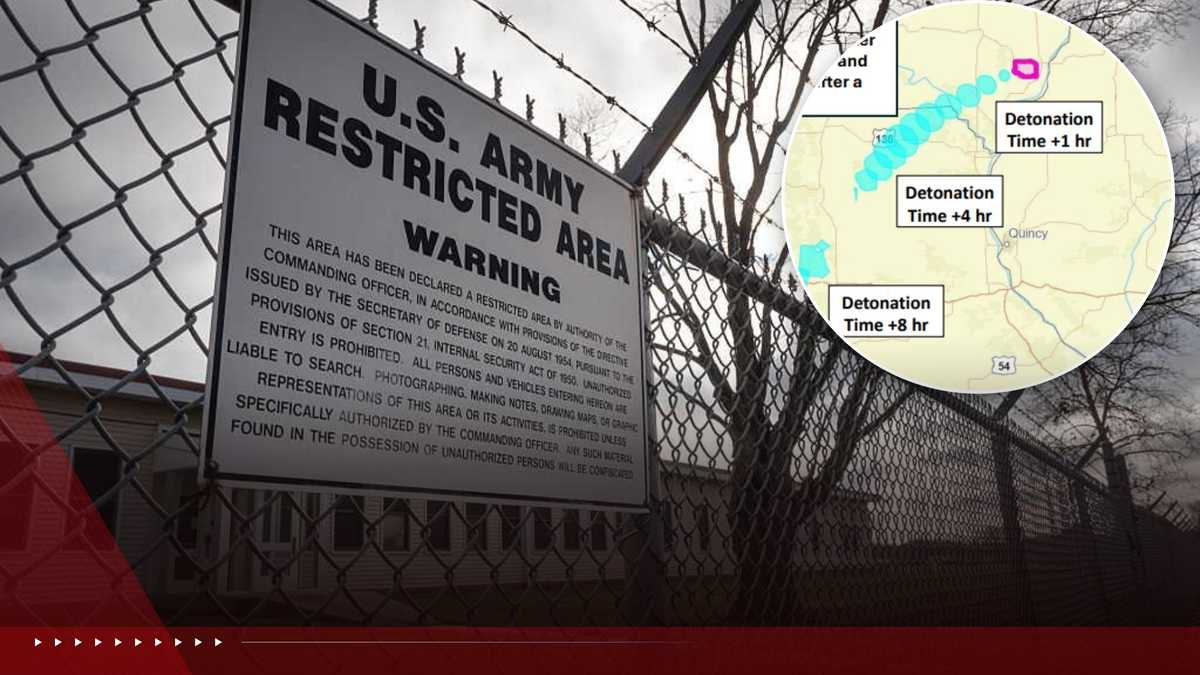
New dispersion modeling maps released ahead of a controlled military demolition show a potential dust plume from the Iowa Army Ammunition Plant drifting southwest across the state line into northern Missouri. The U.S. Army planned the controlled detonation of nearly five tons of degraded lead azide stored in dozens of barrels at the Middletown, Iowa facility.
Weather projections and military trajectory models indicate that prevailing wind patterns could push airborne particulate matter southwest toward rural Missouri communities. The projected dispersion corridor stretches from the plant near Burlington, Iowa, toward northeast Missouri counties, before narrowing as it moves further inland toward the Macon area.
State officials in Missouri, including the Department of Natural Resources and the Department of Health and Senior Services, announced they are closely monitoring the situation. Emergency management teams highlighted that the plant sits roughly 57 miles northeast of the Missouri border, providing substantial buffer distance as the plume disperses through the upper atmosphere.
The materials targeted for destruction consist of roughly 68 barrels containing approximately 10,000 pounds of lead azide that had degraded and recrystallized over several decades. Military explosive ordnance experts warned that the aging chemical compounds had become extremely shock-sensitive, creating an imminent risk of spontaneous detonation if moved or transported off-site.
The planned detonation followed days of intense legal wrangling and public controversy across the tri-state region. Environmental organizations and community groups sought emergency court injunctions to halt the blast, expressing concern over potential toxic lead exposure and airborne particulate fallout downwind from the installation.
Federal appeals judges ultimately cleared the military to proceed with the operation, finding that leaving the unstable explosive compounds in place posed a far greater and more unpredictable hazard to human safety. That judicial clearance cleared the path for defense contractors and Army specialists to execute the disposal under strictly monitored weather conditions.
To minimize environmental contamination, military engineers implemented extensive physical mitigation around the bunker site. The blast plan called for encasing the storage structure under thick layers of earth, sand-filled Hesco barriers, water saturation, and specialized high-expansion foam intended to capture lead particles before they could escape into the ambient air.
Public health authorities emphasized that projected concentrations of lead reaching Missouri airspace are anticipated to remain well within established federal safety thresholds. Despite those assurances, regional officials advised residents who have chronic respiratory conditions or sensitivities to remain aware of local air quality advisories.
The incident underscores broader ongoing challenges faced by the Department of Defense in safely managing and demilitarizing aging munitions stockpiles across the country. Military installations nationwide must balance the immediate mechanical danger of unstable propellants and detonators against the environmental consequences of outdoor open-air disposals.
Multi-agency monitoring teams, including representatives from the Environmental Protection Agency and state regulators, plan to maintain ground-level sensors along the projected plume corridor. Officials intend to analyze atmospheric data and soil samples following the blast to verify that lead levels remained safe and that mitigation barriers functioned as designed.
Primary source: Google News Missouri. Newzly rewrites and structures source reporting for clarity; verify critical details at the original.