world·Missouri·Des Moines County
Maps Show Lead Dust From Middletown Detonation Could Drift Into Missouri
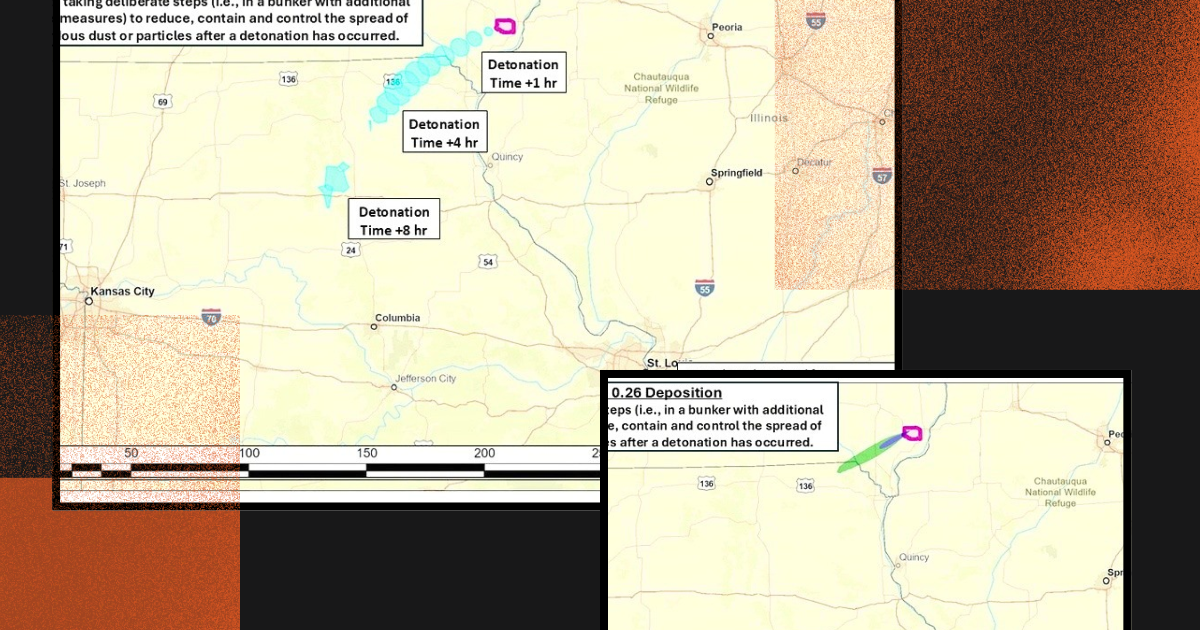
Updated atmospheric dispersion models released by the U.S. Army indicate that toxic lead dust from a controlled munitions detonation in Middletown, Iowa, could travel dozens of miles southwest across the state line into northern Missouri.
In this piece
Atmospheric dispersion modeling from the U.S. Army shows airborne lead dust from a planned munitions demolition in Middletown, Iowa, could drift southwest into…
Updated atmospheric dispersion maps released by military authorities show that a plume of toxic lead dust generated by a controlled munitions detonation at the Iowa Army Ammunition Plant in Middletown could travel southwest across state lines into northern Missouri. The revised environmental projections reflect recent shifts in regional weather patterns and prevailing wind conditions. Local and state emergency managers are closely tracking the projected trajectory to prepare communities situated downwind of the demolition site.
The planned operation in southeastern Iowa involves the controlled destruction of degraded stockpiles of lead azide, a highly sensitive chemical compound used as a primary explosive in detonators and military ordnance. Over time, aged chemical munitions can deteriorate and become dangerously unstable, creating a substantial hazard for facility personnel and surrounding areas. Military officials determined that a managed detonation under controlled atmospheric conditions was necessary to avert an unpredictable, spontaneous blast.
According to the updated modeling, airborne particulate matter and fine dust could remain suspended in the atmosphere for several hours following the blast, drifting toward communities in northeastern and north-central Missouri. While the heaviest surface-level deposition of dust is expected to settle closer to the Middletown facility, fine aerosols are capable of traveling up to one hundred miles under specific atmospheric conditions. Officials have emphasized that dispersion patterns depend heavily on wind speeds, thermal layers, and localized barometric shifts.
Environmental health specialists note that airborne lead particles represent a serious inhalation and contamination hazard, even at relatively modest concentrations. Lead is a potent heavy metal toxin capable of causing neurological impairments, cardiovascular issues, and acute respiratory irritation upon exposure. Vulnerable populations, including young children, pregnant women, and individuals with preexisting respiratory illnesses, face heightened physiological risks from airborne particulate settling.
In response to the updated dispersion trajectory, emergency management authorities and regional agencies issued updated precautionary guidance for residents residing along the projected fallout path. Communities within five miles of the detonation zone were placed on high alert and advised to prepare for potential evacuation orders if conditions deteriorate. Residents situated between five and twenty miles downwind were urged to shelter indoors, shut windows, and turn off external ventilation systems during the operational window.
Agricultural officials have also extended safety warnings to regional farmers, livestock producers, and food growers throughout southeastern Iowa and neighboring Missouri counties. State agricultural departments advised producers to shelter livestock in enclosed structures where feasible and cover outdoor water troughs and feed supplies to avoid heavy metal contamination. Agricultural specialists warned that surface dust deposits on open pastures could pose ingestion hazards for grazing cattle and other domestic animals.
To mitigate the spread of hazardous emissions, defense engineers and specialized disposal crews implemented physical barriers and containment mechanisms around the detonation bunkers. Crews deployed specialized blast suppression techniques, including thick layers of soil, water dousing curtains, ballistic gelatin blankets, and heavy containment foams designed to trap particulate matter at the source. Officials stated these protective measures aim to significantly suppress the initial thermal shockwave and curtail the total volume of particulates entering the upper airstream.
The transboundary nature of the projected plume prompted coordinated communication between environmental regulators and emergency agencies in both Iowa and Missouri. Officials in Missouri are coordinating with federal counterparts and regional monitoring networks to track ambient air quality readings in real time once the demolition proceeds. State environmental departments maintain that monitoring teams will deploy mobile sensors to track any discernible spikes in airborne lead concentrations as the plume moves southwest.
The execution of the detonation remains strictly contingent upon optimal atmospheric conditions that comply with stringent military and regulatory safety criteria. Technicians will continuously review updated meteorological radar scans and surface wind trajectories before initiating the final demolition countdown. Regional authorities have urged residents throughout the projected path to monitor official emergency broadcasts and adhere to all public health directives until post-detonation air sampling confirms that particulate levels have returned to normal baseline readings.
Primary source: Google News Missouri. Newzly rewrites and structures source reporting for clarity; verify critical details at the original.