Narwhal’s Legendary Tusk Conceals Opposing Internal Spirals, X-Ray Study Finds
Advanced 3D X-ray scans have revealed that the narwhal tusk contains two counter-twisting microscopic spirals, resolving a centuries-old mystery of how the Arctic whale's slender tooth withstands extreme torsional stress.
In this piece
An international team of scientists using advanced X-ray imaging has discovered that the narwhal's iconic tusk houses two intertwined microscopic spirals…
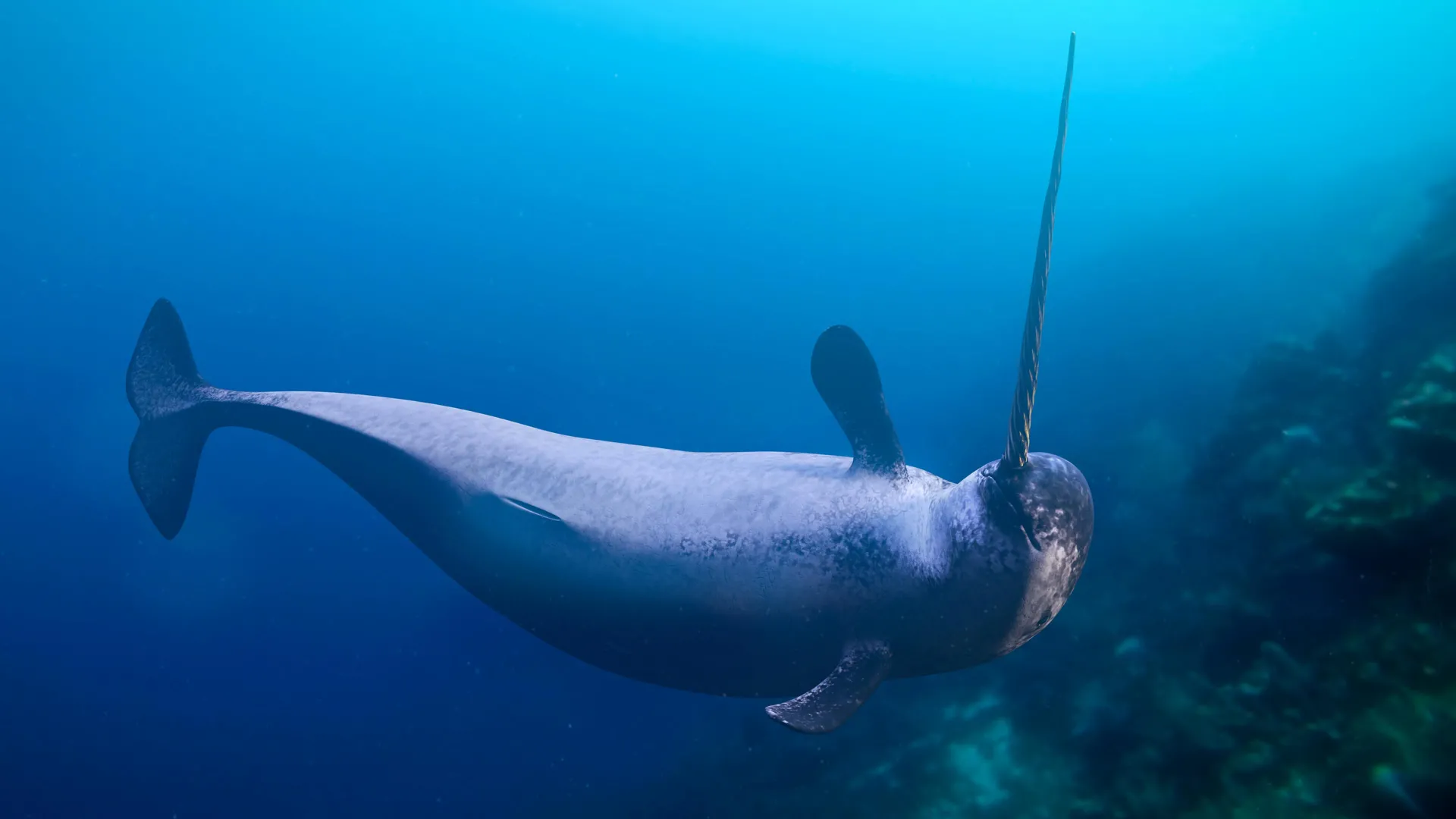
The narwhal's iconic spiral tusk, historically celebrated in folklore and traded across medieval Europe as a mythical unicorn horn, conceals a sophisticated structural feat of natural engineering. An international team of scientists utilizing advanced X-ray imaging technology has discovered that the Arctic whale's elongated appendage contains two opposing, microscopic spiral patterns intertwined within its internal architecture.
According to research detailing the findings, the tusk is not a uniform spiral as long assumed from its visible outer appearance. High-resolution three-dimensional scans revealed that the outer layer and the inner core twist in opposing directions. While the mineralized collagen fibrils in the outer cementum layer curve in a left-handed spiral, the underlying dentine twists inward in a right-handed orientation.
Researchers achieved the breakthrough using advanced synchrotron X-ray facilities and tensor tomography, techniques capable of mapping nanoscale fiber alignments without destroying delicate biological specimens. The non-invasive imaging allowed the scientific team to observe the directional flow of mineralized structural tissues through every cross-section of the tusk. Previous imaging methods had lacked the resolution required to distinguish the subtle architectural variation between these tightly bonded layers.
Biologically, the narwhal's tusk is actually an overgrown, erupted left canine tooth that projects through the upper lip, predominantly in males, and can grow several meters in length. Unlike typical mammalian teeth, which feature hard enamel on the outside protecting softer dentine inside, the narwhal tusk lacks enamel and possesses a flexible exterior. This unusual composition has puzzled evolutionary biologists and materials scientists for centuries.
The newly identified dual-spiral arrangement resolves a longstanding mechanical conundrum regarding how such a slender structure survives extreme physical strain. In the icy waters of the Arctic, narwhals routinely subject their extended tusks to heavy hydrodynamic drag, flexing, and accidental impacts. The counter-rotating microstructures serve as a biological counterbalance, distributing mechanical stress evenly across the tooth and preventing catastrophic fractures.
Beyond resisting external bending and twisting forces, the opposing helical design plays a crucial role in maintaining the tusk's remarkable axial stability during continuous growth. In conventional spiral growth patterns, continuous rotational stress would typically cause a structure to warp, curl, or deform over time. By counteracting the rotational torque generated by the outer layer with an equal and opposite internal twist, the tusk can extend straight forward over many years.
The discovery extends beyond marine biology, offering compelling insights for synthetic materials design and bio-inspired engineering. Modern engineers face persistent hurdles when developing long, slender composite materials that must endure multi-directional torsion without snapping or fatiguing. Emulating the narwhal's intertwined, multi-directional fibrous network could inspire resilient lightweight materials for aerospace components, medical implants, and flexible infrastructure.
The findings also contribute to the broader scientific understanding of Arctic wildlife adaptations in one of the planet's harshest environments. Narwhals inhabit remote polar regions where behavioral observation remains logistically challenging, making anatomical investigations essential to understanding their survival strategies. Unlocking the functional mechanics of their specialized tusks illustrates how evolutionary pressures optimize form and durability under intense physical demands.
Scientists anticipate that further investigations into the microstructural development of marine mammal dentition will clarify precisely when and how these opposing spirals emerge during early development. Additional studies utilizing comparative high-energy imaging may also reveal whether similar counter-twisting patterns exist in other animal tusks or natural load-bearing structures. As researchers continue analyzing the structural data, the Arctic whale's legendary tooth continues to redefine conventional understandings of natural structural mechanics.
Primary source: ScienceDaily. Newzly rewrites and structures source reporting for clarity; verify critical details at the original.