NASA Drone Test Demonstrates Navigation Technology for Planetary Landings
A drone carrying NASA’s SPLICE guidance, navigation and control payload completed simulated lunar landing maneuvers, demonstrating technology intended to help spacecraft autonomously reach safe landing sites.
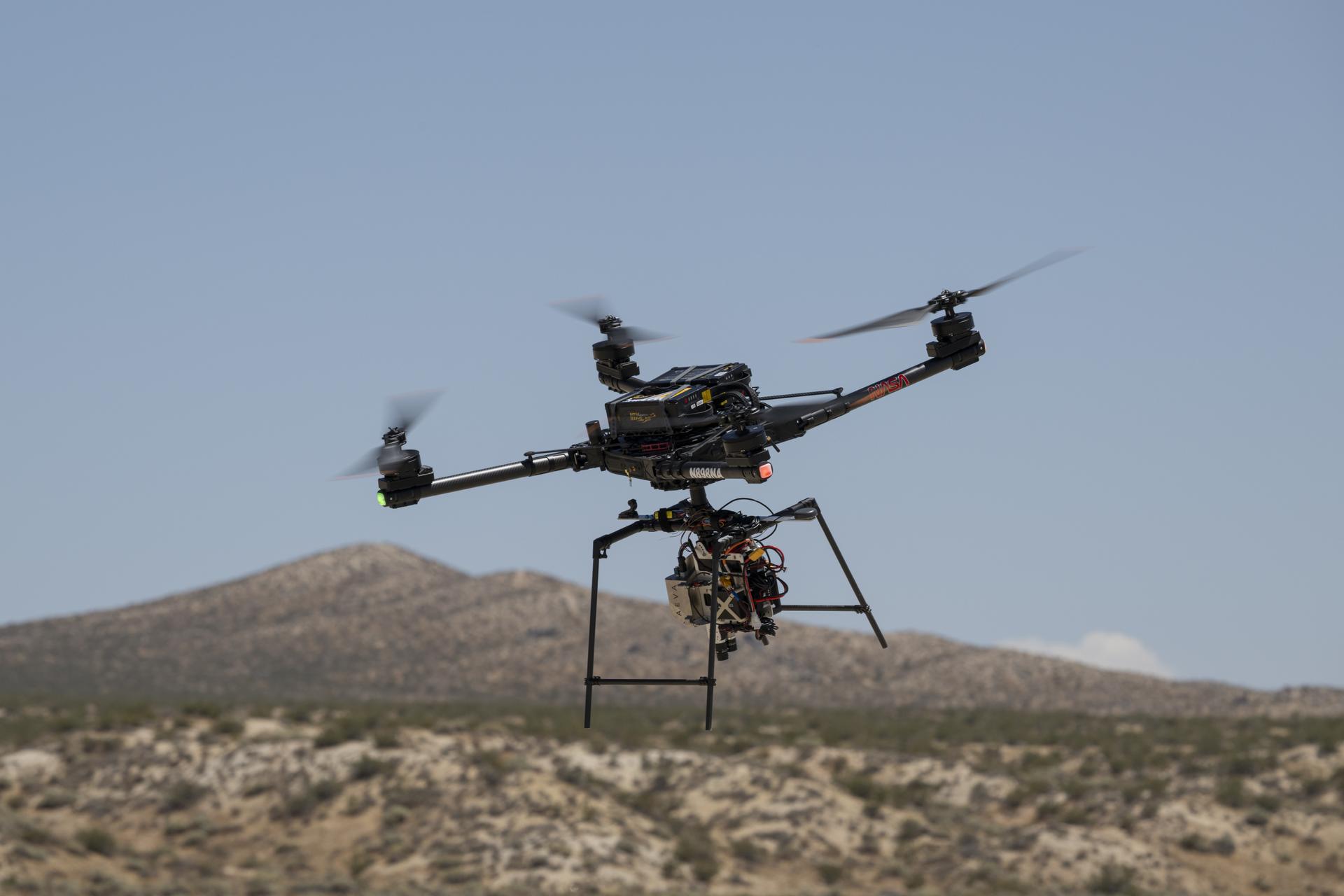
NASA has successfully demonstrated navigation technology intended to help spacecraft autonomously reach safe landing sites on the Moon and other planets. An Alta-X drone carrying the agency’s Safe and Precise Landing – Integrated Capabilities Evolution, or SPLICE, guidance, navigation and control payload completed simulated lunar descent and landing maneuvers on Aug. 27.
The flight used a drone to test capabilities being developed for planetary landings, rather than conducting an actual lunar descent. NASA described the demonstration as successful, providing an indication of progress toward its goal of helping spacecraft navigate to suitable landing locations without relying entirely on external direction.
SPLICE brings guidance, navigation and control into the landing experiment. Those functions address related but distinct parts of a descent: determining where a vehicle is, establishing where it needs to go and directing its movement toward that destination. The payload’s operation during simulated maneuvers was the focus of the reported flight.
The broader objective is not simply to reach a planetary surface, but to arrive at a place where a spacecraft can land safely. That distinction makes navigation an important part of landing technology development. A successful descent must connect a vehicle’s approach with its intended destination, rather than treat touchdown as an isolated event.
Using a drone allows researchers to exercise landing-related capabilities through flight maneuvers without sending the experimental payload to the Moon. However, a simulated lunar descent remains different from a planetary landing. The reported success should therefore be understood as a technology demonstration, not evidence that the system has already performed its intended role on another world.
The supplied NASA account does not include measurements of landing accuracy, details of the flight conditions or a breakdown of the payload’s performance. It also does not specify which individual capabilities were evaluated during each maneuver. Those omissions limit how precisely the demonstration can be assessed beyond the agency’s statement that it was completed successfully.
NASA’s stated ambition extends beyond lunar operations to landings on other planets, giving the experiment a broader purpose than a single destination. Still, the supplied account does not identify a spacecraft assignment or a timetable for operational use. The demonstration establishes a reported test outcome, rather than a commitment to deploy SPLICE on a particular mission.
The next question is how the demonstrated capabilities will translate into future spacecraft landing systems. NASA’s brief account does not outline follow-up testing or deployment milestones. For now, the Aug. 27 flight represents a successful simulated descent and landing demonstration in the agency’s effort to develop autonomous navigation for safer planetary arrivals.
Primary source: NASA Breaking News. Newzly rewrites and structures source reporting for clarity; verify critical details at the original.