NASA Features Gravitational Clash in the NGC 7771 Galaxy Group
NASA has spotlighted the NGC 7771 galaxy group, capturing a slow-motion cosmic battle roughly 200 million light-years away where multiple massive spiral systems are locked in destructive gravitational interactions.
In this piece
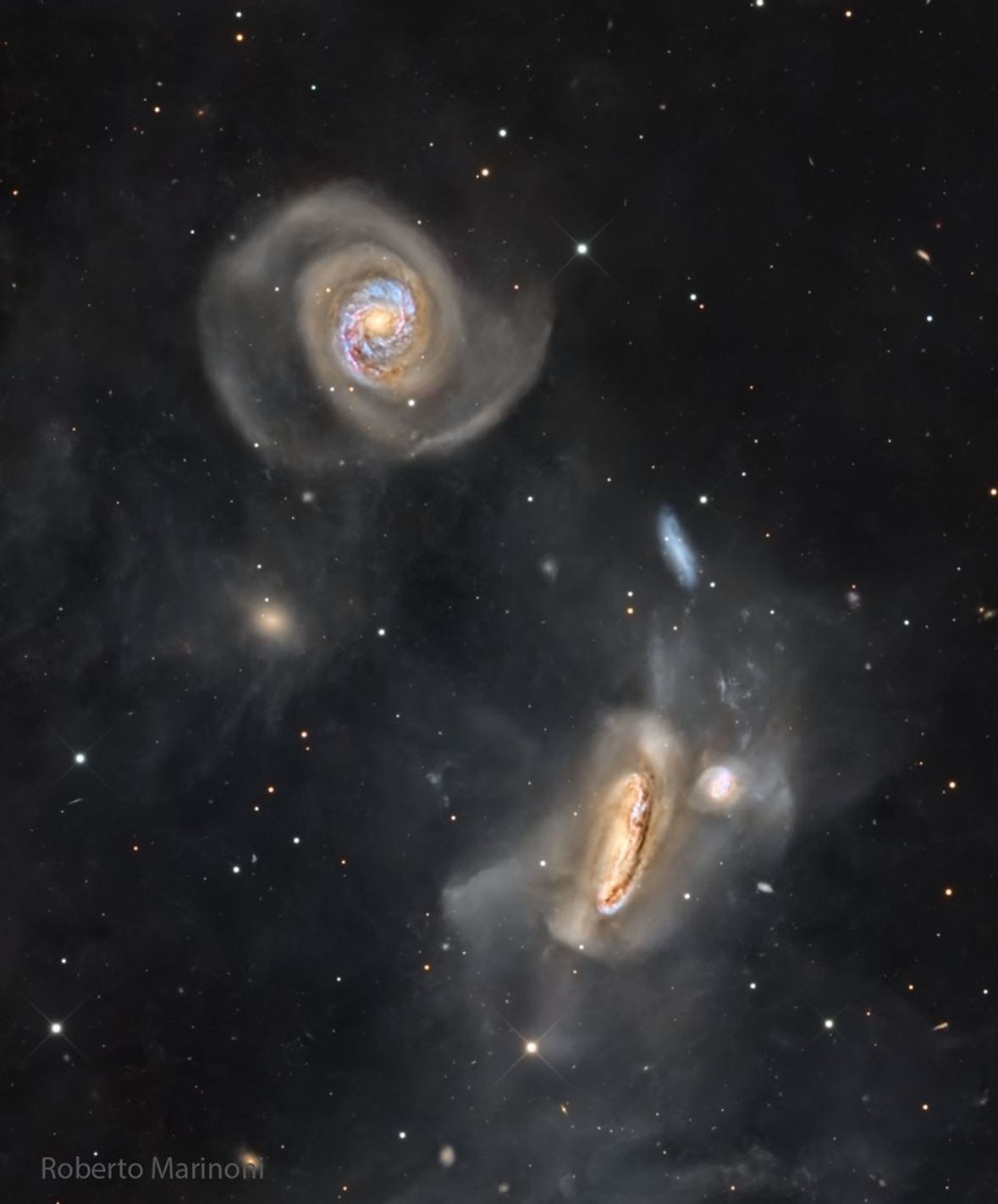
NASA’s Astronomy Picture of the Day has featured the interacting NGC 7771 galaxy group in the constellation Pegasus. Located 200 million light-years away, these…
NASA’s Astronomy Picture of the Day has highlighted a dramatic cosmic encounter in deep space, featuring the interacting NGC 7771 galaxy group. The detailed deep-sky portrait captures multiple spiral galaxies engaged in a protracted gravitational skirmish located roughly 200 million light-years from Earth. The featured scene illustrates the turbulent dynamics that shape cosmic structures across vast stretches of space and time.
Prominently showcased in the observation is the barred spiral galaxy NGC 7771 alongside the companion spiral NGC 7769 and smaller neighbor NGC 7770. Situated within the boundaries of the northern constellation Pegasus, these massive systems appear locked in an intricate orbital dance. Mutual gravitational pull has visibly warped their spiral architectures, pulling stellar material outward into expansive celestial ribbons.
Tidal interactions between close celestial neighbors are responsible for the dramatic distortion evident across the group. As the galaxies repeatedly swing past one another, intense gravitational forces drag out faint streams of stars and interstellar dust. These faint tidal tails and bridges serve as cosmic footprints, mapping previous close encounters that occurred over hundreds of millions of years.
The violent gravitational perturbation does more than reshape galactic silhouettes. Compressing vast clouds of interstellar gas and dust, these close passes trigger bursts of rapid star formation throughout the interacting disks. Clusters of brilliant young stars light up along the distorted spiral arms and tidal remnants, punctuating the ongoing structural upheaval.
Galaxy groups like the NGC 7771 collective are fundamental to understanding the hierarchical assembly of the universe. In modern cosmological models, small structures coalesce under gravity to form progressively larger galactic systems. While isolated galaxies can remain stable for eons, dense group environments make repeated gravitational collisions and disturbances inevitable.
Observations of actively interacting groups provide astronomers with empirical testing grounds to evaluate complex computational simulations. Because deep-space collisions unfold over timelines impossible to observe in human lifespans, capturing galaxies at various stages of disruption helps reconstruct the physics of galactic mergers. Researchers can examine how angular momentum, gas stripping, and stellar kinematics govern the transformation.
The chaotic processes underway in NGC 7771 also offer a compelling preview of the Milky Way’s distant future. Astronomers predict that our own galaxy will embark on a similar collision course with the neighboring Andromeda spiral in several billion years. Studying distant interacting systems allows scientists to anticipate how star systems reorganize during such monumental cosmic transitions.
Astrophysicists note that the gravitational skirmish within the NGC 7771 group will ultimately resolve in a complete merger. Over billions of years, orbital decay and dynamic friction will draw the colliding disks together, coalescing the distinct spiral galaxies into a single, massive elliptical galaxy. The delicate spiral arms visible today will disperse, replaced by a smooth, spheroidal distribution of aging stars.
For now, the system remains frozen in a dynamic stage of intermediate interaction, preserved for terrestrial observers through long-exposure astrophotography. Ongoing surveys and space-based observatories continue to monitor such interacting clusters to map the distribution of dark matter and gas kinematics driving their evolution. NASA’s presentation of the NGC 7771 group underscores how cosmic violence continually refines the architecture of the observable universe.
Primary source: NASA Breaking News. Newzly rewrites and structures source reporting for clarity; verify critical details at the original.