Volcanic Eruption Extends Iwo Jima Coastline in the Pacific
A shallow volcanic eruption off the southeast coast of Iwo Jima has reshaped the Pacific island's shoreline, though researchers caution that persistent ocean waves could quickly erode the newly formed landmass.
In this piece
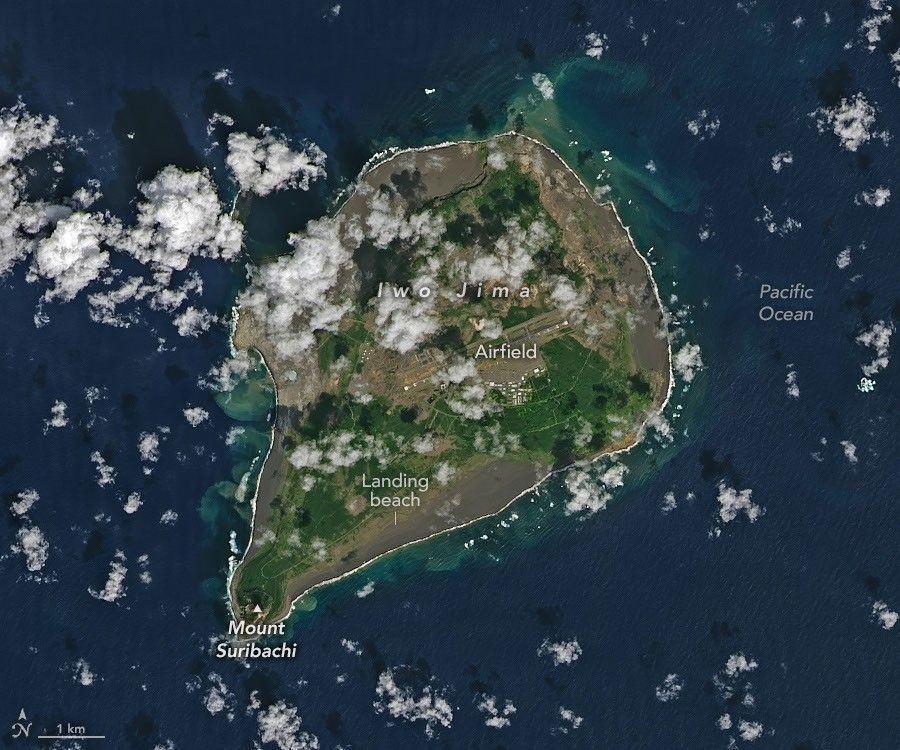
Satellite observations show a recent undersea volcanic eruption off Iwo Jima has visibly extended the island's coastline with fresh volcanic material.…
A recent volcanic eruption off the southeastern shore of Iwo Jima has significantly altered the island's perimeter, extending its coastline into the Pacific Ocean. Satellite tracking and aerial observations documented the sudden emergence of new land connected to the island's shoreline following sustained subsurface activity. While the event marks a dramatic geological transformation in the region, researchers emphasize that the durability of this newly deposited ground remains highly uncertain.
The emergence followed shallow underwater eruptive activity that propelled plumes of steam, gas, and fragmented rock above the water surface. As accumulating volcanic material breached the water line, it gradually consolidated into a visible land extension adjoining the existing beach. The sudden expansion has provided earth observation platforms with a striking view of immediate coast building in real time.
Iwo Jima, historically recognized for its rugged volcanic terrain and dark sands, lies along a heavily active tectonic zone within the Pacific basin. Submarine volcanoes and coastal vents throughout this maritime belt frequently exhibit fluctuating levels of unrest and hydrothermal activity. The island itself has a long documentation of episodic uplift and thermal venting, reflecting continuous geological movement beneath the seabed.
Volcanic formations created in shallow marine environments generally emerge from rapid accumulations of tephra, volcanic ash, and fragmented pumice. When magma interacts violently with cold seawater, explosive fragmentation occurs, generating vast volumes of loose debris. These pyroclastic deposits can assemble rapidly around an active vent, producing temporary islets or coastal aprons within days of sustained venting.
Earth observation satellites, including instruments operated by NASA and international partners, have provided regular surveillance of the dynamic shifts along the coast. High-resolution imagery captured the transition from discolored seawater and localized ocean boiling to an expanded terrestrial boundary. Comparing imagery across consecutive orbital passes has enabled geoscientists to trace the exact progression of the emerging terrain.
The formation offers scientists a valuable case study in the rapid genesis and vulnerability of oceanic volcanic landforms. Understanding how these features interact with maritime elements helps vulcanologists refine models of coastal evolution and offshore eruptive dynamics. Moreover, the phenomena supply crucial data on how rapidly emerging landforms influence local bathymetry and nearshore ocean currents.
A central question surrounding the new coastal strip is whether the accumulated material can withstand persistent exposure to Pacific waves. Landforms composed primarily of unconsolidated tephra and porous ash are exceptionally susceptible to mechanical erosion from ocean swells and seasonal storms. Without sustained lava flows to cap and weld the loose particles into solid rock, such formations often erode as rapidly as they appear.
Past eruptions throughout the Pacific volcanic arc have repeatedly demonstrated the temporary nature of many shallow marine landmasses. While some volcanic islands successfully solidify and endure for decades, numerous others have been degraded back beneath sea level within weeks or months after active venting ceases. Scientists note that coastal extensions face similar mechanical stress, where shifting currents continuously scour the newly introduced substrate.
In the coming months, remote sensing instruments will continue tracking the shoreline to measure rates of accretion or mechanical retreat. Researchers plan to evaluate whether subsequent thermal pulses supply denser lava or if oceanic swells will systematically carve away the newly established beach. For now, the expanded coast stands as a vivid reminder of the volatile forces actively shaping the planet's remote island chains.
Primary source: NASA Breaking News. Newzly rewrites and structures source reporting for clarity; verify critical details at the original.