NASA Highlights SPHEREx Mission's Ability to Peer Through Cosmic Dust
NASA's Astronomy Picture of the Day showcases how the SPHEREx space telescope uses near-infrared spectroscopy to pierce obscuring cosmic dust clouds, mapping celestial chemistry and the early universe across the entire sky.
In this piece
A feature on NASA's Astronomy Picture of the Day highlights the SPHEREx observatory's ability to peer through dense cosmic dust using near-infrared…
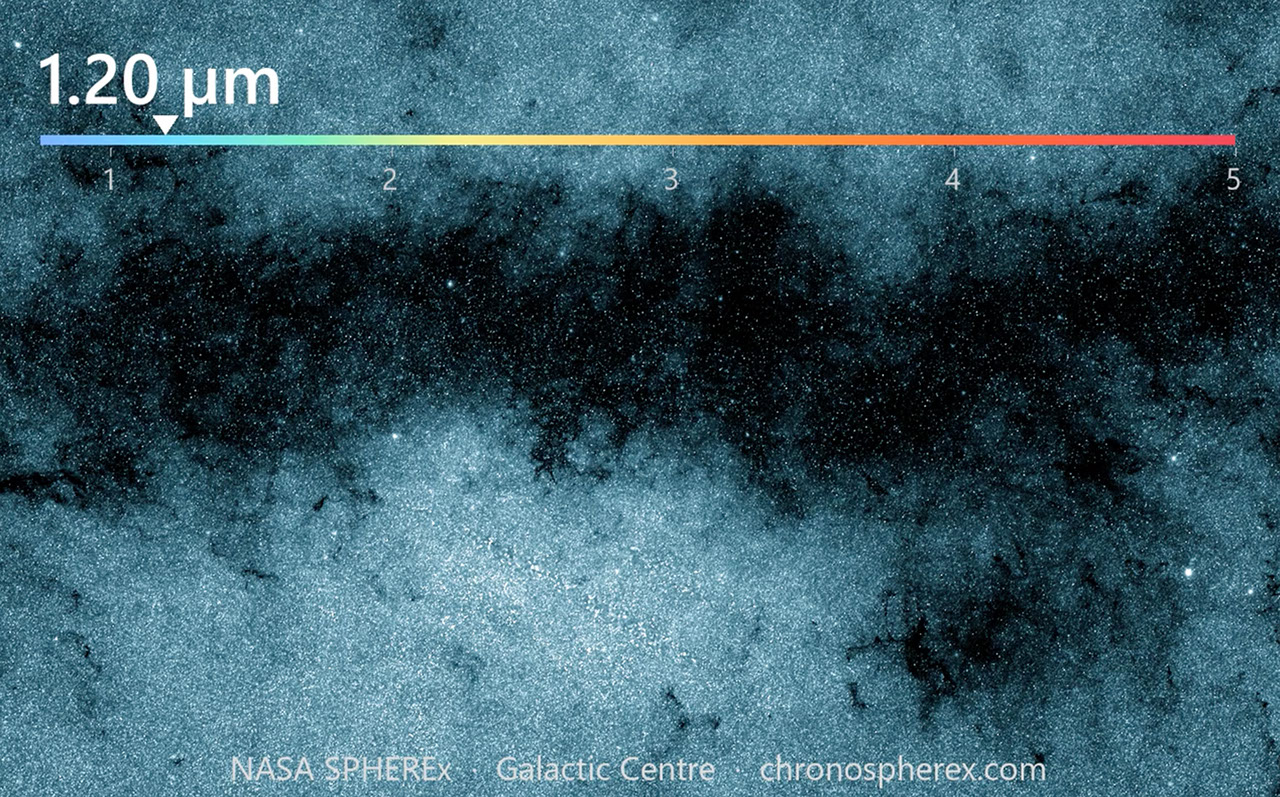
NASA's Astronomy Picture of the Day has featured a compelling visualization showcasing how the SPHEREx space telescope penetrates obscuring cosmic dust. The release underscores the observatory's capacity to reveal celestial environments that remain completely veiled in optical wavelengths, offering researchers an unobstructed view into star-forming clouds and distant galaxies.
Known formally as the Spectro-Photometer for the History of the Universe, Epoch of Reionization and Ices Explorer, SPHEREx is engineered to perform an all-sky survey in the near-infrared spectrum. Rather than focusing solely on narrow fields of view, the spacecraft systematically records wide swaths of the cosmos to compile comprehensive maps of the celestial sphere.
Interstellar dust composed of silicates, carbon compounds, and soot-like polycyclic aromatic hydrocarbons typically absorbs and scatters visible light, creating opaque barriers in deep space images. Near-infrared radiation has longer wavelengths that pass through these particulate clouds far more effectively, allowing instruments like SPHEREx to detect radiation originating from behind and within dense nebulae.
A defining feature of the SPHEREx mission is its specialized spectroscopic design, which disperses incoming light into 102 distinct near-infrared wavelengths. By cataloging these color bands for hundreds of millions of objects, the mission constructs a vast three-dimensional dataset that reveals the precise chemical composition and movement of cosmic material.
Within the Milky Way, the observatory focuses heavily on tracing biogenic compounds, particularly water ice, carbon monoxide, and carbon dioxide frozen onto dust grains. These interstellar ices represent the raw chemical ingredients necessary for prebiotic chemistry, providing vital clues about how habitable conditions develop in nascent planetary systems.
Beyond examining galactic chemistry, the telescope is tasked with investigating fundamental cosmology and the very beginnings of the universe. By mapping the three-dimensional distribution of more than 450 million galaxies, scientists hope to detect subtle statistical patterns left behind by cosmic inflation, the exponential expansion believed to have occurred moments after the Big Bang.
The survey also charts the collective glow emitted by all galaxies across cosmic time, known to astrophysicists as the extragalactic background light. Measuring fluctuations in this diffuse background helps astronomers quantify total star formation throughout universal history and trace the emergence of the first generation of galaxies.
NASA's Astronomy Picture of the Day service routinely features such scientific imagery to translate complex astrophysics research into engaging visual updates for the public. Authored and curated by professional astronomers, the educational platform contextualizes ongoing spacecraft operations and highlights the latest observational breakthroughs.
As SPHEREx continues its orbital observations, the resulting all-sky spectroscopic catalogs are poised to supply astronomers with rich targets for high-resolution follow-up studies using observatories such as the James Webb Space Telescope. Researchers expect the mission's wide-ranging datasets to serve as a cornerstone resource for galactic astrophysics and cosmological modeling over the coming decades.
Primary source: NASA Breaking News. Newzly rewrites and structures source reporting for clarity; verify critical details at the original.