NASA’s Voyager 1 Makes History by Reaching One Light-Day From Earth
NASA’s Voyager 1 has reached one light-day from Earth after more than 49 years of flight, placing humanity’s farthest spacecraft 16.1 billion miles away and requiring 24 hours for signals to travel home.
In this piece
NASA’s Voyager 1 probe has officially reached one light-day from Earth, traveling approximately 16.1 billion miles over more than 49 years in space. The…
NASA’s Voyager 1 spacecraft has crossed a historic threshold in deep space, officially reaching a distance of one light-day from Earth. The milestone marks the first time a human-made object has traveled far enough that a radio signal, moving at the speed of light, requires a full 24 hours to bridge the gap back home. Mission trackers confirmed the achievement occurred at 2:16 a.m. PST (5:16 a.m. EST) on Nov. 18.
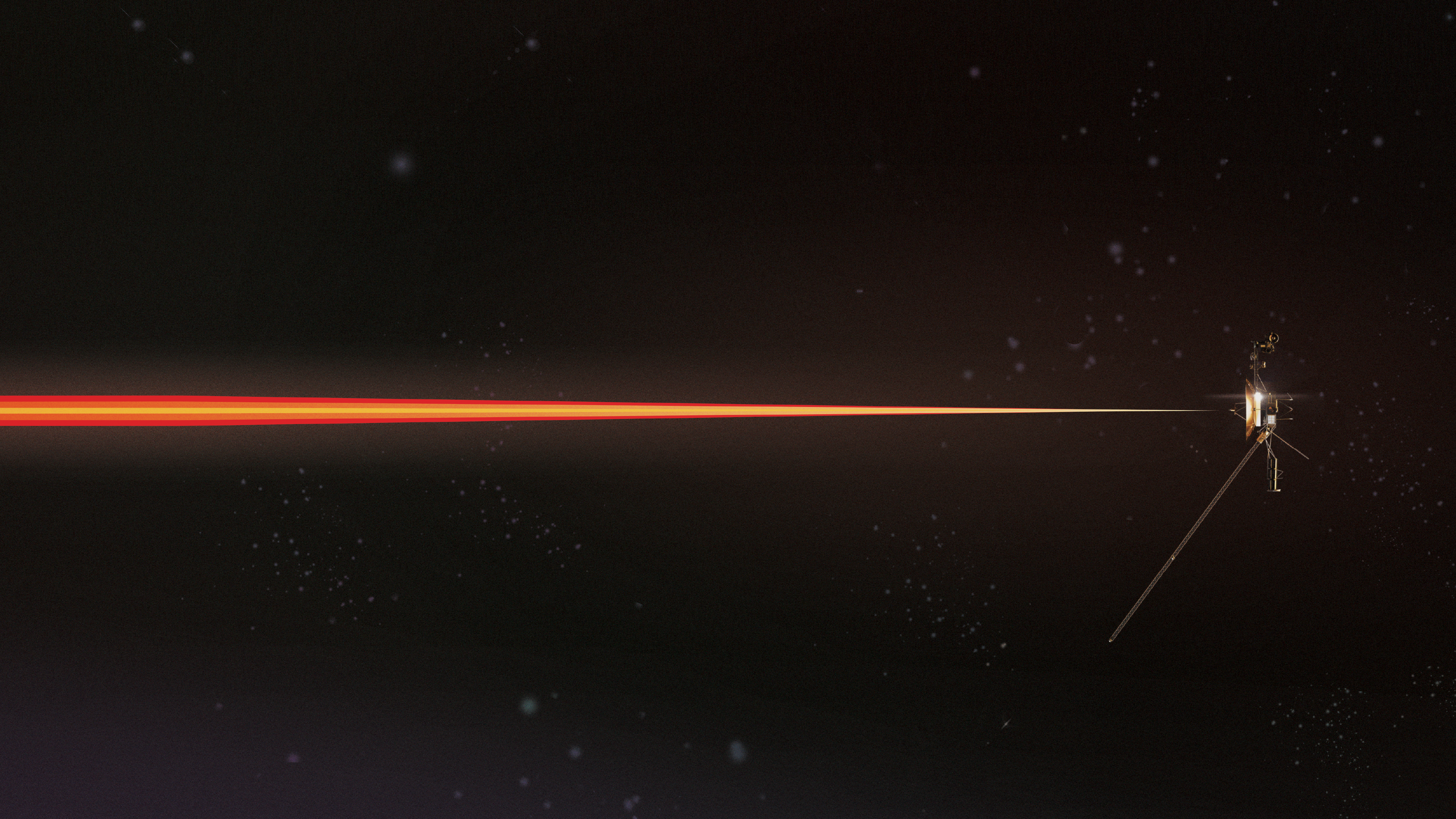
At one light-day out, the probe is located approximately 16.1 billion miles (25.9 billion kilometers) away from Earth. A light-day represents the total distance that light traverses through the vacuum of space over a 24-hour span. The distance underscores the unprecedented scope of the spacecraft's journey, which has continued unabated for more than 49 years.
The milestone carries practical implications for daily flight operations and science data collection. Because electromagnetic waves travel at the speed of light, any instruction dispatched to the spacecraft now takes an entire Earth day to arrive. Mission controllers must subsequently wait another 24 hours to receive a confirmation signal, creating a 48-hour round-trip communication loop.
Launched in late 1977, Voyager 1 originally set out on a primary mission to explore the outer giant planets of the solar system. Alongside its twin, Voyager 2, the spacecraft completed historic flybys of Jupiter and Saturn, returning groundbreaking imagery and measurements. After completing its planetary tour, the spacecraft continued outward, eventually crossing into the interstellar medium beyond the sun's protective bubble.
Voyager 1 officially entered interstellar space years ago, making it humanity’s pioneer probe in the space between the stars. In this remote expanse, the spacecraft continues to measure interstellar plasma, cosmic rays, and magnetic fields untamed by solar wind. Reaching one light-day emphasizes just how far into this uncharted environment the mission has ventured.
Sustaining operations across billions of miles and nearly five decades represents an exceptional engineering accomplishment. The probe relies on declining nuclear power sources and vintage 1970s hardware to keep its essential systems running. Over recent years, engineers have meticulously managed electrical power, turned off non-critical heaters, and adjusted thrusters to extend the vehicle's functional lifespan.
The achievement is widely seen as a landmark moment in human exploration and modern science. Traveling beyond one light-day places humanity's reach on an astronomical scale previously reserved only for observations of distant stars. For scientists and engineers, the probe remains an enduring testament to what long-duration robotic spaceflight can accomplish.
Moving forward, the Voyager team intends to keep operating Voyager 1 for as long as its remaining power and instrumentation allow. As the spacecraft glides deeper into the interstellar void, each additional mile will set a new endurance benchmark for deep-space exploration. Even after its final signal eventually fades, Voyager 1 will silently coast through the galaxy as an everlasting emissary of human curiosity.
Primary source: NASA Breaking News. Newzly rewrites and structures source reporting for clarity; verify critical details at the original.