NASA Showcases Star Birth in Dark Nebula Lynds 1251
NASA's Astronomy Picture of the Day has featured a striking deep-exposure view of Lynds 1251, a dense molecular cloud roughly 1,000 light-years away where hidden baby stars carve glowing cavities through interstellar dust.
In this piece
NASA highlighted the dense star-forming cloud Lynds 1251 as its Astronomy Picture of the Day on Monday, showcasing new details of stellar birth within the…
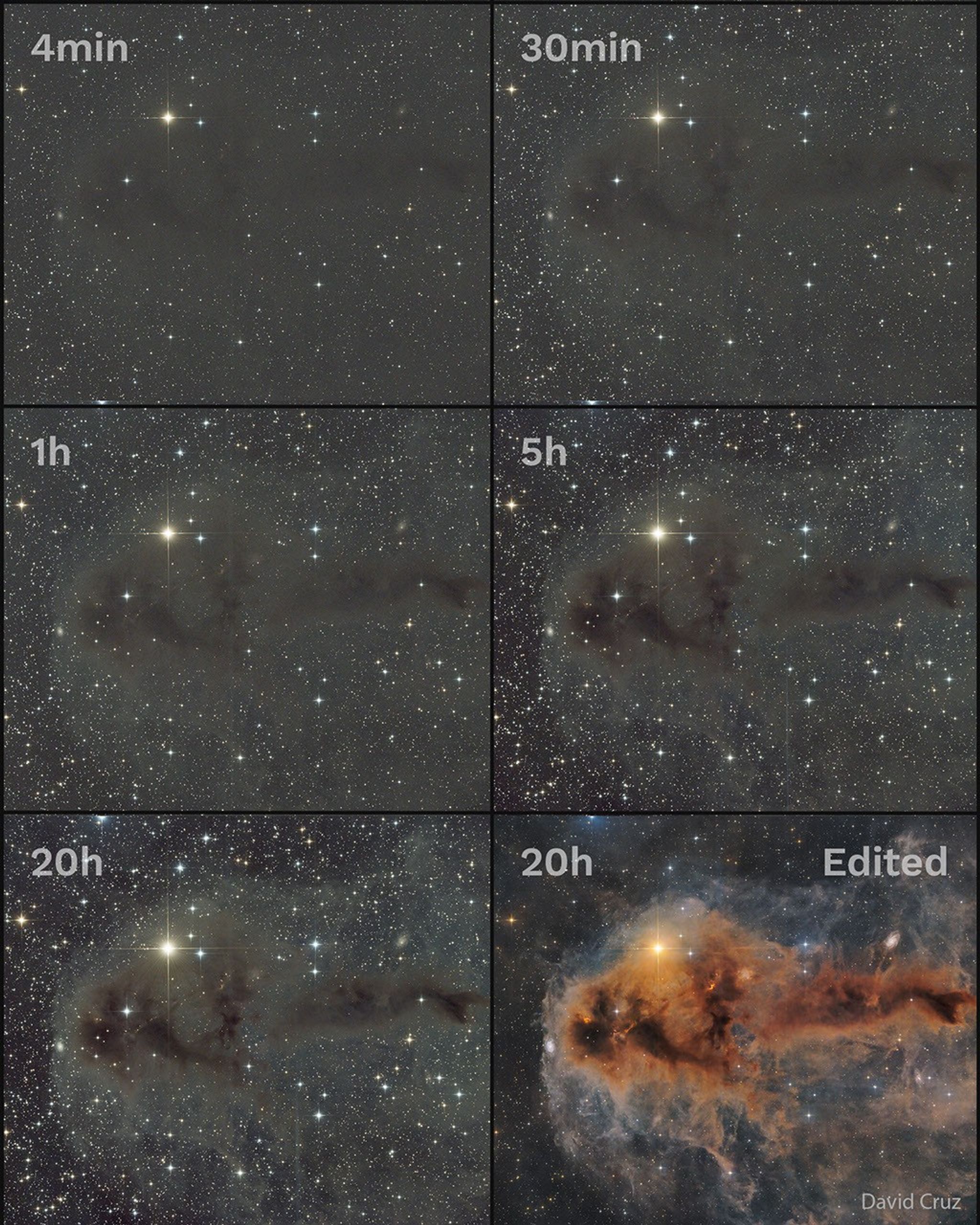
NASA’s Astronomy Picture of the Day on Monday spotlighted Lynds 1251, a sprawling molecular cloud laced with interstellar dust and active star-forming nurseries. Captured in a detailed deep-field exposure by astrophotographer David Cruz, the portrait illustrates how newborn stars emerge from seemingly opaque curtains of cosmic dust. The feature brings renewed public and scientific attention to the intricate processes shaping stellar birth in the nearby Milky Way.
Cataloged formally as LDN 1251 in Beverly Lynds’ classic 1962 catalog of dark nebulae, the celestial cloud sits approximately 1,000 light-years from Earth. It drifts just above the plane of the Milky Way within the Cepheus flare molecular cloud complex. While dark nebulae often appear as starless voids in modest telescopes, long-duration imaging reveals complex, sculpted dust structures illuminated by internal and ambient galactic radiation.
Among amateur and professional astronomers, the nebula is sometimes colloquially dubbed the Rotten Fish Nebula because of its winding, elongated silhouette against the surrounding starry sky. The dramatic appearance is caused by dense concentrations of interstellar dust grains that absorb and scatter visible light from background stars. Only deep exposures across multiple optical filters can pull faint reflection clouds and subtle dust gradients out of the darkness.
Far from being empty voids, clouds like Lynds 1251 harbor active pockets of star formation buried deep within their densest cores. As gravitational collapse pulls cold gas and dust together, young stellar objects begin generating powerful winds and bipolar energetic jets. When these high-speed outflows slam into the surrounding molecular material, they excite the gas into emitting a distinctive reddish glow, producing features known as Herbig-Haro objects.
Beyond revealing the turbulent dynamics of star formation, deep telescopic integration of the region exposes extraordinary depth across the field of view. Because the obscuring dust varies in density across the cloud, small windows of relative transparency allow light from the distant universe to filter through. In the deep background, remote galaxies millions of light-years away can be glimpsed as tiny, faint smudges resting far behind the local galactic dust.
The detailed presentation of LDN 1251 underscores the dramatic evolution of modern astronomical imaging over recent decades. Where early photographic plates recorded only the broad outlines of dark obscuring clouds, current charge-coupled detectors and narrow-band filters capture faint emission line signatures alongside delicate reflection nebulae. Astrophotographers pooling hours of targeted exposure time can now resolve filamentary structures once accessible only to major research observatories.
Molecular clouds like Lynds 1251 serve as natural laboratories for astrophysicists studying the initial conditions of stellar and planetary system development. Understanding how magnetic fields, turbulence, and radiation pressure interact within dense dust filaments helps theorists refine models of the stellar initial mass function. These cold environments represent the earliest stages of chemical evolution that eventually seed new solar systems with complex organic molecules.
Astronomers anticipate that space-based observatories and upcoming wide-area surveys will continue probing deep into LDN 1251 using infrared and submillimeter wavelengths. Telescopes equipped to penetrate dust veils will catalog newly formed protostars and measure accretion rates within the core. For observers worldwide, NASA’s daily showcase reinforces how the darkest corners of the night sky often harbor the most vigorous beginnings of cosmic life.
Primary source: NASA Breaking News. Newzly rewrites and structures source reporting for clarity; verify critical details at the original.