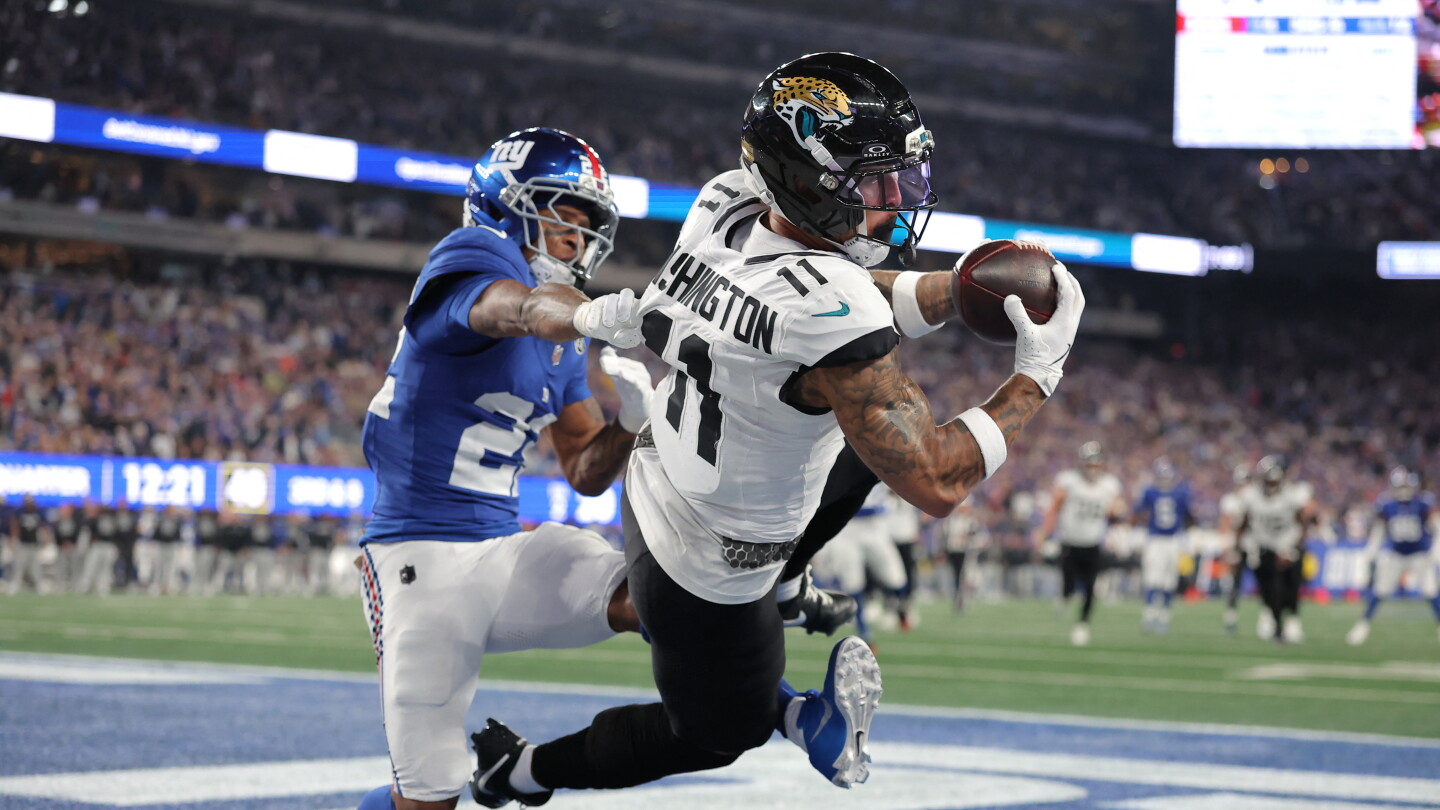
NFL says Parker Washington did not control the ball until he was out of bounds
The NFL has concluded that Parker Washington did not control the football until he was out of bounds, NBC Sports reported. The finding turns on when possession is established at the sideline.
In this piece
NBC Sports reported that the NFL determined Parker Washington did not control the ball until he was out of bounds. The league’s view focuses on the moment of…
The NFL has said that Parker Washington did not control the football until he was out of bounds, according to a report by NBC Sports. The league’s conclusion addresses a fundamental question in any disputed catch near the sideline: not simply whether the ball was in a receiver’s hands, but when control was established.
NBC Sports carried the league’s finding under a headline stating that Washington did not control the ball until he was out of bounds. The published account available here does not include a play-by-play description, a score, an opponent, or quoted remarks from Washington or game officials. Those details are not supplied in the source material and are not assumed here.
Under long-standing NFL catch standards, a receiver must control the ball, get two feet or another body part down in bounds, and complete the process of the catch. Contact with the sideline before that process is finished can turn an apparent reception into an incomplete pass. Control that arrives only after a player is out of bounds does not satisfy the in-bounds requirement.
Sideline plays are difficult because several events happen almost together. A receiver may reach, pin the ball, drag a foot, and cross the boundary within a fraction of a second. What looks secure on a standard broadcast angle can look unfinished on a tighter replay. The NFL’s statement, as reported, places the moment of control outside the field of play.
That distinction matters because fans, coaches, and players often judge a catch by the visual of the ball in the receiver’s hands. Replay review is narrower. Officials are asked to identify the first frame in which control exists and to compare that frame with the player’s position relative to the boundary. If control and an in-bounds touch do not overlap, the pass is incomplete.
Washington is the player named in the league’s finding. The report does not, in the material at hand, describe what he said afterward or whether the call was challenged, confirmed, or reversed on the field. Any account of his reaction, the down and distance, or the effect on a drive would go beyond what the source states.
Calls of this kind sit at the center of weekly debates about replay. The league has spent years refining how “control” and “the process of the catch” are explained to officials and to the public, in part because marginal sideline plays produce the sharpest disagreements. A determination that control came only out of bounds is one of the cleaner formulations the rulebook allows: the ball may have been secured, but not while the receiver was still in play.
The finding also illustrates the limit of a single camera. A side view can show a foot on the white line while an end-zone or high angle shows the ball still moving. Reviewers are expected to use the available angles together. NBC Sports’ report attributes the conclusion to the NFL; it does not reproduce the video or the internal notes behind that conclusion.
For Washington, the practical result of such a ruling is that the play is treated as if the catch was not completed in bounds. Without additional reporting, it is not possible to say how the series continued, whether points followed, or how the call was discussed inside either locker room.
What comes next is the ordinary path for a disputed catch once the league has spoken. Broadcast partners such as NBC Sports carry the explanation, and clubs and viewers measure it against the pictures they saw. If the NFL expands on the ruling, that further comment would be the place to look for the precise frame, the review process, and any competitive consequence. Until then, the established point is the one the league has already made: control, in its judgment, did not exist until Washington was out of bounds.
Primary source: Google News Washington. Newzly rewrites and structures source reporting for clarity; verify critical details at the original.