Norway and Finland leaders hold rare call with Putin
Finnish President Alexander Stubb and Norwegian Prime Minister Jonas Gahr Støre spoke directly with Vladimir Putin on Tuesday, marking the first such contact between a European allied leader and the Kremlin chief in over a year.
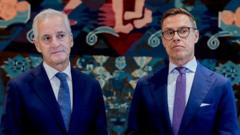
Finnish President Alexander Stubb and Norwegian Prime Minister Jonas Gahr Støre spoke by telephone with Russian President Vladimir Putin on Tuesday, in what both Nordic governments described as a frank and substantive discussion focused on ending Russia's war against Ukraine. The call, conducted from Helsinki, marks the first direct communication between Putin and a leader from one of Ukraine's European backers since French President Emmanuel Macron's phone call with the Kremlin in July 2025.
Both leaders stressed that their nations' military support for Ukraine would continue unabated, even as they pushed for a diplomatic opening. Stubb said the conversation was shaped by geography as much as strategy. "We are neighbouring countries to Russia," he said. "The outcome of this war will have a direct impact on our and the broader European security. Ending the war requires direct discussions."
Supportre struck a similar note, citing the human toll of the conflict. "The war comes with enormous human and material costs," he said, adding that the two leaders had stressed to Putin "the importance of de-escalation" during the call.
The Kremlin confirmed the conversation and said the three leaders also discussed security and stability in the Baltic Sea and the High North. According to Moscow's readout, Putin raised Russia's "legitimate interests" as a precondition for any settlement, a formulation Western governments have consistently rejected as a demand for territorial concessions. All three leaders agreed to maintain direct contact going forward, the Kremlin added.
Tuesday's call was framed by Helsinki and Oslo as a follow-up to an October 20 meeting in Oslo, where Stubb and Støre met with U.S. special envoy Steve Witkoff and Ukrainian President Volodymyr Zelensky. That gathering was aimed at repairing strained relations between Kyiv and Washington and charting a new diplomatic path out of the war. The Nordic leaders said the Putin call was conducted in consultation with Ukraine.
Zelensky responded to news of the call with a pointed message directed at Moscow. "Russia must stop dragging out the war," the Ukrainian president said, signalling Kyiv's ongoing frustration with the pace of any potential negotiations.
Not all European capitals were supportive of the outreach. Danish Prime Minister Mette Frederiksen publicly criticised the initiative as uncoordinated, reflecting the broader tension within Europe over how — and whether — to engage Putin directly while the fighting continues.
Both Finland and Norway share land borders with Russia and have been among the most active European donors of military aid to Ukraine since the full-scale invasion began in February 2022. Finland joined NATO in April 2023, making it one of Moscow's newest formal adversaries in the alliance. Norway has been a NATO member since the alliance's founding in 1949. Their willingness to open a direct channel with Putin is therefore seen as a significant diplomatic signal.
The call comes ahead of planned peace-focused talks in Abu Dhabi in early November, where a Russian delegation is expected to participate. The Abu Dhabi meetings represent one of the more concrete diplomatic developments in months, and Tuesday's phone call appears designed to lay groundwork — or at minimum test Moscow's seriousness — before those talks begin.
Whether the conversation will translate into any measurable shift in Russia's position remains unclear. European officials and analysts have long warned that Putin has used pauses in diplomacy to consolidate battlefield positions rather than move toward genuine negotiations. The Nordic leaders acknowledged the difficulty of the path ahead but argued that direct dialogue, however uncomfortable, is a necessary part of ending the war.
Primary source: BBC World. Newzly rewrites and structures source reporting for clarity; verify critical details at the original.