Odisha Records Rs 2,103 Crore in Cigarette Sales, Yielding Rs 319.54 Crore in SGST for FY26
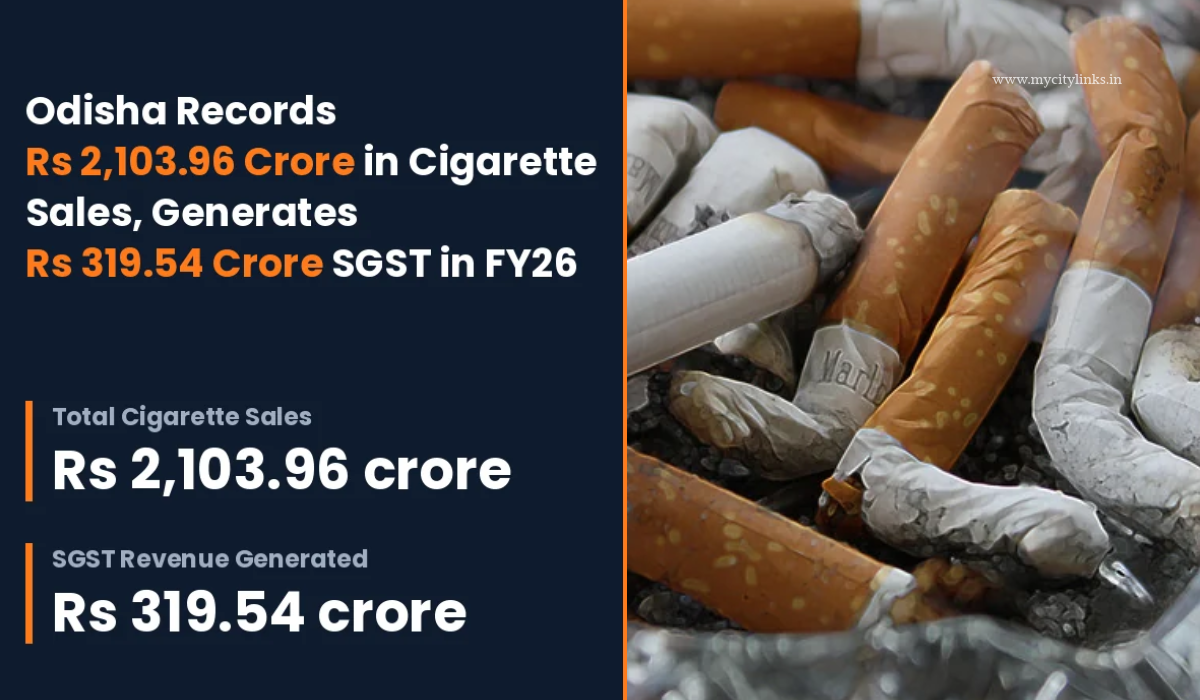
Odisha recorded over Rs 2,103 crore in cigarette sales during the 2025–26 fiscal year, yielding Rs 319.54 crore in state GST, according to data tabled in the state assembly by Chief Minister Mohan Charan Majhi.
In this piece
Cigarette sales in Odisha reached Rs 2,103.96 crore in financial year 2025–26, generating Rs 319.54 crore in State Goods and Services Tax revenue. Chief…
Odisha recorded a total taxable value of Rs 2,103.96 crore in cigarette sales during the 2025–26 financial year, according to official data presented in the Odisha Legislative Assembly. The substantial turnover in manufactured tobacco products generated Rs 319.54 crore in State Goods and Services Tax for the state exchequer. The figures were formally placed on record by Chief Minister Mohan Charan Majhi in a written response to legislative inquiries.
The disclosure came during legislative proceedings in response to specific questions tabled by Sonepur lawmaker Niranjan Pujari regarding tobacco consumption and associated tax collections. The state government submitted detailed accounting figures covering sales and tax yields for products categorized under Harmonized System of Nomenclature code 2402, which governs cigarettes and related manufactured tobacco items.
According to the detailed breakdown tabled in the assembly, the exact taxable value of cigarette transactions reached Rs 2,103,96,86,686 across the state during the fiscal period. From this commercial volume, the state government realized an exact revenue of Rs 3,19,54,13,042 under its State Goods and Services Tax ledger.
In his submission, Chief Minister Majhi highlighted significant structural modifications in the tax architecture governing cigarettes following national consensus at the Goods and Services Tax Council. Acting on key recommendations adopted during the 56th GST Council meeting, authorities overhauled the indirect tax regime for cigarettes effective February 1, 2026. The overhaul was designed to adjust national tax slabs while preserving critical revenue flows for state administrations.
Under the restructured framework, the total GST levy on cigarettes was set at 40 percent, split evenly between a 20 percent State GST and a 20 percent Central GST component. Prior to this revision, cigarettes attracted an indirect tax rate of 28 percent, comprising 14 percent SGST and 14 percent CGST, alongside a GST Compensation Cess. With the transition to the 40 percent rate, the compensation cess component was reduced to zero.
The Chief Minister also outlined the administrative mechanism used to levy and collect indirect taxes on manufactured cigarettes. Under the prevailing rules, tax liability is linked directly to the Retail Sale Price marked on each cigarette pack. The revenue is primarily assessed and collected from manufacturers at the initial stage of factory dispatch, establishing tighter oversight across distribution networks.
Beyond the dual GST structure, cigarettes remain subject to statutory central duties levied independently by the Union government. The central administration continues to collect Central Excise Duty as well as the National Calamity Contingent Duty under existing federal tax provisions. These concurrent levies ensure that tobacco products remain among the most comprehensively taxed consumer commodities in the country.
The disclosure highlights the significant role sin goods continue to play in financing Odisha's public budget. The receipt of nearly Rs 320 crore in state GST offers vital resources to support infrastructure priorities, public healthcare initiatives, and social welfare commitments across the state. At the same time, the substantial sales volume points to sustained consumer demand despite stringent statutory taxation and ongoing public health advisories.
Looking ahead, state revenue authorities are tracking the fiscal impact of the simplified 40 percent GST rate as collections stabilize across subsequent reporting periods. Finance officials expect the revised single-tier structure and point-of-manufacture collections to provide greater predictability for the state exchequer. Future legislative sessions are likely to monitor whether the elevated headline tax rate influences retail consumption patterns or further bolsters state tax realization.
Primary source: Google News Odisha. Newzly rewrites and structures source reporting for clarity; verify critical details at the original.