Pakistan's First Astronaut Launches to China's Tiangong Space Station
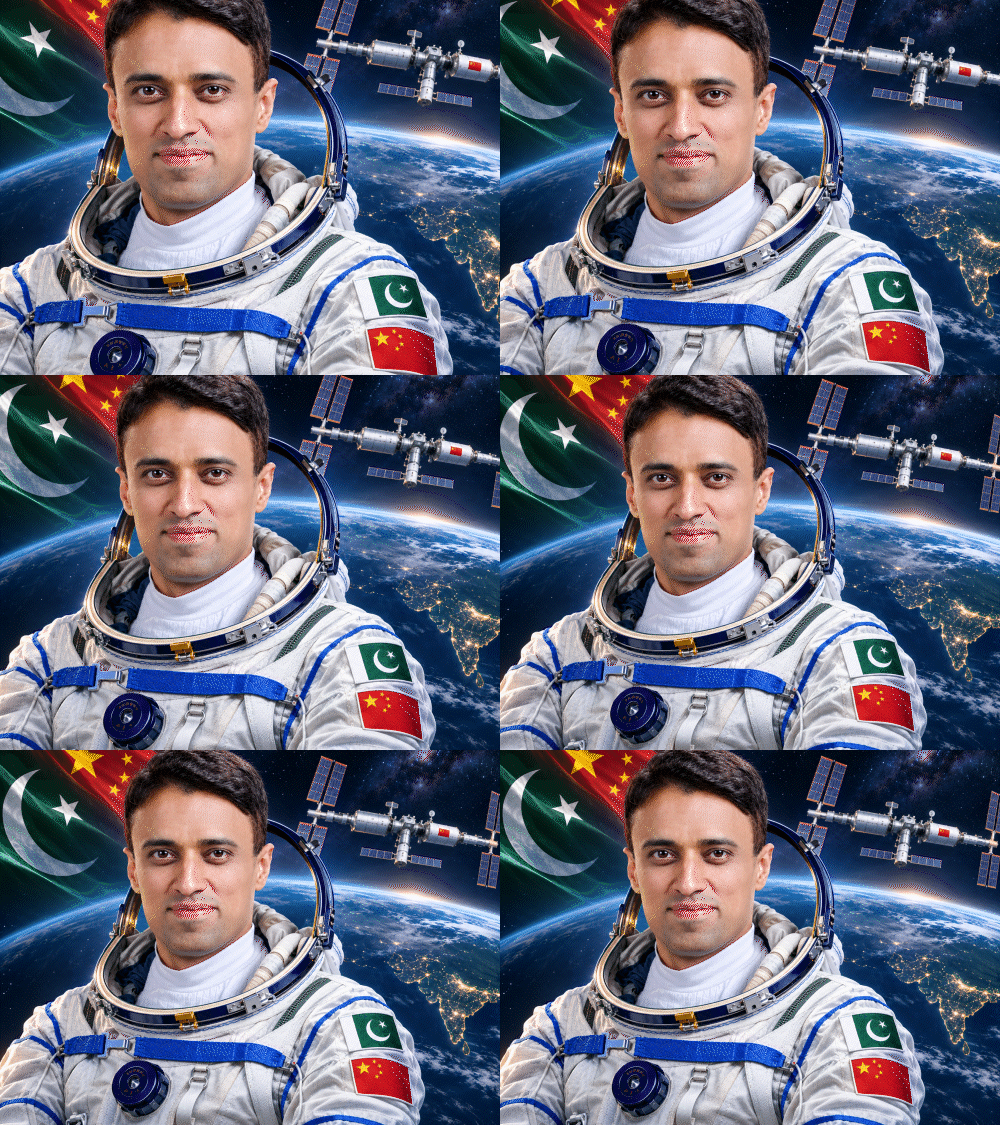
Pakistani astronaut Muhammad Zeeshan Ali has reached China's Tiangong space station on the Shenzhou-24 mission, marking Pakistan's first spaceflight and the station's first foreign guest.
In this piece
Pakistan's first astronaut, Muhammad Zeeshan Ali, has arrived at China's Tiangong space station aboard the Shenzhou-24 spacecraft. During his weeklong mission,…
Pakistan has achieved a significant milestone in its aerospace history as its first astronaut, Muhammad Zeeshan Ali, journeyed into orbit aboard China's Shenzhou-24 mission. The spacecraft successfully carried the crew to China's Tiangong space station, marking the first time a Pakistani citizen has traveled into space. The milestone also establishes Ali as the first foreign national and non-Chinese crew member to board China's permanently crewed orbital laboratory.
Ali, a seasoned Pakistan Air Force pilot selected and trained as a specialized payload specialist, launched alongside veteran Chinese astronauts Tang Hongbo and Wu Yi. The joint flight represents the culmination of years of technical dialogue and bilateral agreements between Islamabad and Beijing aimed at expanding human spaceflight collaboration. The launch proceeded smoothly from the Jiuquan Satellite Launch Center, placing the crew into orbit on schedule.
To ensure an inclusive living and working environment aboard the orbital outpost, the Astronaut Centre of China introduced comprehensive cultural and dietary accommodations. Mission planners provided specially packaged halal space rations to meet Ali's dietary requirements throughout his orbital tenure. Operating protocols and equipment manuals aboard the station were also formatted in both English and Chinese to facilitate seamless technical coordination among the international crew.
Ali's operational schedule on the Tiangong complex centers on conducting four core scientific experiments developed through close bilateral collaboration. The selected payloads focus on life-support microbiology, agricultural biotechnology, and advanced material performance under microgravity conditions. Each scientific investigation was designed to leverage the unique orbital environment to produce data that cannot be replicated in terrestrial laboratories.
One of the primary biological studies involves indigenous cyanobacteria strains gathered from Pakistan to test their metabolic viability in microgravity. Scientific teams are monitoring how these photosynthetic microorganisms process carbon dioxide and generate breathable oxygen outside Earth's atmosphere. Researchers believe the findings could contribute critical insights toward developing closed-loop biological life-support systems required for future extended space exploration missions.
A second biological investigation focuses on agricultural resilience and global food security through an experiment led in partnership with the University of Agriculture Faisalabad. Researchers dispatched packages of quinoa seeds into orbit to observe how prolonged exposure to high-radiation environments and weightlessness affects germination, genetic mutation, and seed longevity. Scientists hope the resulting data will help develop hardier, climate-resilient crop varieties capable of thriving in harsh arid regions.
In the domain of physical sciences, the mission includes tests on novel structural materials to evaluate their stability against orbital degradation. The experiments examine the mechanical characteristics of graphene-based composite structures and self-healing carbon fiber formulations subjected to vacuum and temperature extremes. Insights gained from these tests could assist aerospace engineers in manufacturing lighter, more durable shielding and structural components for future spacecraft.
The mission underscores the strategic depth of China-Pakistan aerospace relations, which have grown steadily over recent decades. While China has actively promoted the Tiangong station as an open platform for international scientific cooperation, Pakistan has deepened its partnership with Beijing to access cutting-edge orbital infrastructure. The joint endeavor reflects broader geopolitical and scientific alignments between the two neighboring countries.
Following the completion of the planned scientific protocols, Ali will conclude his short-duration stay of approximately one week aboard the space station. Mission personnel will prepare for spacecraft undocking, atmospheric reentry, and recovery operations in accordance with standard return procedures. Ground teams and scientific panels in both nations are preparing to receive the returned experimental samples for in-depth laboratory analysis and subsequent joint publications.
Primary source: Divya Bhaskar International. Newzly rewrites and structures source reporting for clarity; verify critical details at the original.