Residents Begin Leaving Devastated Frontline Town of Oleshky as Evacuation Corridor Opens
Civilians have begun evacuating the devastated, Russian-occupied town of Oleshky after a temporary humanitarian corridor opened, though several hundred residents reportedly remain behind without basic utilities.
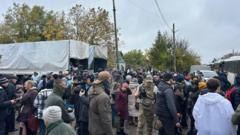
Civilians have begun departing the heavily damaged, Russian-occupied town of Oleshky following the opening of a negotiated evacuation corridor. The operation offers a rare route out for residents who have endured months of intense frontline combat and isolation in southern Ukraine. Aid workers and local monitors reported that convoys have begun transporting civilians away from the battered settlement.
Despite the opening of safe passage, several hundred people are understood to have chosen to remain in Oleshky. Many of those staying behind are elderly or caring for vulnerable relatives who cannot easily undertake the arduous journey. For those who stayed, conditions remain exceptionally harsh as the town continues to suffer without dependable running water, electricity, or gas supplies.
The humanitarian crisis in Oleshky has grown increasingly severe as frontline hostilities have severed essential supply networks. Basic necessities including commercial food deliveries, critical prescription medicines, and heating fuel have been almost entirely cut off for prolonged periods. Community members who remain have largely relied on dwindling stockpiles, local wells, and precarious mutual assistance networks to survive.
Oleshky sits on the Russian-occupied east bank of the Dnipro River in the Kherson region, directly across from Ukrainian-controlled territory. Following Ukraine's liberation of Kherson city on the western bank in late 2022, the river became one of the most heavily fortified and actively contested front lines of the war. As a consequence, Oleshky has remained under sustained artillery shelling and pervasive aerial drone surveillance.
The town has suffered repeated catastrophic shocks throughout the conflict, including severe inundation in mid-2023 following the destruction of the Kakhovka hydroelectric dam downstream. Vast areas of Oleshky were submerged under floodwaters, ruining housing stocks, contaminating fresh groundwater, and destroying vital local infrastructure. That devastation compounded the existing wartime destruction, leaving residential areas in a state of prolonged ruin.
The establishment of the current humanitarian corridor required delicate logistical coordination and localized ceasefires to ensure civilian safety. Specialist demining teams were deployed along agreed transit paths to clear unexploded ordnance and explosive remnants of war before civilian vehicles could pass. Convoy operators were organized to deliver emergency humanitarian supplies into the town while carrying evacuees out.
The routing of departing civilians remains a subject of intense focus and concern among humanitarian organizations and Ukrainian officials. Evacuees seeking passage to Ukrainian-held territory often face complex, indirect transit corridors that traverse Russian-controlled areas and neighboring states. Ensuring safe transit without detention or forced diversion remains a paramount operational challenge for international observers tracking the movements.
The localized opening underscores the extraordinary difficulty of establishing humanitarian access across active frontlines in the conflict. Successful pauses in hostilities are rare along the southern axis, where opposing forces remain locked in positional warfare across the Dnipro riverbed. Even temporary corridors provide vital relief, though they rarely indicate any broader political settlement or lasting cessation of fighting.
Looking ahead, relief agencies and monitoring groups will closely observe whether the evacuation window remains open long enough to extract all willing residents. Continuing artillery duels and weather conditions could quickly disrupt the fragile transport arrangements at any moment. For the hundreds of residents who remain inside Oleshky, surviving the coming weeks will depend on whether emergency supply lines can remain functional amid ongoing military tension.
Primary source: BBC World. Newzly rewrites and structures source reporting for clarity; verify critical details at the original.