world·Virginia·Arlington County
Second Federal Judge Blocks Trump's Proposed Arch Near Arlington National Cemetery
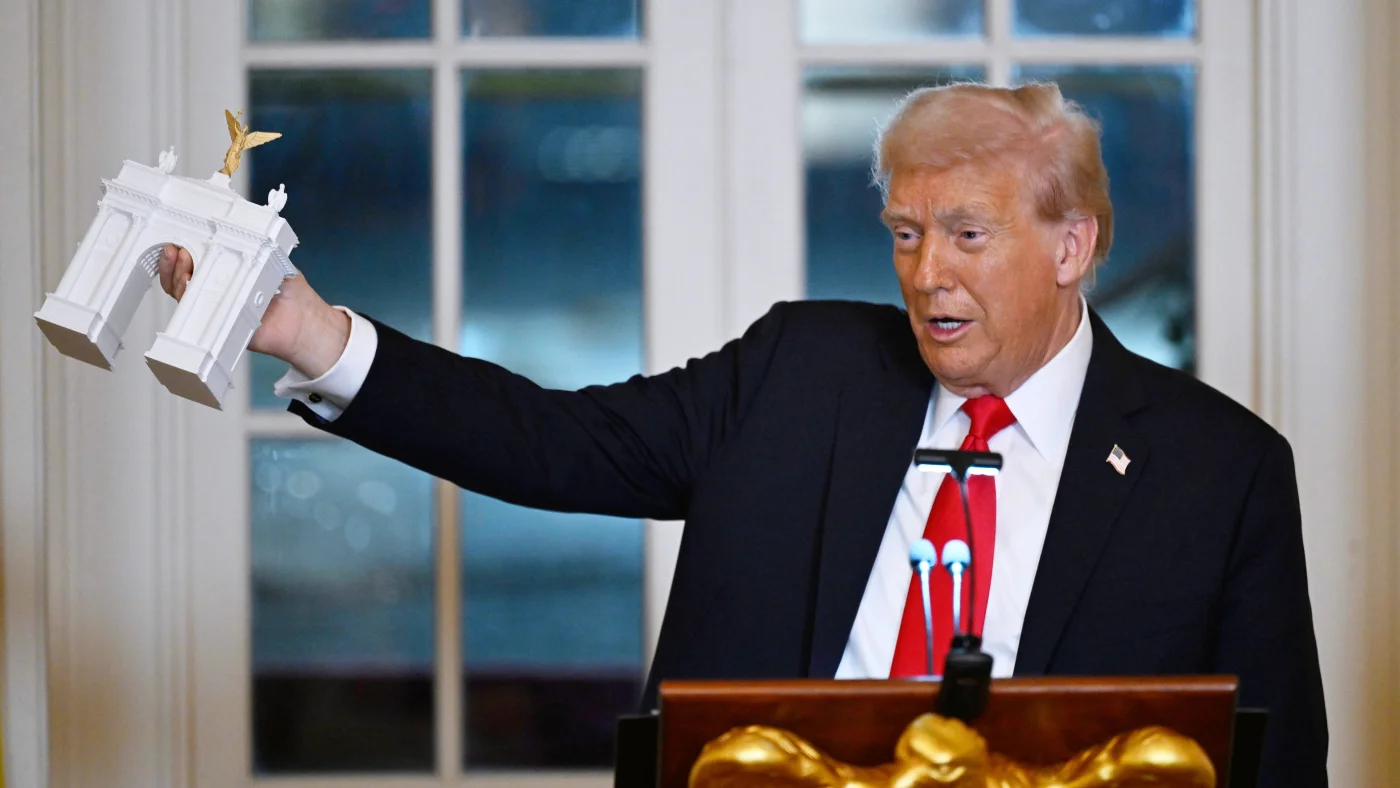
A second federal judge has blocked President Donald Trump's proposed triumphal arch near Arlington National Cemetery, ruling that the rushed 250-foot monument lacks legal authorization and poses unresolved safety hazards.
In this piece
A second federal judge has halted construction of President Donald Trump's proposed 250-foot triumphal arch near Arlington National Cemetery. U.S. District…
A second federal judge has halted the construction of President Donald Trump's proposed 250-foot triumphal arch near Arlington National Cemetery, concluding that the project is unlikely to withstand legal scrutiny. U.S. District Judge Leonie Brinkema issued a preliminary injunction on Thursday, sharply criticizing the initiative as an ill-conceived and rushed effort that bypassed mandatory statutory reviews. The ruling deals another significant legal blow to the administration's signature architectural proposal.
Presiding in Alexandria, Virginia, Judge Brinkema rejected federal attorneys' arguments that a century-old law provided sufficient authority to proceed without explicit congressional approval. The administration had claimed that a 1925 statute governing Memorial Bridge columns authorized the monument, but the judge found no statutory basis for applying that provision to a massive triumphal arch. She stressed that executive agencies cannot circumvent standard legislative authorization when embarking on monumental public works.
Judge Brinkema also highlighted severe deficiencies in the administration's environmental and economic evaluations, pointing out that federal officials failed to properly assess public safety risks. The court raised specific alarms regarding the deployment of towering construction cranes in close proximity to Ronald Reagan Washington National Airport and busy military helicopter corridors. The lack of thorough airspace coordination and risk analysis undermined the government's justification for fast-tracking the site preparation.
The Virginia ruling arrives just days after U.S. District Judge Tanya Chutkan in Washington issued a temporary restraining order halting preliminary ground-clearing in a separate legal challenge. That parallel lawsuit, brought by military veterans, preservation groups, and civic advocates, argued that the monument violates federal historic preservation mandates and environmental protection statutes. Together, the dual judicial orders create a formidable legal barrier across neighboring jurisdictions.
The case before Judge Brinkema was initiated by the Arlington County Board, which contended that federal agencies ignored local zoning, environmental impacts, and traffic infrastructure. Local officials argued that placing a gargantuan arch at the gateway to the historic burial grounds would disrupt surrounding neighborhoods and degrade civic infrastructure. The county sought immediate injunctive relief after heavy machinery began mobilizing near the cemetery gates without local consultation.
The proposed monument has sparked intense public controversy, drawing particular criticism from families of fallen service members and veterans organizations. Many Gold Star families voiced anguish over the prospect of a massive, politically charged monument overshadowing Arlington National Cemetery, which has served as a solemn resting place for American war dead since the Civil War. Critics argue that the triumphal design clashes fundamentally with the cemetery's solemn, contemplative character.
Supporters of the monument and White House officials have defended the arch as a grand patriotic tribute designed to honor the nation's military heritage and aesthetic grandeur. Government lawyers maintained in court filings that the executive branch holds broad discretion to oversee federal lands and memorialize national achievements. They argued that halting construction delays a patriotic civic landmark intended to inspire future generations of visitors to the nation's capital.
Legal scholars noted that the judicial blocks reflect longstanding administrative law principles requiring federal projects to follow transparent statutory processes. Federal courts have consistently required agencies to complete thorough environmental assessments, engage relevant stakeholders, and secure clear funding appropriations before breaking ground on capital projects. By attempting to bypass these procedural benchmarks, the administration exposed the monument to immediate judicial intervention.
The Justice Department is expected to appeal the injunctions to the U.S. Court of Appeals for the Fourth Circuit and the D.C. Circuit as it seeks to revive the project. However, with multiple federal judges finding the administration's legal theories tenuous and its procedural reviews defective, any resumption of construction faces an arduous legal path. For now, the heavy equipment remains parked, leaving the future of the contentious triumphal arch deeply uncertain.
Primary source: Google News U.S.. Newzly rewrites and structures source reporting for clarity; verify critical details at the original.