SpaceX Catches Starship With Mechazilla Tower for the First Time
SpaceX successfully caught its Starship vehicle with the Mechazilla launch tower for the first time during Flight 15 testing, achieving a landmark milestone in its push toward fully reusable spaceflight.
In this piece
SpaceX has completed its first successful tower catch of the Starship upper-stage vehicle using the Mechazilla launch infrastructure. The milestone came despite…
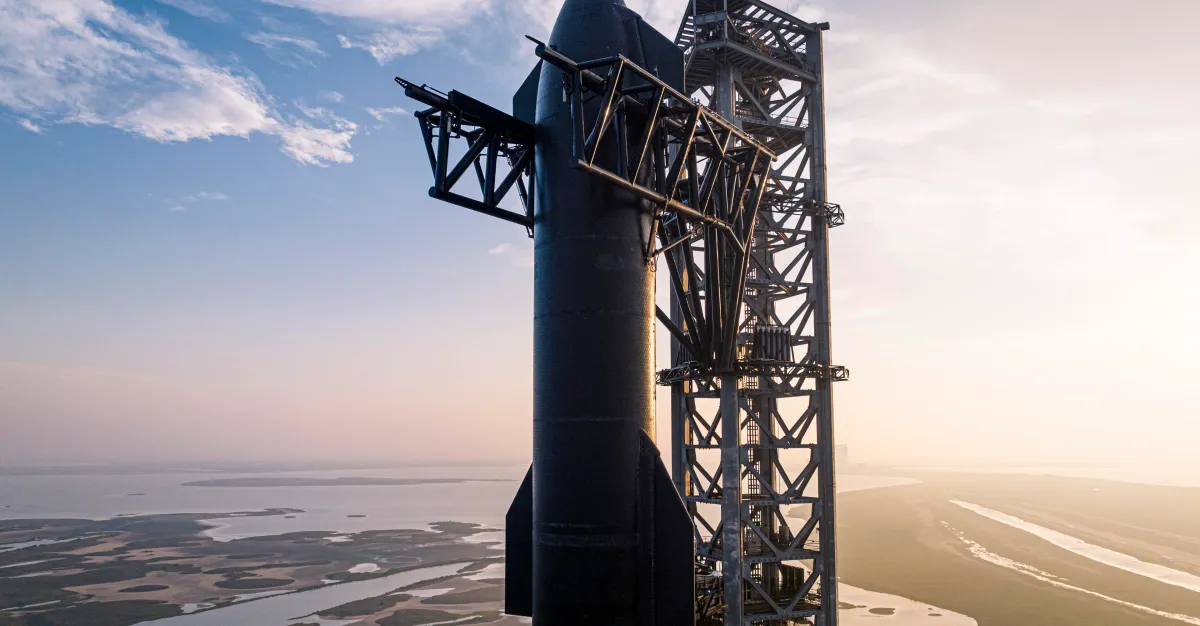
SpaceX has achieved a major milestone in aerospace engineering by successfully catching its Starship vehicle using the Mechazilla launch and catch tower for the first time. The recovery maneuver represents the first time the tower's mechanical arms have secured the upper-stage spacecraft itself rather than the lower booster stage. While the company previously aborted a planned catch attempt for the Flight 15 booster, the successful capture of the Starship vehicle marks a pivotal step forward for the program.
The recovery system relies on giant mechanical arms, commonly referred to as chopsticks, integrated into the massive Mechazilla tower structure. These arms are engineered to arrest the descent of the returning vehicle directly out of mid-air as it hovers near the launch site. While SpaceX had previously demonstrated this capture technique on its heavy booster stages, applying the maneuver to the Starship spacecraft introduces an entirely new operational milestone.
The breakthrough came during a mission that encountered mixed operational objectives during recovery operations. Ground controllers initially faced an aborted attempt to catch the Flight 15 booster stage before pivoting focus toward the spacecraft. Overcoming that initial setback, mission operators successfully coordinated the complex descent and tower alignment required to secure the upper-stage ship.
Catching an upper-stage vehicle presents distinct engineering hurdles compared to recovering a standard booster. The Starship vehicle enters the atmosphere after orbital-velocity trajectories, requiring precise aerodynamic deceleration and rapid thrust adjustments right before capture. The vehicle must maneuver with pinpoint accuracy relative to the fixed tower structure, leaving virtually no margin for positional error.
The fundamental purpose behind the chopstick catch architecture is to revolutionize how space vehicles land and are serviced. By using the launch tower to capture the rocket, engineers can eliminate the need for traditional landing legs and associated deployment hardware on the spacecraft. Shedding the mass of onboard landing gear allows the vehicle to carry more useful payload while simplifying the structural design of the vehicle.
Beyond direct weight savings, the Mechazilla catch mechanism is designed to dramatically accelerate turnaround times between spaceflights. In traditional spaceflight systems, recovered vehicles must be transported across extensive distances from maritime barges or landing zones back to launch pads. Placing the vehicle directly back onto or beside the launch mount enables rapid inspection, refueling, and preparation for subsequent missions.
Achieving full and rapid reusability remains the central requirement underpinning the entire Starship architecture envisioned by SpaceX and CEO Elon Musk. The system is designed to support high-cadence launch manifests capable of transporting heavy cargo and crew to orbit and eventual deep-space destinations. Proving that both the booster and the Starship itself can be caught mechanically validates a core component of this operational philosophy.
Despite the successful capture of Starship, the aborted catch of the Flight 15 booster indicates that recovery operations remain an evolving engineering process. Mission engineers will need to analyze telemetry from both the aborted booster recovery and the successful spacecraft catch to refine their automated guidance systems. Developing reliable and consistent capture sequences under varied environmental conditions will be essential before routine operations can proceed.
Moving forward, SpaceX is expected to evaluate inspection data from the captured Starship to determine how the airframe withstood the mechanical capture forces. Further flight tests will likely focus on closing the loop by attempting dual recoveries of both the booster and the upper-stage ship on subsequent missions. The successful demonstration confirms that tower-based catches are technically feasible, setting the stage for more ambitious recovery testing in upcoming flights.
Primary source: The Verge. Newzly rewrites and structures source reporting for clarity; verify critical details at the original.