Supreme Court to Hear Delhi Traders' Challenge Over Disruptions from Protests
The Supreme Court of India has agreed to hear challenges brought by local trader associations seeking to curb disruptions caused by prolonged protests in central Delhi commercial zones, setting the stage for a critical constitutional balancing test.
In this piece
The Supreme Court of India is set to evaluate petitions from Delhi trader groups challenging the notification of protest venues like Ramlila Maidan near major…
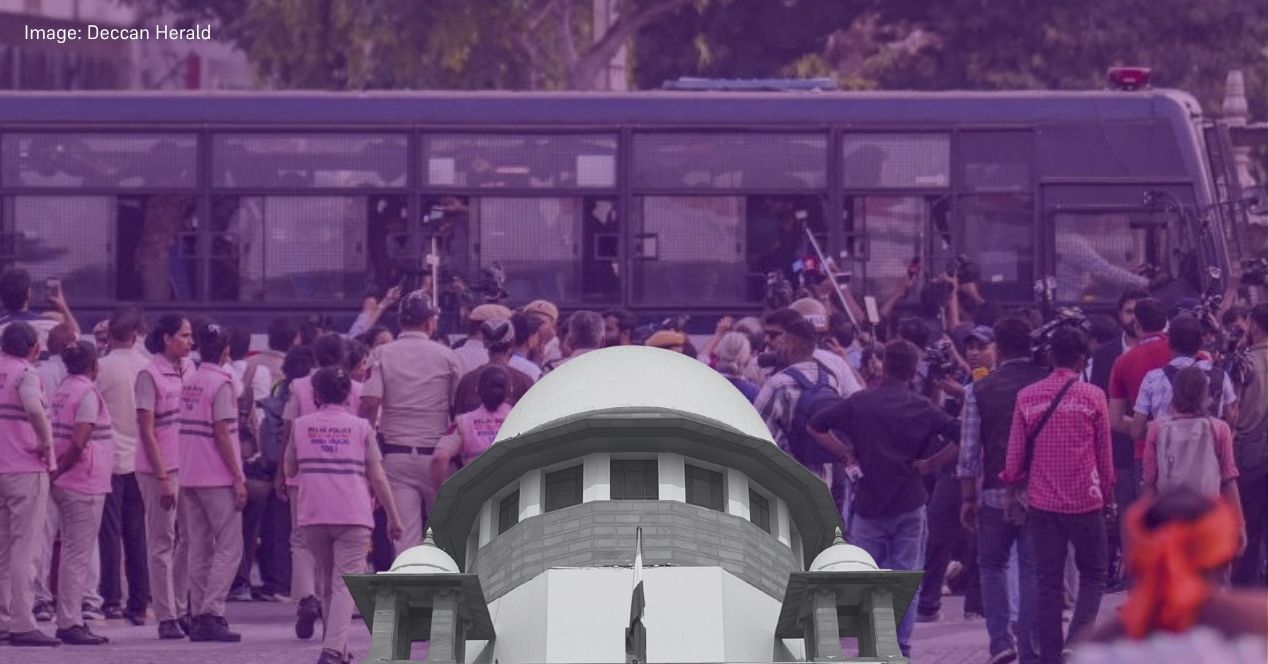
The Supreme Court of India has agreed to consider a series of legal challenges filed by local trader associations opposing frequent and prolonged demonstrations in the heart of the national capital. The petitions focus on commercial disruptions around prominent central locations, specifically questioning the ongoing designation of sites such as Ramlila Maidan as protest grounds. A three-judge bench led by Chief Justice Surya Kant indicated that the court will examine how competing fundamental rights must be balanced when demonstrations disrupt public life.
Appearing on behalf of commercial groups including the Kirana Committee Delhi, Senior Advocate Mukul Rohatgi submitted that continuous agitations have caused severe financial harm to neighboring business establishments. The traders argued that extensive barricading, traffic diversions, and heightened security restrictions routinely choke access to major wholesale and retail markets. According to the merchants, such measures have caused customer footfall and daily sales to drop dramatically, threatening the livelihoods of small shopkeepers and daily-wage workers.
Central to the traders' plea is a formal challenge to the regulatory framework that permits large-scale public demonstrations within dense commercial and residential districts. The petition contends that designating Ramlila Maidan, situated adjacent to historic trading hubs and densely populated neighborhoods, imposes an unreasonable burden on local economic activity. The merchants urged the court to reconsider whether such spaces should continue hosting large demonstrations when alternative venues could prevent commercial paralysis.
During preliminary proceedings, the bench, which also includes Justice Joymalya Bagchi and Justice V. Mohana, underscored the delicate legal balance required in such disputes. Chief Justice Surya Kant observed that while citizens possess an undeniable constitutional right to assemble peacefully and register dissent, designated demonstration sites cannot be occupied indefinitely to the detriment of others. The bench noted that the judiciary must weigh the right to protest against the economic survival and freedom of movement of other citizens.
The case brings into sharp relief the interplay between different clauses of Article 19 of the Constitution of India. Protesters rely on the fundamental freedoms of speech, expression, and peaceful assembly without arms to advocate for political and social causes. Conversely, business owners and local residents assert their corresponding rights to carry on trade, practice their occupations, and move freely through public thoroughfares.
To manage the complex matrix of legal grievances, the top court decided to categorize and streamline the cluster of pending matters. The bench ordered that the traders' commercial petitions be heard alongside broader petitions concerning guidelines for public protests, including a plea brought forward by CPI(M) leader M.A. Baby. This procedural consolidation aims to prevent redundant arguments while addressing both civil liberties and administrative governance in an orderly manner.
Delhi has frequently served as the primary epicenter for protracted demonstrations, agricultural rallies, and socio-political mobilizations over recent years. While authorities have periodically enacted local restrictions and designated specific zones to maintain law and order, surrounding communities often bear the brunt of long-term logistical friction. Municipal authorities and police forces have repeatedly struggled to maintain normal urban functionality without infringing upon constitutionally guaranteed civil dissent.
The outcome of the litigation could carry substantial implications for municipal planning, public administration, and urban policing across Indian cities. If the court establishes stricter operational guidelines or shifts demonstration corridors away from commercial zones, it could alter how public assemblies are managed nationwide. Legal observers note that defining clear parameters will be essential to ensure that neither fundamental liberty completely eclipses the other in shared civic spaces.
The Supreme Court is expected to take up the categorized petitions in detailed subsequent hearings, where it will assess responses from administrative authorities and participating stakeholders. As the proceedings advance, the bench will seek to delineate clear judicial principles that protect legitimate democratic expression while safeguarding the economic rights of local communities.
Primary source: Google News Delhi. Newzly rewrites and structures source reporting for clarity; verify critical details at the original.