Tanzania Celebrates First Natural Gas Discovery in More Than a Decade
A joint drilling campaign at Mnazi Bay in southern Tanzania has confirmed reserves of 223 billion cubic feet of gas — the country's first discovery since 2015 — raising hopes of expanded electricity output and regional energy influence.
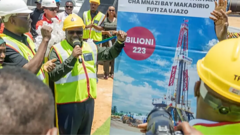
Tanzania has announced the discovery of an estimated 223 billion cubic feet of natural gas at the Kasa-1X ST2 well in the Mnazi Bay licence area in Mtwara Region, the country's first confirmed gas find in more than a decade. Energy Minister Dr Juma Zuberi Homera described the result as a "major milestone" for the East African nation, whose last comparable discovery came in 2015.
The well was drilled jointly by France's Maurel & Prom, which holds a 60 percent interest in the Mnazi Bay licence, and the state-owned Tanzania Petroleum Development Corporation, which holds the remaining 40 percent stake after increasing its share in 2024. Maurel & Prom put gross reserves at around 200 billion cubic feet, with approximately 120 billion cubic feet attributable to its own working interest.
Maurel & Prom said first gas production from Kasa-1X ST2 could begin as early as November 2026. The company estimates the well could produce up to 50 million cubic feet of gas per day, while the government's own projection points to around 30 million cubic feet per day sustained over at least ten years.
Mnazi Bay is already Tanzania's most productive onshore gas licence. Two other wells in the programme — MB-5 and MS-2 — are expected to add a further 65 million cubic feet per day to existing Mnazi Bay output, which currently stands at around 130 million cubic feet per day. Combined, the three new wells could push total production from the licence to roughly 200 million cubic feet per day.
The gas feeds the 542-kilometre Mtwara-to-Dar es Salaam pipeline and is sold primarily to the Tanzania Electric Supply Company. More than 80 percent of the country's natural gas output goes toward electricity generation, making the Mnazi Bay licence a critical component of Tanzania's domestic power supply.
Tanzania holds total proven gas reserves of approximately 57.54 trillion cubic feet, with the bulk — around 47 trillion cubic feet — sitting in deep offshore blocks that have yet to be commercially developed. Onshore reserves, of which Mnazi Bay is the principal contributor, stand at roughly 10.41 trillion cubic feet. The new find adds meaningfully to the recoverable onshore base.
Beyond domestic power, the government is eyeing a broader role for the country in regional energy markets. Minister Homera confirmed that Tanzania is in active discussions with four prospective investors about developing small-scale liquefied natural gas projects, a move that would allow the country to monetise reserves and export gas to neighbouring states.
The announcement arrives at a commercially significant moment for Maurel & Prom. The company reported a 12 percent year-on-year rise in working-interest production in Tanzania for the first nine months of 2026, alongside a 62 percent jump in Tanzania-derived sales revenue to 63 million US dollars. It has pledged an 80 million US dollar investment programme in the licence.
The Production Sharing Agreement governing Mnazi Bay was originally signed in 2004, with Maurel & Prom entering the licence in 2009 and concluding a gas sales agreement with TPDC in 2014. TPDC's stake was increased from 20 percent to 40 percent in 2024, giving the state a larger share of future revenues as the licence enters a new phase of activity.
Analysts have noted that a sustained period of investment drought — shaped by low global gas prices and policy uncertainty — had slowed exploration across East Africa for much of the past decade. The Kasa-1X ST2 result is therefore seen as a potential catalyst, signalling that Tanzania's onshore acreage retains commercially viable prospectivity and may attract renewed interest from international operators.
Primary source: BBC World. Newzly rewrites and structures source reporting for clarity; verify critical details at the original.