Trump-Linked World Liberty Financial Wallet Sells 12,121 ETH at $19M Loss
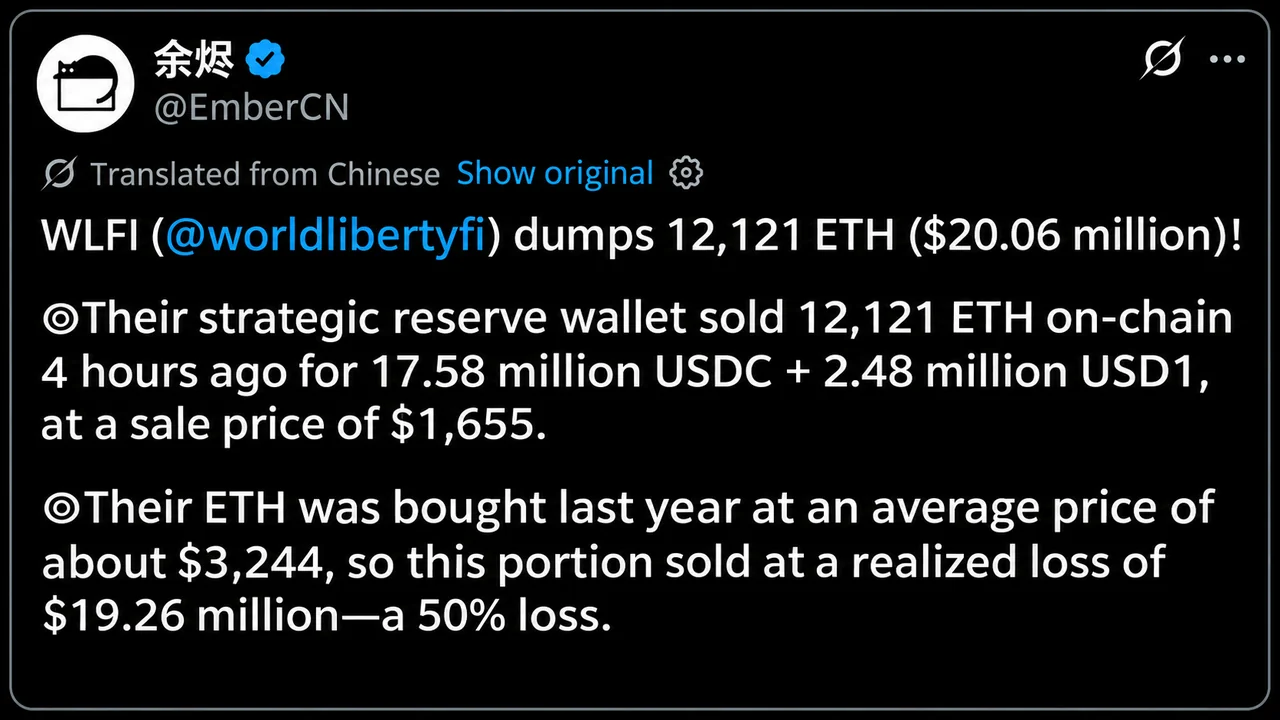
A reserve wallet linked to World Liberty Financial offloaded 12,121 ether at roughly $1,655 per token, onchain records show, locking in a realized loss of more than $19 million.
In this piece
A reserve wallet tied to the Trump-affiliated World Liberty Financial project has sold 12,121 ether at approximately $1,655 per coin, according to onchain data.…
A cryptocurrency reserve wallet associated with World Liberty Financial has liquidated 12,121 ether, locking in a realized loss of approximately $19.26 million. Public onchain tracking data shows that the tokens were sold at an average price of $1,655 each. The substantial transaction immediately drew scrutiny across the decentralized finance sector and broader digital asset markets.
Blockchain records indicate that the reserve address had originally acquired the ether position when prices traded near $3,244 per coin. With ether subsequently experiencing significant downward market pressure, the decision to divest at current valuations translated into an effective loss of nearly half the capital deployed. The transaction highlights the rapid capitalization swings that institutional and project treasuries face during prolonged market contractions.
World Liberty Financial emerged as a prominent decentralized finance initiative closely tied to Donald Trump and his broader family network. The project was unveiled with ambitions to provide lending, borrowing, and stablecoin services, attracting substantial attention from retail participants and political observers alike. Given the high-profile branding attached to the venture, movements within its treasury and reserve wallets remain under continuous public surveillance.
The broader cryptocurrency landscape has faced sharp pullbacks from cyclical highs, leaving many treasury holdings underwater relative to their initial accumulation ranges. When ether drifted from its earlier peaks above $3,000 down into the mid-$1,600 territory, digital asset reserves across multiple decentralized protocols suffered extensive unrealized declines. While some organizations elect to hold through sustained downturns, others choose to exit positions to mitigate further exposure.
Entities managing protocol treasuries frequently adjust portfolio compositions for operational funding, risk management, or debt settlement needs. Selling digital assets at a loss can occur when projects seek to reallocate capital into stablecoins, meet short-term liquidity commitments, or reduce market vulnerability. However, the specific strategic reasoning behind the timing and execution of this particular sale has not been publicly detailed by project representatives.
Because public blockchains record every transfer, reserve wallet transactions are visible in real time to automated analytics platforms and independent researchers. Large divestments by recognizable organizations often trigger immediate discussions regarding market sentiment and risk tolerance. Observers quickly noted that absorbing an eight-figure deficit marks one of the larger individual realized losses recorded by a prominent venture this cycle.
Market participants often view treasury liquidations with caution, particularly when thousands of coins hit centralized exchanges or automated liquidity pools in concentrated batches. Such transactions can introduce localized selling pressure or signal defensive posturing by project insiders. Even so, the broader ether market continues to absorb sizable transactions as trading volumes shift alongside macroeconomic trends.
The development reinforces ongoing debates regarding treasury management practices across politically connected and celebrity-backed cryptocurrency initiatives. Critics frequently emphasize that volatile digital assets require disciplined risk mitigation and transparent governance frameworks to protect protocol health. Conversely, supporters note that market drawdowns are an inherent feature of decentralized finance that impacts novice and established operations alike.
Looking ahead, market analysts and blockchain trackers will be watching the World Liberty Financial address closely to determine whether additional asset liquidations will follow. Observers are also waiting to see whether project leaders will address the transaction in upcoming community updates or governance announcements. For now, the recorded transaction stands as a stark reminder of the financial stakes embedded in managing large-scale crypto reserves during turbulent market conditions.
Primary source: Bitcoin.com News. Newzly rewrites and structures source reporting for clarity; verify critical details at the original.