United Fidelity Bank Fails in Largest US Bank Collapse Since 2024
Federal regulators seized Indiana-based United Fidelity Bank on Friday, marking the largest U.S. banking failure since early 2024 and triggering an estimated $1.83 billion hit to the FDIC insurance fund as First Citizens Bank assumes operations.
In this piece
United States banking regulators have shuttered Indiana-based United Fidelity Bank, marking the largest domestic bank collapse since 2024. The failure is…
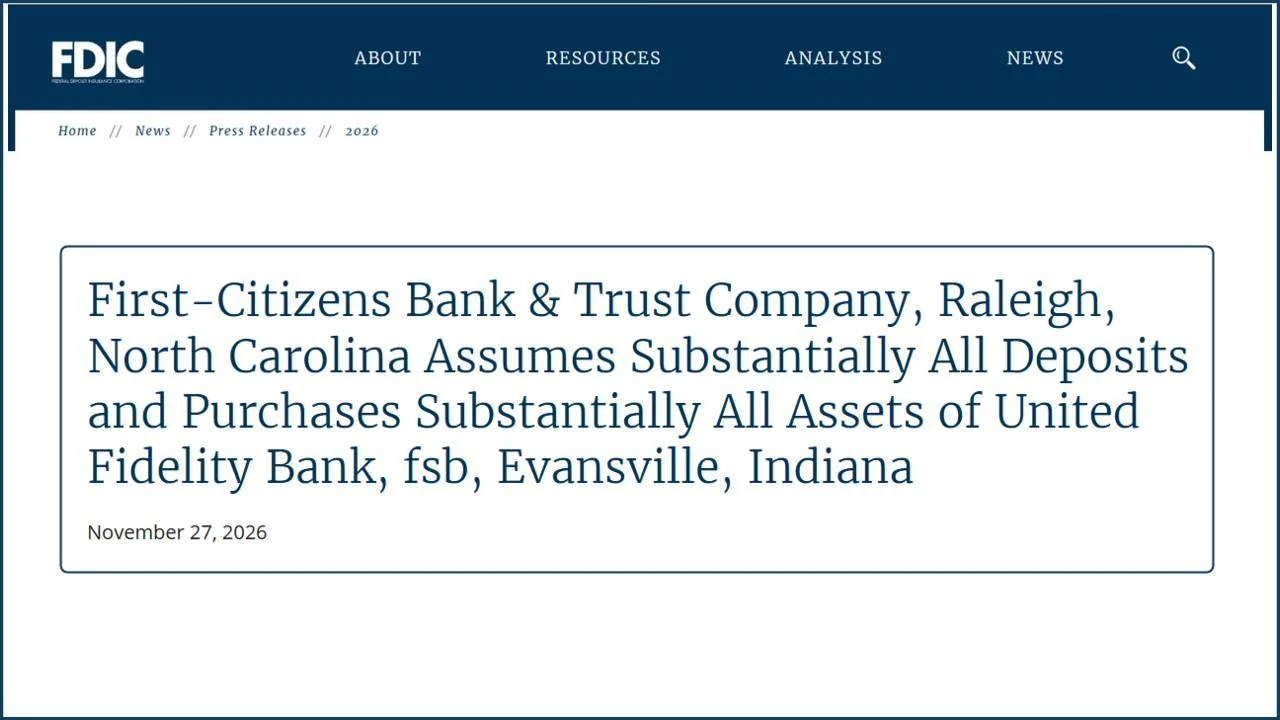
Federal regulators abruptly closed United Fidelity Bank on Friday, appointing the Federal Deposit Insurance Corporation as receiver in what stands as the largest domestic banking failure since early 2024. The Evansville, Indiana-based institution was shuttered by the Office of the Comptroller of the Currency following mounting financial strains. Under an immediate purchase and assumption agreement, North Carolina-based First-Citizens Bank & Trust Company agreed to take over substantially all customer deposits and assets.
The failure is projected to impose a substantial financial cost on the federal government's safety net. The FDIC estimated that resolving the institution will drain approximately $1.83 billion from its Deposit Insurance Fund. At the time of its closure, United Fidelity Bank managed roughly $5.9 billion in total assets and held about $5.4 billion in customer deposits, representing the most significant seizure since Republic First Bank folded in April 2024.
First Citizens Bank negotiated the takeover by agreeing to assume approximately $4.5 billion of United Fidelity's deposit base while acquiring about $3.1 billion of its loan portfolio at a steep asset discount. The sharp discount of around $2.6 billion reflects distressed and nonperforming loan assets that the failed lender accumulated prior to regulatory intervention. The FDIC noted that the transaction was selected after determining it represented the least costly resolution option for the insurance fund.
For everyday retail and commercial depositors, regulators moved quickly to prevent disruption and ensure uninterrupted access to their money. All insured deposits transferred seamlessly to First Citizens Bank, and United Fidelity's twenty-two branches across Indiana, Illinois, Florida, Colorado, and the U.S. Virgin Islands are scheduled to reopen under the First Citizens banner. Customers were advised that existing debit cards, checks, and automated clearing house transactions would continue to operate without interruption.
Borrowers with mortgages, commercial credit lines, or personal loans through United Fidelity were instructed to proceed with their routine payments under current contractual terms. First Citizens will service the assumed debt, while the FDIC will retain the remaining portfolio of non-purchased assets for eventual liquidation. Regulators underscored that borrower obligations remain legally binding despite the ownership transition.
The collapse represents a notable test of regional banking stability following the turbulent period that began with the collapses of Silicon Valley Bank and Signature Bank in early 2023. While federal officials emphasized that United Fidelity suffered from idiosyncratic asset quality deterioration rather than systemic liquidity contagion, the sheer magnitude of the loss to the insurance fund is drawing scrutiny. The estimated hit constitutes over thirty percent of the failed lender's total assets, underscoring severe portfolio distress.
The acquisition further consolidates the role of First Citizens Bank as a favored consolidator of distressed regional financial institutions. Headquartered in Raleigh, First Citizens notably acquired the bulk of Silicon Valley Bank out of receivership in 2023, rapidly expanding its national footprint. The latest deal expands the lender's presence across the Midwest and southern markets without exposing it to immediate capital strain, thanks to loss-sharing arrangements and asset write-downs facilitated by the FDIC.
Banking analysts and supervisory authorities will closely analyze the regulatory audit trail leading up to Friday's intervention. Industry observers point out that regional lenders have faced persistent headwinds, including elevated interest rates, commercial real estate stress, and regulatory compliance pressures. Regulators have maintained that the broader domestic banking system remains sound, well-capitalized, and capable of withstanding isolated failures.
Looking ahead, the FDIC will proceed with the liquidation of retained assets over the coming quarters to minimize net losses to the Deposit Insurance Fund. An official receivership report and review of supervisory practices are anticipated as standard regulatory protocol following major resolutions. Meanwhile, former United Fidelity customers will gradually see their accounts integrated into First Citizens' permanent digital and branch infrastructure.
Primary source: Bitcoin.com News. Newzly rewrites and structures source reporting for clarity; verify critical details at the original.