What Public Health Experts Say About Friday's Iowa Lead Azide Detonation
Public health researchers warn that an unprecedented military blast of 9,500 pounds of degraded lead azide in Iowa carries dispersion uncertainties, urging downwind residents to guard against toxic particulate exposure.
In this piece
The U.S. Army executed an emergency controlled detonation of 9,500 pounds of unstable lead azide at the Iowa Army Ammunition Plant on Friday. Public health…
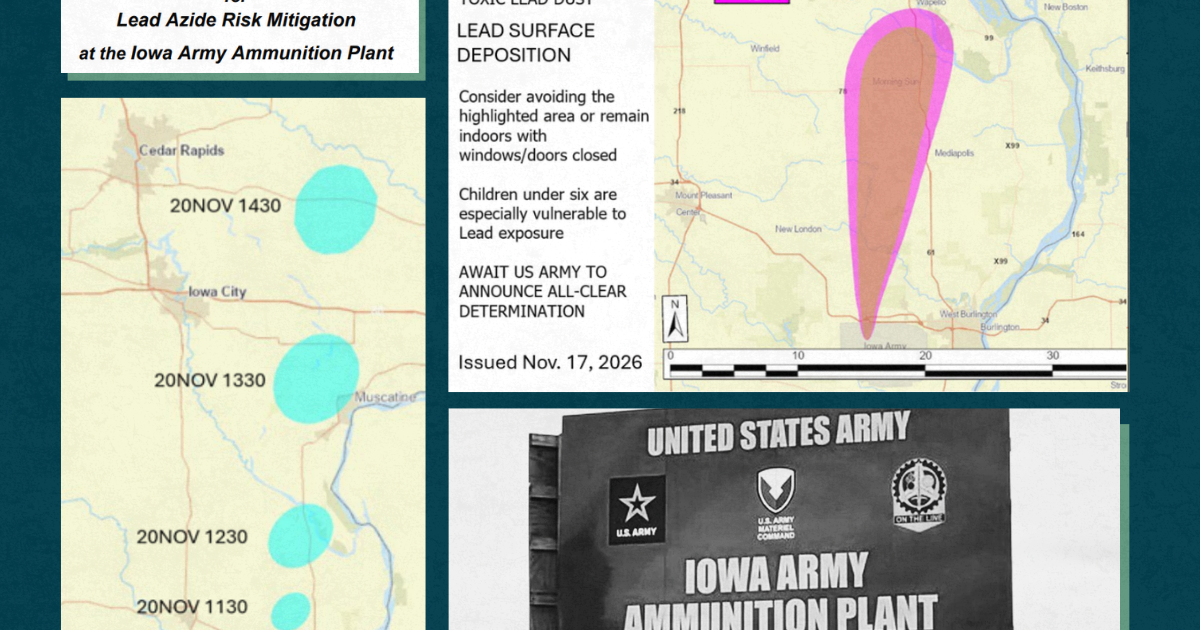
The controlled detonation of nearly 9,500 pounds of degraded lead azide at the Iowa Army Ammunition Plant has drawn close scrutiny from environmental health scientists assessing the regional impact of the unprecedented blast. Military officials and federal regulators authorized the emergency in-place destruction after determining the aging, crystallized explosives stored near Middletown were too volatile to safely transport.
The stockpile, contained in roughly 68 drums, consisted of lead azide that had destabilized during underground storage at the 19,000-acre facility in Des Moines County. Because the primary explosive becomes extraordinarily sensitive to friction, shock, and heat as it degrades, the U.S. Army and the Environmental Protection Agency concluded that an open detonation was the only viable method to prevent a catastrophic accidental explosion.
Public health specialists, however, cautioned that destroying such a large volume of the neurotoxic compound in an open blast is without precedent in the United States. Patrick O'Shaughnessy, a professor of occupational and environmental health at the University of Iowa, noted that the lack of comparable historical data complicates efforts to predict precisely how the resulting particulate plume will behave across downwind communities.
Atmospheric conditions played a decisive role in the timing of the detonation, as planners waited for specific wind patterns to assist with particulate dilution. O'Shaughnessy explained that while calm air allows larger dust particles to fall immediately around the blast zone, moderate winds of roughly 15 miles per hour help disperse lighter toxic particles over a wider geographic area, substantially lowering airborne concentrations at any single location.
The primary public health concern centers on the release of microscopic lead dust, a persistent environmental toxin with well-documented neurological hazards. Health experts emphasize that there is no safe threshold for lead exposure in the human body, with young children, infants, and pregnant women facing the highest risks of developmental delays, cognitive impairment, and behavioral complications.
Medical and environmental authorities emphasized that clear skies do not guarantee that the air is free from contamination following the blast. O'Shaughnessy stressed that microscopic lead dust is invisible to the naked eye, warning residents that visual clarity should never be used as an indicator of outdoor air safety.
Public health officials advised residents living downwind of the facility to remain indoors throughout the afternoon, keep windows tightly closed, and shut off ventilation systems that draw in outside air. Agricultural producers in surrounding rural areas were similarly advised to monitor livestock and take preventative steps to protect animal feed and open water troughs from settling fallout.
To dampen the spread of airborne dust, military contractors soaked surrounding soil and deployed industrial water misters around the detonation bunker prior to triggering the blast. While researchers described those physical suppression methods as valuable, experts acknowledged that water curtains cannot capture all particulate matter generated by an explosion of that magnitude.
To track environmental dispersion in real time, independent researchers from the University of Iowa deployed mobile air-sampling monitors alongside federal monitoring networks positioned throughout the region. Environmental regulators and local health departments plan to analyze filter samples and soil readings in the days ahead to determine overall lead deposition and verify whether protective measures adequately minimized civilian exposure.
Primary source: Google News Iowa. Newzly rewrites and structures source reporting for clarity; verify critical details at the original.