What Trump, Xi, and Putin Achieved at Historic Trilateral Summit
U.S. President Donald Trump, Chinese President Xi Jinping, and Russian President Vladimir Putin concluded a historic trilateral summit in Shenzhen with a joint peace declaration, prompting debate over tangible achievements versus diplomatic symbolism.
In this piece
Leaders of the United States, China, and Russia issued a joint declaration of peace following landmark trilateral talks in Shenzhen, according to BBC News.…
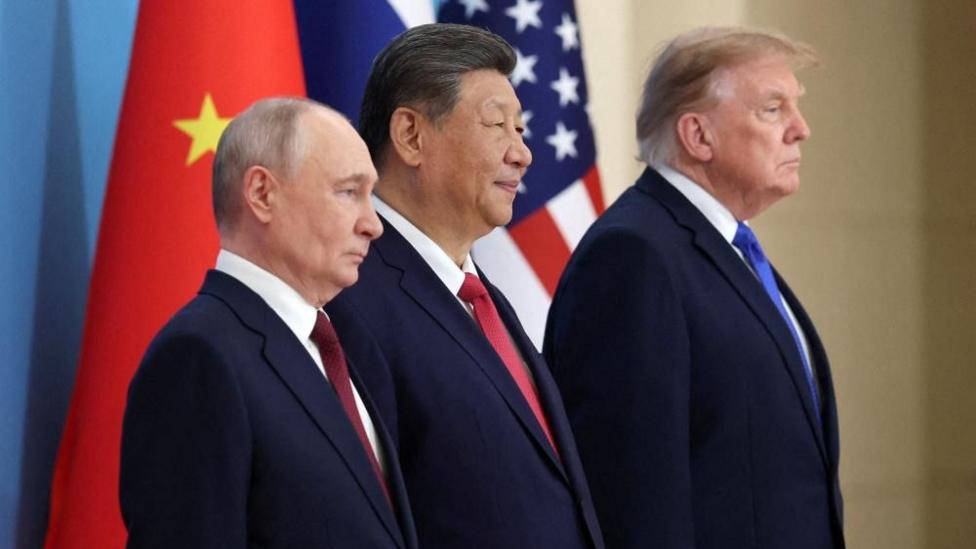
U.S. President Donald Trump, Chinese President Xi Jinping, and Russian President Vladimir Putin concluded an unprecedented trilateral meeting with a joint declaration of peace, according to reports by BBC News. The historic 90-minute closed-door talks brought together the leaders of the world's three foremost nuclear powers on the sidelines of the Asia-Pacific Economic Cooperation summit in Shenzhen.
In their shared statement, the three leaders affirmed the long-standing diplomatic principle that a nuclear war cannot be won and must never be fought. While the leaders agreed to pursue future trilateral discussions aimed at mitigating atomic risks and halting nuclear proliferation, the final text included no binding mechanisms, verification timelines, or numerical caps on their respective arsenals.
The joint declaration also outlined commitments toward international energy stability, with an emphasis on bolstering petroleum production and maintaining dependable global fuel supplies. Additionally, the leaders endorsed procedural reforms within the United Nations to better handle international security challenges, while sharply criticizing external legal bodies.
Notably, the document warned that bodies such as the International Criminal Court must not overstep their jurisdiction, explicitly reiterating the broad legal immunity granted to sovereign heads of state. The provision carries significant practical weight for Putin, who has faced an active arrest warrant issued by the Hague-based court since 2023.
For Trump, the trilateral gathering represented an opportunity to project decisive deal-making diplomacy and bypass traditional multilateral channels. The U.S. president hailed the encounter as a historic milestone, presenting the session as a pragmatic step toward thawing strained superpower relations and delivering on his campaign pledges to defuse global hostilities.
Xi utilized Beijing's host role to showcase China as an indispensable global mediator capable of convening the world's most polarized rivals under one roof. The format reinforced Beijing's push for a multipolar global order, presenting an alternative to Western-led international governance while deepening strategic coordination with Moscow and stabilizing ties with Washington.
For Putin, sitting alongside the American and Chinese heads of state provided a powerful visual rebuff to Western attempts at diplomatic isolation following the invasion of Ukraine. By securing joint language on energy supplies and leader immunity, the Russian leader gained tangible diplomatic leverage without conceding ground on Moscow's military operations.
Despite the triumphant rhetoric from the participants, Western allies and foreign policy analysts raised immediate doubts regarding the summit's substantive outcomes. Critics noted that the declaration conspicuously avoided concrete pathways to resolve ongoing conflicts in Eastern Europe and the Middle East, functioning primarily as symbolic stagecraft rather than a binding peace framework.
International observers pointed out that the meeting signals a fundamental realignment toward great-power spheres of influence at the expense of established post-war rules. Transatlantic security officials expressed concern that normalizing top-level coordination without strict accountability could undermine collective security commitments across Europe and the Indo-Pacific.
Looking ahead, the true consequence of the Shenzhen declaration will depend on whether working-level diplomatic tracks emerge to negotiate concrete agreements. BBC News reported that while future sessions on strategic stability remain nominally planned, deep ideological divides, economic rivalries, and unresolved battlefield realities will test whether the joint declaration translates into durable peace.
Primary source: BBC US & Canada. Newzly rewrites and structures source reporting for clarity; verify critical details at the original.