Wisconsin Expects No Impact From Planned Iowa Army Munitions Detonation
Wisconsin emergency officials confirm the state will see no environmental or health effects from a planned U.S. Army controlled detonation of unstable lead azide at an Iowa munitions facility on Monday.
In this piece
Wisconsin emergency management authorities report that a planned U.S. Army controlled detonation of degraded lead azide in Iowa will not affect Wisconsin on…
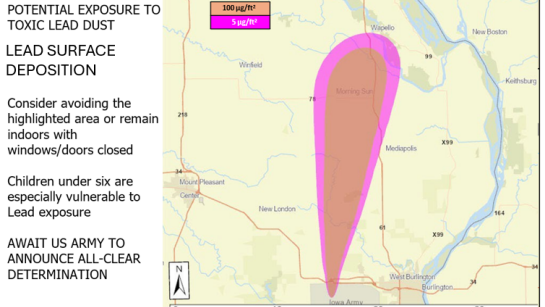
Wisconsin is not expected to experience any environmental or public health impacts from a planned U.S. Army controlled detonation of lead azide in neighboring Iowa on Monday, according to state emergency officials and regional reports. Broadcast affiliate WISN reported that official atmospheric projections indicate the disposal operation will not pose a danger to Wisconsin communities. State emergency management agencies affirmed that meteorological data and dispersion models show no threat to air quality within the state.
The planned operation involves the controlled destruction of degraded lead azide, a volatile chemical compound historically utilized as an explosive primer in military munitions. Military personnel determined that aging stockpiles housed at an Army ammunition facility in Iowa had become increasingly unstable after decades in storage. Experts noted that degraded batches of the chemical can crystallize, significantly increasing its sensitivity to temperature changes, mechanical friction, and physical handling.
Because deteriorated lead azide becomes acutely susceptible to accidental detonation from minor movement or shock, authorities concluded the material could not be transported safely over public highways or rail lines. Military leadership and hazardous materials specialists determined that conducting an in-place, controlled blast represented the only viable option for neutralizing the volatile chemical. The decision followed extensive technical evaluations aimed at eliminating the risk of an uncontrolled catastrophic explosion on site.
The announcement of the disposal operation sparked immediate concern across the upper Midwest, prompting residents, local leaders, and public health officials in neighboring states to question potential environmental hazards. Unverified modeling and speculation circulating across social media exacerbated fears that a plume containing lead particles could drift across state borders. Regional emergency coordinators quickly moved to counter unsubstantiated claims by pointing the public toward vetted scientific data from federal agencies.
In response to widespread inquiries from the public, Wisconsin emergency management authorities coordinated with federal specialists to evaluate all available dispersion projections. Officials determined that prevailing wind directions, anticipated blast dynamics, and the substantial geographical distance from the Iowa facility ensure that Wisconsin will remain well outside any potential fallout zone. State agencies emphasized that no protective measures or adjustments to daily routines are necessary for Wisconsin residents.
Environmental organizations and community advocates have kept close watch over the planned blast due to the toxic profile of heavy metals released during open detonation. Inhalation of airborne lead dust can cause serious health complications, particularly for young children, expectant mothers, and individuals with underlying respiratory conditions. Consequently, regulatory bodies and public health departments have stressed the necessity of strict containment protocols and transparent communication throughout the process.
The operation has encountered heightened legal and political scrutiny in the days leading up to its scheduled execution, with regional lawmakers calling for thorough reviews of safety procedures. Community leaders in adjacent jurisdictions had previously sought delays and independent reviews to ensure that downwind populations would not be subjected to hazardous particulate exposure. Federal authorities, meanwhile, maintained that delaying the disposal indefinitely could allow the chemical compound to deteriorate further into an even more hazardous state.
State and regional environmental agencies are expected to maintain active oversight leading up to and during the planned execution of the blast on Monday. Stationary air monitoring stations across the broader region remain equipped to track particulate levels and verify that dispersion models hold true once the detonation occurs. Emergency coordinators noted that any unexpected shifts in atmospheric pressure or wind currents would be closely monitored in real time.
Wisconsin emergency management officials reiterated that residents do not need to alter their daily activities or take precautionary measures ahead of Monday's scheduled operation. State authorities indicated they will remain in continuous communication with federal defense officials and neighboring state agencies throughout the procedure. Should any unforeseen developments or significant shifts in weather patterns occur, public safety agencies pledged to issue prompt updates to the public.
Primary source: Google News Wisconsin. Newzly rewrites and structures source reporting for clarity; verify critical details at the original.