'An annoying buzz': The search for stealthier drones
As drone delivery expands into cities across the US and UK, a high-pitched rotor buzz is fuelling neighbourhood complaints — and pushing companies to rethink how they design their aircraft.
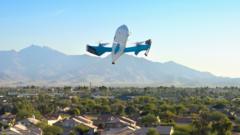
Drone deliveries are arriving faster than ever, but so are the complaints. Residents in Dallas, suburban Chicago, and communities across the UK have begun describing the overhead hum of commercial delivery drones as an unwelcome intrusion — a high-pitched, persistent sound unlike ordinary traffic noise that many find uniquely unsettling.
The problem has a measurable dimension. FAA testing found that, measured from 50 feet away, Amazon Prime Air drones register around 88 decibels during a delivery, Wing drones around 84, and Zipline's platform — the quietest of the three — approximately 79 decibels. Acoustic researchers note that even lower readings can feel disproportionately intrusive when they occur at low altitude directly above homes.
Antonio Torija Martinez, a professor of acoustic engineering at the University of Salford, has studied why drone sound provokes such a strong reaction. People respond more intensely to sounds they perceive as novel, intrusive, or likely to become frequent, he has observed — a dynamic that works against the drone industry as its services expand and overflights become routine rather than rare.
Ashley Schmidt, a 44-year-old Dallas resident, put it bluntly: the buzz of delivery drones overhead triggers what she described as a fight-or-flight response, a complaint that has become common as Amazon and its competitors have rolled out services across hundreds of US cities and towns.
Companies are aware of the reputational risk and have begun engineering responses. Amazon Prime Air says its latest custom propellers produce almost half the perceived sound of earlier designs. Wing says it actively varies flight paths to prevent any one street from being repeatedly overflown, and has invested in low-noise rotor geometry as a core design principle.
Start-ups are going further. London-based Greenjets has built an enclosed propulsion system that wraps spinning blades inside a pod, muffling the sound and directing what remains away from the ground. The company claims its system can reduce drone noise by at least two-thirds, and it has already attracted interest from police, security, and conservation operators where discretion matters as much as speed.
Detroit entrepreneur Greg Sharrow took a different approach. His firm, Sharrow Engineering, developed twisted, loop-shaped rotor blades with no blade tips — the part of a conventional propeller responsible for the sharpest, most piercing noise. Early results, he says, are dramatically quieter than standard rotors.
The regulatory framework is still catching up. The FAA oversees commercial drone operations but has faced criticism for prioritising airspace integration over community noise standards. Responsibility for addressing resident concerns has largely fallen to individual operators and local governments, creating an uneven patchwork of rules.
Military drone development offers a cautionary note. Robert Tollast, a research fellow at the Royal United Services Institute, has observed that defence programmes have historically prioritised speed, range, and payload over acoustic footprint — a set of trade-offs that civilian drone makers are now under pressure to reverse.
The stakes are commercial as well as social. Industry analysts and drone operators broadly agree that public tolerance is a prerequisite for the scale of expansion both logistics companies and regulators are projecting. If the buzz becomes a defining feature of low-altitude urban airspace, the political and regulatory pressure to curtail drone flights could slow the entire sector. For now, the engineering race to silence the hum is only just beginning.
Primary source: BBC Technology. Newzly rewrites and structures source reporting for clarity; verify critical details at the original.