As Himalayan Glaciers Melt, Ladakh Banks Water in Engineered Ice
As climate change accelerates the retreat of Himalayan glaciers, farming villages in Ladakh are building artificial ice stupas and automated reservoirs to store winter water for critical spring irrigation.
In this piece
High-altitude communities across Ladakh are constructing artificial glaciers and automated ice stupas to combat water scarcity caused by retreating Himalayan…
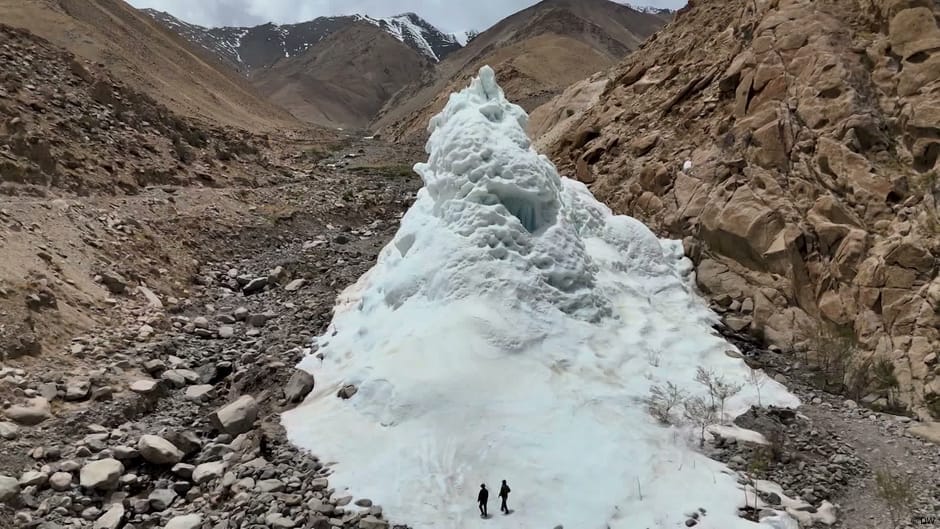
Villages across the high-altitude desert of Ladakh are turning to engineered ice structures and artificial reservoirs to store vital water as Himalayan glaciers rapidly retreat under rising global temperatures. In settlements such as Ursi, local communities are building and refining ice towers and frozen caches to safeguard freshwater supplies ahead of the crucial spring planting season.
Ladakh has long functioned in extreme conditions where annual precipitation is scarce and farming relies almost exclusively on seasonal snowmelt and glacier runoff. In recent decades, shifting weather patterns, dwindling winter snowfall, and accelerated glacial retreat have disrupted the natural flow cycles that local agriculture depends on.
The core agricultural challenge lies in timing: farmers need abundant water in early spring to sow barley, peas, and other staple crops, yet natural glaciers at higher elevations often do not begin melting significantly until early summer. Without early meltwater, seedlings fail to germinate, leaving farming families vulnerable to crop failure.
To bridge this critical window, local innovators and communities have developed artificial glaciers and conical ice stupas that freeze winter streamflow when temperatures drop well below freezing. By piping excess winter stream water through vertical outlets, the spray freezes in sub-zero air, gradually accumulating into towering frozen cones that resist direct sunlight.
Recent developments in the region have expanded these grassroots methods with automated reservoir systems. Engineers and researchers have integrated automated valves, sensors, and remote monitoring systems to optimize water spray and ice formation while significantly reducing manual maintenance under harsh sub-zero conditions.
The integration of automated controls has helped communities store millions of liters of water in a single winter season, allowing ice mounds to persist deeper into the warmer months. As these frozen structures melt steadily during the dry spring, the runoff flows into local irrigation channels, enabling farmers to cultivate additional acreage that previously lay barren.
For remote villages, reliable water access in April and May directly supports food security, household livelihoods, and regional stability. Local reliance on agriculture remains central to community life across the high plateaus, where transportation of outside produce over snowbound mountain passes is costly and logistically precarious.
The Himalayan region, often described as the world's Third Pole due to its immense concentration of frozen water, is warming at rates significantly higher than the global average. Glaciologists have warned that thousands of Himalayan glaciers are losing mass at an accelerating pace, threatening water security for hundreds of millions of people downstream.
While engineered ice structures offer an immediate lifeline for high-altitude villages, environmental observers emphasize that localized adaptation measures cannot halt the systemic decline of major mountain glaciers. Communities view the ice towers as a vital bridge to buy time, even as long-term water security remains contingent on global climate trajectories and broader resource conservation policies.
Primary source: Google News Ladakh. Newzly rewrites and structures source reporting for clarity; verify critical details at the original.