Audio raises questions over clearance before deadly Spain train crash
Recordings appear to show a high-speed train was cleared to resume its journey while another remained stopped ahead, raising questions about control-centre decisions before the collision in Spain.
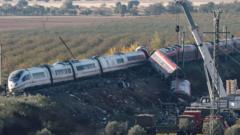
Recordings of exchanges between railway controllers and train drivers appear to show that a high-speed service received permission to move while another train ahead remained stopped before a deadly collision in Spain. The audio puts the instructions issued before the crash at the centre of questions about how the trains came to collide.
The collision involved a Renfe AVE service and an Iryo train near Urda, in Toledo province. Spanish news agency EFE reported that at least 68 people were killed and numerous others injured when the AVE struck the Iryo on Wednesday, October 28.
According to EFE, which obtained the recordings, an operator at infrastructure manager Adif’s Atocha control centre instructed the AVE driver at 8:36 a.m. to disconnect and reconnect the LZB safety system. The controller then authorised the driver to resume running normally under a different signalling arrangement known as BSL.
The exchanges followed a failure affecting the LZB system. Public broadcaster RTVE reported that the AVE driver had notified controllers of a transmission fault before receiving the instruction to continue, placing the management of that disruption at the heart of the emerging account.
In a separate recording described by EFE, the Iryo driver told the control centre that the train would not allow her to restart LZB and that she remained stopped at the entrance signal to Urda. The controller told her to call again if problems persisted, then discussed the train’s equipment difficulties with colleagues.
RTVE reported that controllers had authorised both drivers to resume their journeys, but only the Renfe service moved. That distinction is central to the concern raised by the recordings: permission to restart did not necessarily mean the train ahead had actually cleared the route.
The precise sequence remains contested. RTVE reported that the government’s account placed the collision at 8:53 a.m., while sources close to Iryo gave an earlier time of 8:48 a.m. and disputed whether its driver had received clearance to restart before the impact.
There are also limits to what the released material establishes. RTVE said its reporting drew on three audio recordings and that it was not known whether additional exchanges existed between the parties involved. The available conversations therefore should not be treated as a complete record of every instruction or action before the crash.
The recordings raise questions about what controllers understood about the stopped train and how that information affected the authority given to the following service. They do not, on their own, establish a final allocation of responsibility. A fuller reconstruction will need to reconcile the conflicting timelines with the instructions and train movements described in the audio.
Primary source: BBC World. Newzly rewrites and structures source reporting for clarity; verify critical details at the original.