Bitcoin Falls Below $81,000 as Key Technical Support Gives Way
Bitcoin lost its 50-day moving average as geopolitical concerns weighed on markets. Reported liquidations added pressure, leaving traders watching whether buyers can reclaim the broken technical level.
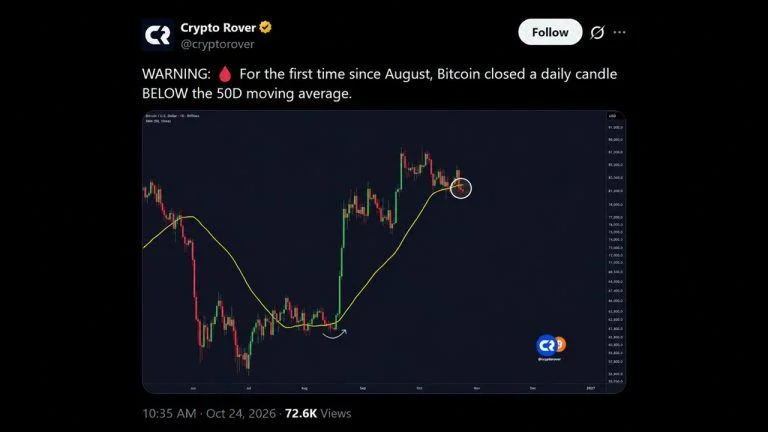
Bitcoin slipped below $81,000 and recorded its first daily close beneath its 50-day moving average since August, according to Bitcoin.com News. The report described a market under pressure from geopolitical uncertainty and leveraged-position liquidations, with a technical level that had repeatedly attracted buyers now sitting above the price.
The publication put bitcoin near $80,800 on Saturday morning, compared with a 50-day average of approximately $81,784 calculated from Coingecko daily closes. For roughly two months, it reported, declines toward that average had drawn buying interest. The latest close interrupted that pattern, although a single break does not establish how long weakness will persist.
A moving average smooths daily price changes to help traders assess the underlying trend. When prices fall beneath a closely watched average, attention often turns to whether the market can recover it or encounters renewed selling there. The distinction matters because a former support level can become a test of buyers’ willingness to commit fresh money.
Bitcoin.com News linked the retreat to President Donald Trump’s comments about a possible further operation against Iran. It also described pressure on equities as oil prices rose. Those developments provide a backdrop for the cryptocurrency decline, but their timing alone cannot establish how much of bitcoin’s move came from geopolitical concerns rather than other selling.
Leverage compounded the weakness, according to figures cited in the report. It attributed $318 million in liquidated cryptocurrency long positions to data shared by Whale Insider, while a broader Coinglass snapshot showed $495.74 million in total liquidations over 24 hours. Those figures cover cryptocurrency markets, rather than bitcoin alone, an important distinction when assessing the scale of bitcoin-specific losses.
Liquidations occur when traders cannot maintain the collateral required for leveraged positions. Forced closures can intensify an existing decline, creating additional selling as prices move against bullish bets. However, liquidation totals describe positions already closed; they do not, by themselves, show whether remaining holders will sell or whether fresh demand will absorb the pressure.
The report also described withdrawals from U.S. spot bitcoin exchange-traded funds, adding another indication of weakening demand. ETF flows and derivatives liquidations measure different activity: one tracks money moving through investment products, while the other captures forced closures of leveraged trades. Reading them together offers context, but neither is a complete measure of investor sentiment.
The immediate question is whether bitcoin can regain its 50-day average and sustain the recovery. Bitcoin.com News also highlighted forthcoming Federal Reserve and inflation developments as potential catalysts. Until buyers re-establish support, the broken average remains a reference point for judging whether this decline is temporary or part of a more persistent retreat.
Primary source: Bitcoin.com News. Newzly rewrites and structures source reporting for clarity; verify critical details at the original.